 Guide On Map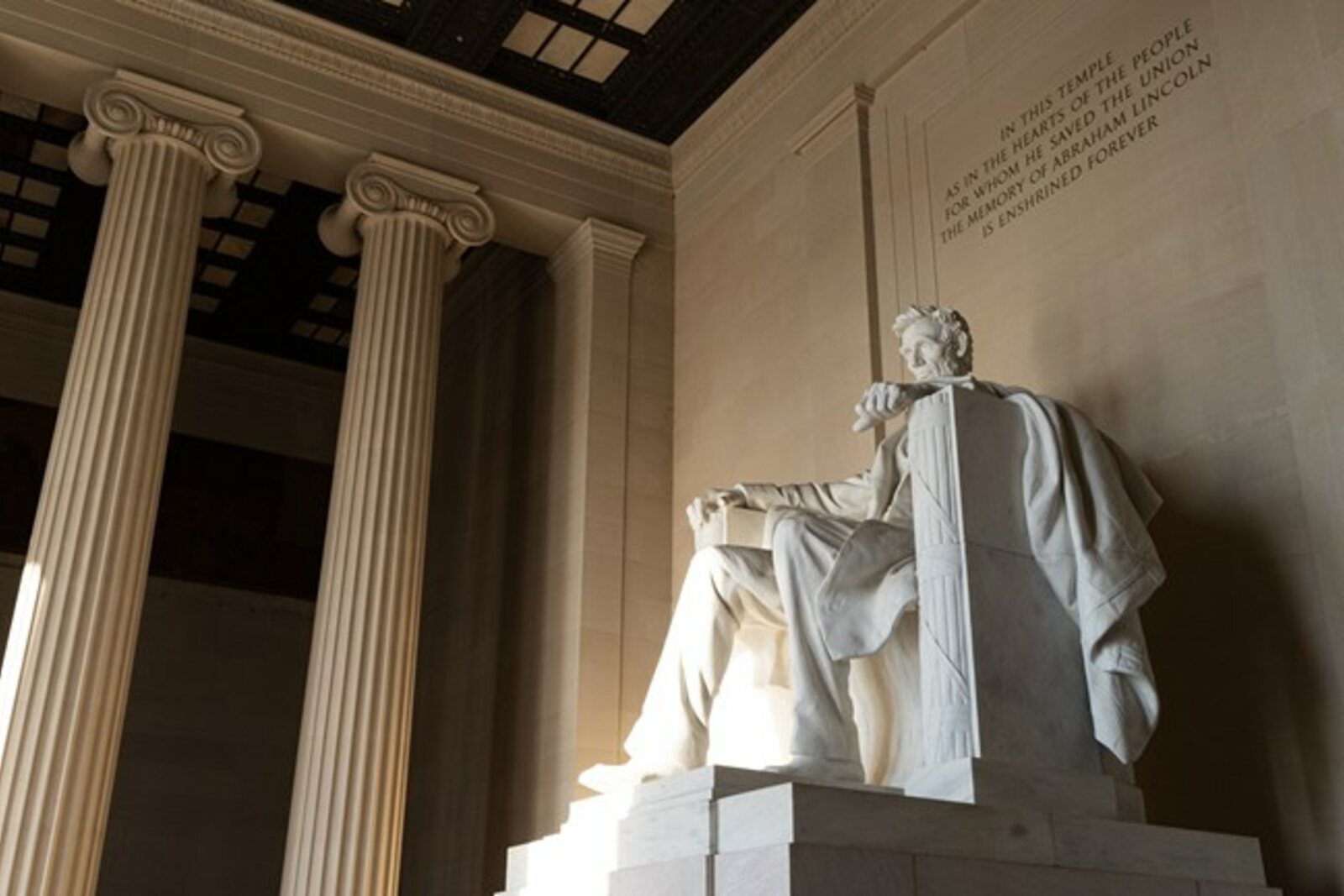
Look around first
What to notice
- Lincoln statue
- Colonnade
- Broad steps
- Texts of speeches on the side walls
The story of the place
Beyond the broad staircase and colonnade, Abraham Lincoln, the sixteenth president of the United States, sits in marble. The United States Congress dedicated this building to him for preserving the Union during the American Civil War and for the proclamation that declared enslaved people in the territory of the rebel states free. The Gettysburg Address and Lincoln's Second Inaugural Address, concerned with ending the war, are carved on the side walls. The terrace before the columns opens toward the Lincoln Memorial Reflecting Pool and the Washington Monument.
On April ninth, nineteen thirty-nine, a grand piano and a row of radio microphones were set up on the steps in front of the columns. Seventy-five thousand people gathered before them, on the terrace and farther along the Lincoln Memorial Reflecting Pool. This concert came about because two ordinary venues in Washington had successively been closed to one singer.
Marian Anderson, a Black American contralto, earned her living through concert performances. In the previous year, her fees alone had brought her nearly a quarter of a million dollars. European audiences received her enthusiastically, and her American concerts played to full houses. In the capital, Anderson sang annually to benefit Howard University's music school, and the previous venues could no longer hold everyone who wanted to attend.
The university asked to use Constitution Hall, the city's largest concert hall, with four thousand seats. The Daughters of the American Revolution, which owned it, allowed only white performers on its stage and refused Anderson. The city board of education then would not permit her concert in the auditorium of Central High School. Even lodging had to be found in a private home: Washington hotels did not accept Black guests.
Anderson's concert manager, Sol Hurok, who needed to save his artist's performance, gave the story of the refusal to newspapers. Eleanor Roosevelt, the first lady and a member of the Daughters of the American Revolution, left the organization in protest. Walter White, head of the civil-rights National Association for the Advancement of Colored People, proposed moving the concert to the Lincoln Memorial. The land here was administered by the U.S. Department of the Interior, and Secretary Harold L. Ickes secured President Franklin D. Roosevelt's consent. Ten days remained until Easter.
The marble man behind the singer was Abraham Lincoln, the sixteenth president of the United States. During the American Civil War, he preserved the Union and issued the Emancipation Proclamation, which declared free the enslaved people in the territory of the rebel states. That is why the United States Congress dedicated this memorial to him, and the Gettysburg Address, with its words about human equality, and Lincoln's Second Inaugural Address, about ending the war, were carved on the side walls. The open space before a man associated with the emancipation of enslaved people made it possible to gather together those whom city halls seated separately or did not admit at all.
Anderson did not seek to become a political speaker: singing remained her profession, and it was with singing that she answered the refusal. Ickes introduced her to the audience, after which she began a twenty-five-minute program with the patriotic song My Country, 'Tis of Thee. In the line where one voice usually sang, “I sing to thee,” Anderson sang, “we sing to thee.” People of different races stood before one stage, while millions listened to the live broadcast on the NBC radio network.
Four years later, the Daughters of the American Revolution invited Anderson to that very Constitution Hall for a benefit concert. She agreed on the condition that the audience would not be separated by skin color. In nineteen fifty-five, Anderson became the first Black soloist at New York City's Metropolitan Opera, and eight years later she sang again on these steps during the March on Washington.
Nothing remains here of the grand piano and radio microphones. In photographs, Anderson stands with her back to the seated Lincoln and faces the Washington Monument; the terrace, columns, and open space for her audience of seventy-five thousand remain in their original places.
Useful on site
The main chamber and outer perimeter are available free of charge unless there are temporary closures. The lower-level museum requires a separate ticket; tickets are issued in advance and in limited batches on the same day. As of early July 2026, the area was affected by holiday restrictions.
Checked: July 1, 2026. Check the official source before visiting.Climb at a comfortable pace and pause first by the columns, then turn to face the mall. For this stop, the freely accessible outdoor areas and main chamber are sufficient.