 Guide On Map
Capitol Hill: Law and City Life
From Union Station through the U.S. Capitol to Barracks Row
Guide On Map on your phone
Open the walk like a regular app
It takes about 10 seconds to install. No app store needed.
The whole path
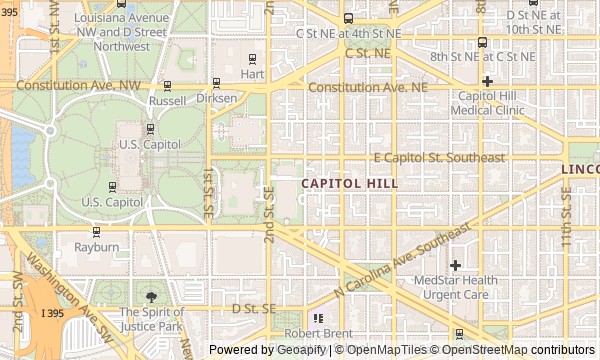
Route map
About the walk
You will begin in a railroad hall and walk toward the dome of the U.S. Capitol. The route will cross the oval Capitol Grounds, pass between Congress, two libraries, and the U.S. Supreme Court, then head into residential blocks—to the market and an old Marine Barracks Washington, D.C.
This will not be a ceremonial survey of federal institutions. At Union Station, there is still a place where a locomotive went through the floor. Behind the court’s columns, a prisoner’s pencil-written letter will come into view. At the library, eighty-two copies of one book will be waiting for you, and at the meat counter, a decision that determined the fate of an entire market.
The story will rest on human actions, documents, and the things in front of you. Where only a legend remains, it will not be presented as proven fact.
After this walk, Capitol Hill will no longer shrink to a single dome: you will be able to tell where laws are written here, where they are tested, and how everyday life continues beside them.
Why this order
Union Station will serve as the route’s northern gateway: from there, the U.S. Capitol dome sets the direction toward the Capitol Grounds. You will first make sense of the space laid out before the building, so the U.S. Capitol appears not as an isolated monument but as the destination of paths and open views. From the legislative chambers, the route moves to the Library of Congress—a collection that grew from the needs of lawmakers—and then through the neighboring block to the U.S. Supreme Court, where federal rules are put to the test. The nearby Folger Shakespeare Library reveals another side of knowledge: a private collection whose site beside government institutions had to be defended. From there, the route heads east, away from monumental facades, to Eastern Market, where preserving the neighborhood became the everyday work of vendors. The final turn south along 8th Street SE leads to the barracks: after laws, books, and city trade, the walk ends where soldiers once set out to defend the capital.
Those who want to understand Capitol Hill beyond the postcard Fans of political, urban, and book history Those who care about specific human decisions rather than a list of dates
Those looking only for a quick overview of the main facades Those who do not enjoy long historical stories Those who want a walk exclusively through museums
Before you go
Check visiting conditions for each building in advance through its official channels: government institutions, library spaces, and an active military barracks set access independently of one another. Do not tie the success of the walk to entering every interior—the main stories can be read in Union Station’s vaults, the open Capitol Grounds, the dome, stairs, inscriptions, and brick walls. Allow extra time for interior spaces and be ready for security screening. Also check whether Eastern Market is trading on the day of your visit and whether a public ceremony is being held at the barracks: an ordinary street and a special event offer entirely different experiences.
When to go
The outdoor route can be completed in one unhurried walk, with pauses for all eight stories. Even one thorough interior visit will noticeably lengthen the day, while several interiors or a ceremony at the barracks will turn the route into a half-day program. Start early enough that you do not reach the market and final stretch in a rush.
Backup plan
If you cannot get inside the U.S. Capitol, the libraries, or the U.S. Supreme Court, keep the order of the stops: their exterior details directly support the stories. At the court, read the western inscription and study the pediment figures; at the Library of Congress, set its lavish facade against the story of overcrowded shelves; and at the Folger Shakespeare Library, pause at the unexpectedly restrained appearance of a private collection. If the market is not trading, look over the restored brick hall and continue along 8th Street SE. Closed barracks gates do not undo the ending either: the rhythm of the neighborhood, the complex perimeter, and the Commandant's House let the story conclude from outside.
Route conditions
Elevation. Ascent — 17 m; descent — 14 m
OpenStreetMap extract of June 18, 2026: database data, not a check on the ground. Data © OpenStreetMap contributors, ODbL licence
Walk plan
Open in maps ↗- 1
Union Station
The monumental entrance to the capital opens the route with the story of the moment when the usual arrival arrangement stopped working. - 2
Capitol Grounds
This stop explains why the familiar approach to Congress required the destruction of the former park. - 3
U.S. Capitol
Behind the ceremonial facade lies an episode in which a dispute over slavery moved from parliamentary speech to direct violence. - 4
Library of Congress
Here you will see how private books and cramped working conditions changed the idea of a library for the whole country. - 5
U.S. Supreme Court
One poorly prepared petition shows how a constitutional question can begin far from the halls of the capital. - 6
Folger Shakespeare Library
A private collection becomes an occasion to talk about land, concealed purchases, and a project that the collector's wife completed after his death. - 7
Eastern Market
A working counter will help you understand how the tenants preserved a place the city was already planning to close. - 8
Barracks Row and Marine Barracks Washington, D.C.
The final stop links today’s ceremonial post to the day when its garrison marched out to meet the British army.
Route features
Everything you need stays in the browser
Progress, saves and your trip plan are stored on this device.
Add Guide On Map to your home screen so the walk opens outside the browser.
How we handle sources, maps and corrections: our editorial standards