 Guide On Map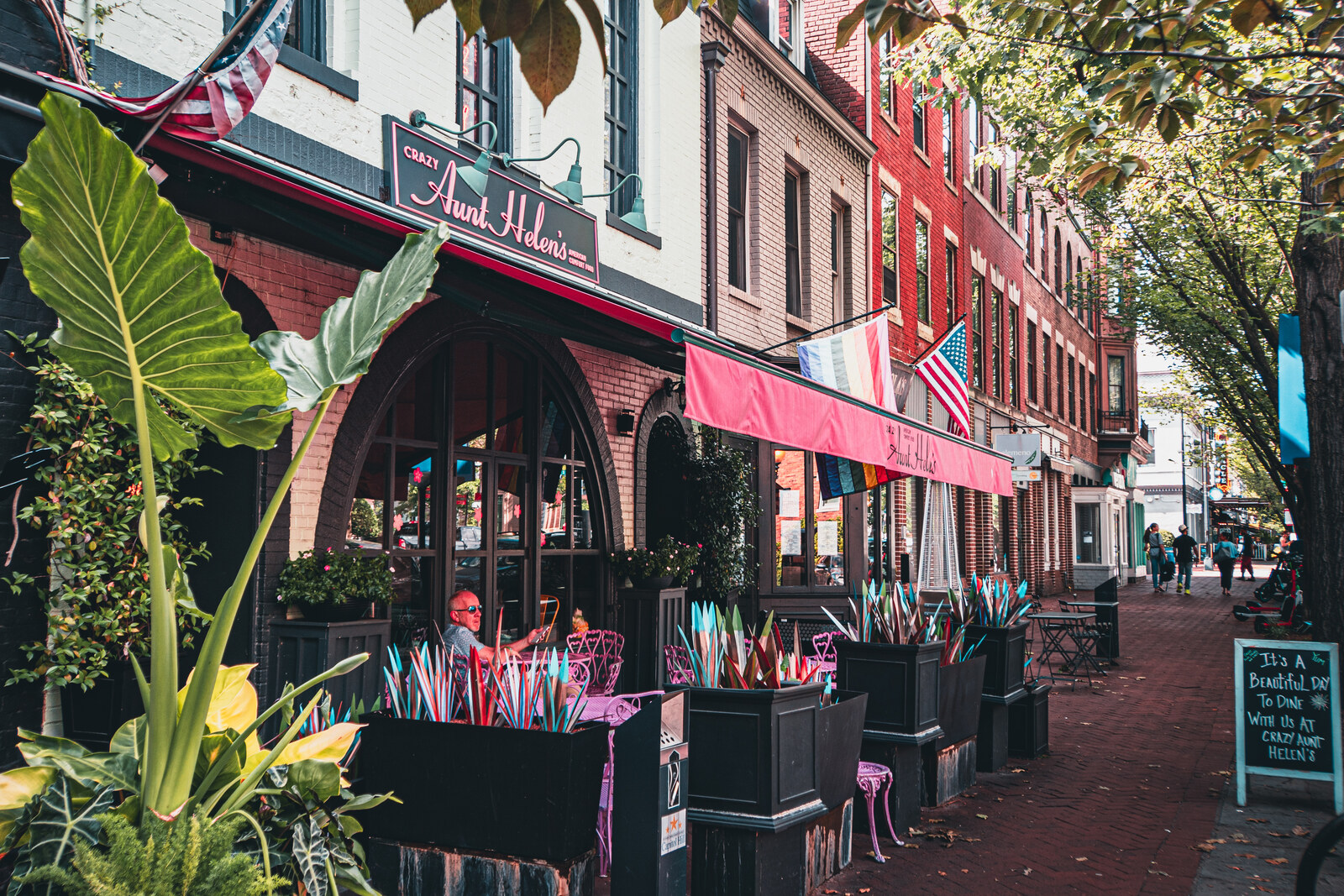
Look around first
What to notice
- Brick wall
- Parade ground
- Commandant's House
- Barracks buildings
The story of the place
On the map, this is 8th Street SE. Its commercial stretch is called Barracks Row because it faces the oldest active post of the U.S. Marine Corps. Behind the brick wall, Marines live, perform guard duty, and prepare for ceremonies. The band, a ceremonial guard company, a silent drill platoon, and the unit that carries coffins at military funerals are based here. The parade ground remains at the center of the complex.
This proximity of the barracks, the U.S. Capitol, and the Washington Navy Yard was planned in advance. In the spring of eighteen oh one, President Thomas Jefferson and Lieutenant Colonel William Ward Burrows, the second commandant of the young U.S. Marine Corps, rode through the still nearly empty Washington. Burrows needed a permanent place for headquarters and soldiers. They chose this site near the Washington Navy Yard: from here, it was possible to march quickly to the U.S. Capitol.
The reasoning behind this arrangement was tested thirteen years later. On August twenty-fourth, eighteen fourteen, the British army was advancing on Washington. Captain Samuel Miller, a career Marine officer, led about one hundred men out of these barracks and toward Bladensburg, where the road to the capital ran. His task was simple and nearly hopeless: to delay the enemy while the American command tried to assemble a defense.
Most of the militia withdrew at the very beginning of the battle. What remained in position were the sailors of Commodore Joshua Barney, a naval commander covering the road with guns, and Miller’s men. When the drivers took the wagons carrying spare ammunition to the rear, the artillerymen had rounds left for two or three shots. The Marines repelled several attacks, then British infantry outflanked them on the right. One soldier shot Miller at nearly point-blank range and shattered his left arm. The wounded Barney ordered the guns disabled and a retreat; otherwise, the remainder of the detachment would have been encircled.
The Marines did not hold the road. Many were killed or wounded, and Miller was taken to a naval hospital. He survived and received an honorary promotion for bravery. The British entered Washington and set fire to the U.S. Capitol, the President’s House, and other government buildings.
The fire did not destroy the barracks complex. According to U.S. Marine Corps tradition, General Robert Ross, who commanded the British land forces, ordered it spared out of respect for the resistance of Miller’s men. No document containing such an order has been found, so the reason remains a tradition rather than a fact. What is certain is this: after the city’s capture, the barracks and the Commandant’s House stood intact.
The old buildings were nevertheless later dismantled and, between nineteen hundred and nineteen oh seven, replaced with the present ones. Only the Commandant’s House at the northern edge of the block, completed in eighteen oh six, remains from the original complex. The head of the U.S. Marine Corps still lives there. This is the very house around which the tradition of General Ross’s order arose.
Useful on site
The street is accessible at all times; evening U.S. Marine Corps parades take place almost every Friday from May through August, begin at 20:45, are free, and require reservations; the gates close before the start.
Checked: June 28, 2026. Check the official source before visiting.This is an active military facility: view it from the public sidewalk and do not expect unrestricted entry. Public parades and musical ceremonies require a separate check of visiting conditions.