 Guide On Map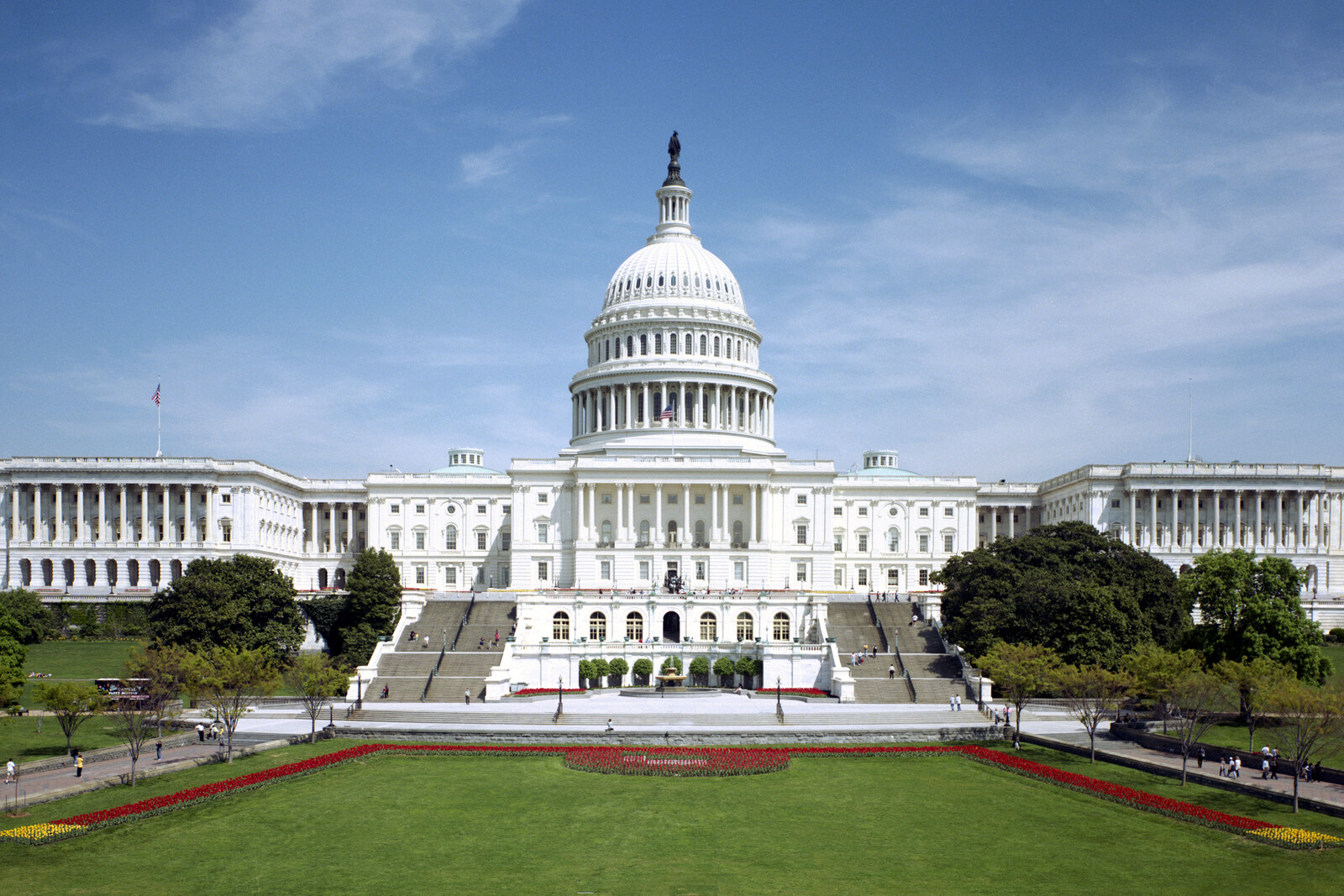
Look around first
What to notice
- Central dome
- Northern U.S. Senate wing
- Southern U.S. House of Representatives wing
- Old Senate Chamber
The story of the place
A central dome rises above the U.S. Capitol, with two wings on either side: the northern one is occupied by the U.S. Senate, the southern one by the U.S. House of Representatives. Both chambers pass Federal laws here, but their halls are not the same age. Near the Capitol Rotunda, slightly to the northeast, the semicircular Old Senate Chamber has been preserved; today the U.S. Senate meets farther north. When they moved, the senators took their desks with them: forty-eight desks made in eighteen nineteen are still used in the current chamber.
On May twenty-second, eighteen fifty-six, Preston Brooks, a member of the U.S. House of Representatives from South Carolina, entered the Old Senate Chamber of the U.S. Capitol after the session had ended. He intended to punish Charles Sumner, the senator from Massachusetts, who was seeking to prohibit the spread of slavery into new American territories. Sumner was sitting at his desk, signing envelopes containing the printed text of a recent speech: the senator's signature allowed it to be sent as official mail.
The speech was called “The Crime Against Kansas.” Two years earlier, Congress had allowed the settlers of Kansas to decide for themselves whether slavery would be legal in the future state. Supporters and opponents of slavery rushed into the territory, and the dispute over voters and voting results turned into armed violence. Sumner demanded that the spread of slavery be stopped and spoke in the U.S. Senate for five hours over two days.
He accused the law's supporters, but devoted particular attention to one of them, Andrew Butler, the senator from South Carolina. Butler sought to preserve for Kansas the possibility of legalizing slavery. Sumner publicly ridiculed both Butler's position and his ideas of honor. Butler was absent that day. Brooks was his relative and decided to answer the insult personally.
Brooks approached the desk, briefly stated the accusation, and struck Sumner on the head with a cane fitted with a metal knob. The senator tried to rise, but the desk was fastened to the floor. As he tore himself free, Sumner pulled it from its fastenings and made his way into the aisle. Brooks followed him and continued to strike him until the cane split apart. Sumner was left lying unconscious; Brooks left the chamber, and no one stopped him.
Both chambers began an investigation. A court fined Brooks for the assault, but the U.S. House of Representatives did not obtain the necessary two-thirds vote to expel him. He then gave up his seat himself, inviting the voters to decide whether he deserved to return. South Carolina voters immediately sent him back to Congress, while supporters sent new canes to replace the broken one. In January of the following year, Brooks died suddenly in Washington.
Sumner underwent treatment for almost three and a half years and appeared in the U.S. Senate only occasionally. Massachusetts legislators—state legislatures elected senators then—reelected him unanimously, keeping his seat and salary for him. After returning, he continued to seek the abolition of slavery and then equal civil rights for freed slaves. He served in the U.S. Senate for another fifteen years. After his death in eighteen seventy-four, Sumner's coffin was placed beneath the dome of the U.S. Capitol for a state farewell.
The old semicircular chamber where Brooks tried to silence him has been preserved northeast of the Capitol Rotunda. The current U.S. Senate meets farther north, in the large wing, and the U.S. House of Representatives in the southern one; together they pass Federal laws. When they moved, the senators took their desks from the old chamber. Forty-eight desks made for the Old Senate Chamber as early as eighteen nineteen are still used in the current chamber.
Useful on site
The Visitor Center is open Monday through Saturday from 08:30 to 16:30; admission and tours are free, reservations are recommended, and the last tour begins at 15:20.
Checked: June 28, 2026. Check the official source before visiting.Viewing from outside is enough for this story. If you want to enter the chambers, check the visiting procedures separately and allow time for the established access procedures.