 Guide On Map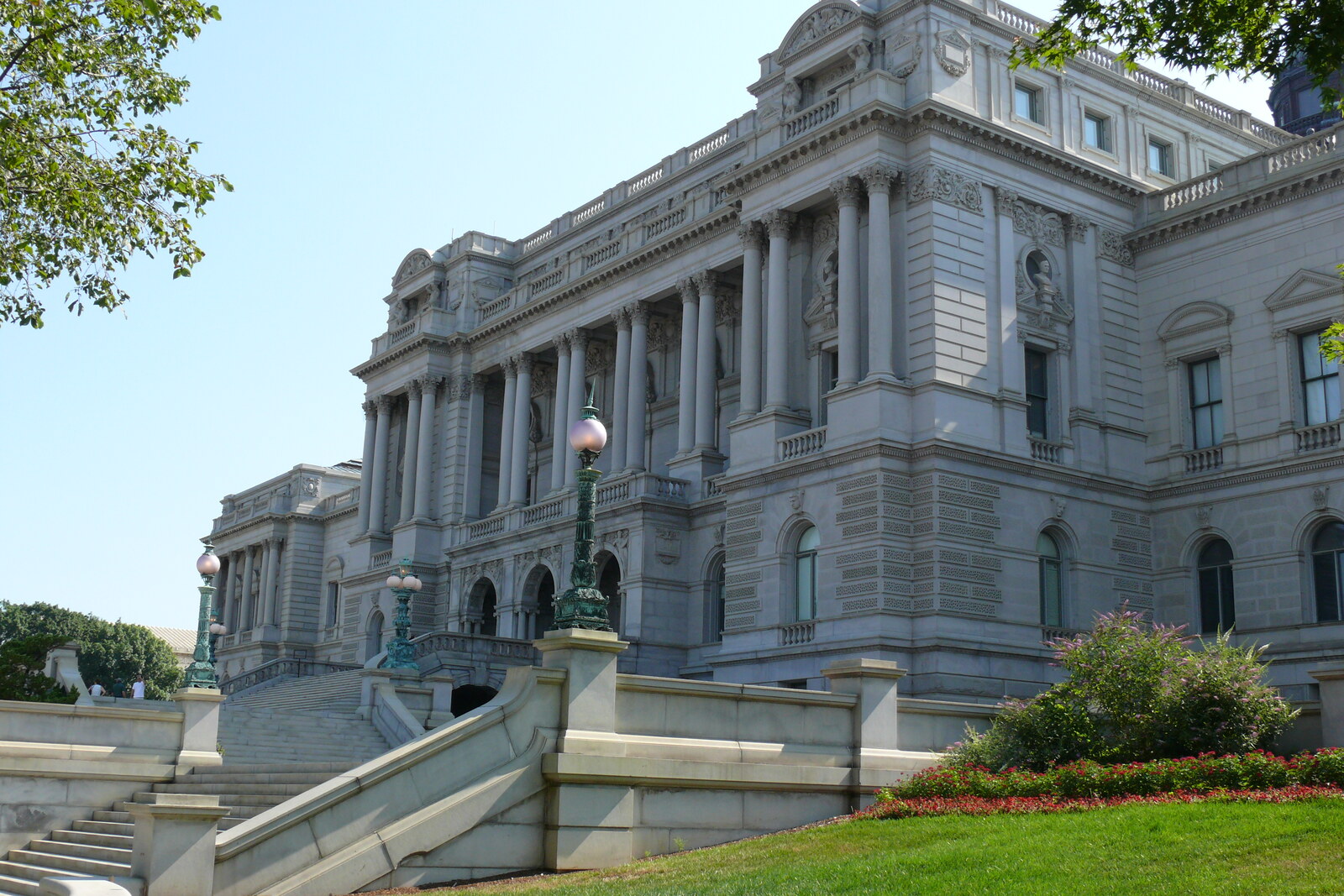
Look around first
What to notice
- The reading room dome
- The round reading room
- The display case with Jefferson's books
- Empty spaces in the collection
The story of the place
In eighteen seventy-seven, the Librarian of Congress, Ainsworth Rand Spofford, reported that more than seventy thousand books were already lying on the floor of the U.S. Capitol. He had sought such an influx himself: he wanted to turn a small collection for lawmakers into a library for the whole country.
For Spofford, this was both his life's work and his livelihood. When he joined as an assistant librarian, he was offered eighteen hundred dollars a year. In a letter to his wife, he admitted that the salary was good, but feared that after a change of president the political appointment would be given to someone else. Spofford remained. Abraham Lincoln appointed him chief librarian, and he received seven staff members and about eighty-two thousand volumes.
In eighteen seventy, Spofford persuaded Congress to transfer copyright registration to the library. An author or publisher wishing to register a work sent two copies. Novels, maps, photographs, sheet music, and pamphlets arrived. Within just four years, these deposits outnumbered purchases. Spofford placed books in the attics of the U.S. Capitol, in basement corridors, by committee doors, and along public staircases.
Almost at once, he demanded a separate building. Congress discussed his proposal for fifteen years. The site was chosen opposite the U.S. Capitol: the library was leaving its overcrowded rooms, but remaining close to those for whom it had been established. Spofford also proposed the interior arrangement: a round reading room beneath a dome, with book stacks and departments around it. This plan can still be seen in the center of the building.
The outcome for Spofford was harsh. In the summer of eighteen ninety-seven, a few months before the building opened, the president appointed another chief librarian. Spofford became an assistant. More than eight hundred tons of books, manuscripts, maps, sheet music, and photographs were moved from the U.S. Capitol to the new premises in horse-drawn wagons. On November first, the doors opened to readers. Spofford continued to build the collection in his subordinate position and worked here until his death.
The building received its present name much later. In nineteen eighty, it was named after Thomas Jefferson, the third president of the United States. Jefferson did not design this palace. His name appeared here because of books.
In eighteen fourteen, British soldiers burned the U.S. Capitol along with the first Library of Congress. Jefferson, already living in retirement at Monticello, offered to replace the lost collection with his own: six thousand four hundred eighty-seven volumes, which he had collected for about fifty years. He was in debt, and a substantial part of the proceeds went immediately to his creditors.
The purchase met with opposition. Some members of Congress considered the price excessive; others objected to books in foreign languages, philosophy, and subjects far removed from laws. The U.S. House of Representatives agreed by a margin of only ten votes. Congress paid twenty-three thousand nine hundred fifty dollars, and in the spring of eighteen fifteen wagons delivered the collection from Monticello to Washington. With it, the library received Jefferson's principle: a lawmaker may need a book on any subject.
Nearly two-thirds of these volumes perished in another fire at the U.S. Capitol in eighteen fifty-one. About two thousand survived. Later, librarians tracked down thousands of books in the same editions and rebuilt the collection. Now the exhibition hall displays side by side Jefferson's original copies, the replacements that were found, and the empty spaces that remain. Beneath the central dome, the reading room conceived by Spofford is in use, while the gallery contains the books because of which the building bears Jefferson's name.
Useful on site
The Thomas Jefferson Building is open to visitors Tuesday through Saturday from 10:00 to 17:00, with last entry at 16:30; a free timed-entry pass is required.
Checked: June 28, 2026. Check the official source before visiting.Outside, focus on the contrast with the working architecture of Congress. Check before your walk whether it is possible to see the Main Hall and the exhibition spaces.