 Guide On Map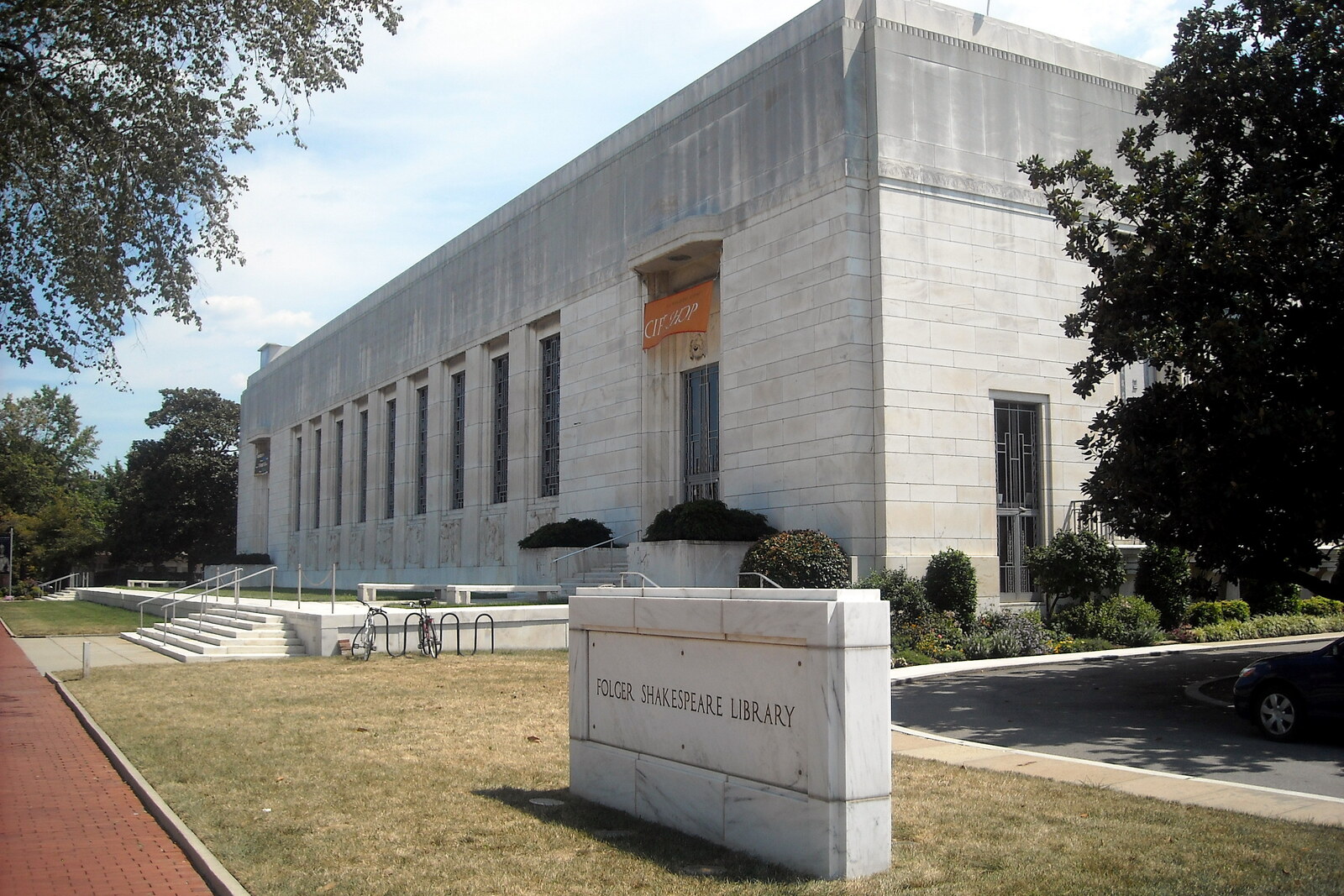
Look around first
What to notice
- White marble facade
- Display case with copies of the First Folio
- Old reading room
- Theater hall
The story of the place
In January nineteen twenty-eight, oil executive and collector Henry Clay Folger learned that the Library of Congress was about to acquire the plot he had nearly finished assembling, house by house. Had the law passed in its original form, there would be no white marble building here.
The Folger name belongs to Henry and his wife, Emily Jordan Folger. They wanted to open their collection of books and manuscripts about the English playwright William Shakespeare to researchers. Henry began as a clerk at an oil company, eventually headed its New York division, and spent the money he earned at Standard Oil on books. Emily reviewed auction catalogs, advised him on what to buy, and maintained a card catalog of the collection.
The couple searched especially persistently for the First Folio, a collection of Shakespeare's plays published seven years after the author's death. It preserved eighteen plays that might otherwise not have reached us. The Folgers acquired eighty-two copies. They differ in typesetting, corrections, missing pages, bindings, and owners' annotations, so comparing several copies gives a researcher what one copy, even the best preserved, cannot.
Before the library existed, these books could not be seen together. The most valuable volumes were kept in bank safe-deposit boxes, while the rest were in crates at Standard Oil warehouses. The Folgers divided the collection among different storage facilities so that a single fire would not destroy everything. At the same time, no one knew its true size: once dealers understood that a wealthy buyer was systematically collecting Shakespeare, prices rose.
For their future library, the couple chose Washington: the U.S. Capitol, the Library of Congress, and other collections needed by scholars were nearby. Fourteen brick houses stood on this site then, known as Grant's Row, a row named for Grant. Henry instructed a lawyer to buy them one at a time and not disclose the buyer's name. Assembling the plot took about four and a half years.
Just then, Congress began preparing land for a new wing of its own library. Grant's Row was included in the proposed area. Henry told Herbert Putnam, director of the Library of Congress, that if the plot were taken, he would move his collection from Washington to another city. Putnam wanted to keep the future research center beside his own library and persuaded a committee of the U.S. House of Representatives to exclude the Folger land from the bill.
Oral promises were not enough for Henry. He refused to begin the design work until the exclusion became law. In May nineteen twenty-eight, both houses passed the amended text unanimously. Grant's Row was demolished by the end of the following year, and construction began in its place.
Henry lived to see the laying of the cornerstone, but two weeks later he unexpectedly died after an operation. The stock market crash had already reduced the funds he left behind, and there was not enough money to complete the building. Emily gave the project three million dollars in Standard Oil stock, then added more the following year. In April nineteen thirty-two, she opened the library the couple had conceived together.
Now researchers work with rare books and manuscripts in the old reading room, plays are performed in the theater, and public exhibition halls have been arranged beneath the gardens. For the first time, all eighty-two copies of the First Folio have been brought together in a display case about six meters long. Above, in the old reading room, the ashes of both Folgers are interred: Henry, who did not live to see the opening, and Emily, who paid for the completion of the construction.
Useful on site
Usually open Tuesday, Wednesday, Thursday, Saturday, and Sunday from 11:00 to 18:00, Friday from 11:00 to 21:00, closed Mondays; admission is free, a timed pass is recommended, and donations are optional.
Checked: June 28, 2026. Check the official source before visiting.Do not mistake a research library for an ordinary reading room. Public access to the interiors and exhibitions should be checked separately; the exterior already reveals the building's concept.