 Guide On Map
Muranów: Jewish Memory and a Postwar Neighborhood
From Krasiński Garden to Umschlagplatz
Guide On Map on your phone
Open the walk like a regular app
It takes about 10 seconds to install. No app store needed.
The whole path
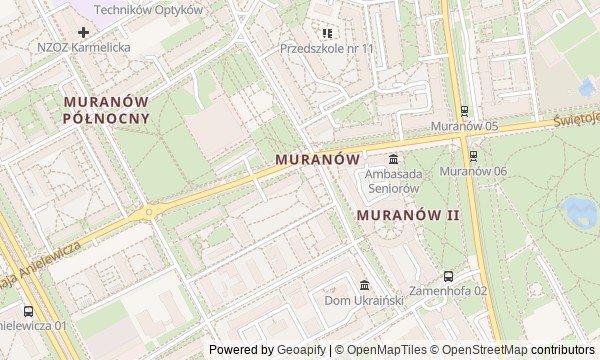
Route map
About the walk
The route begins at Krasiński Garden, crosses postwar Muranów, and ends at a former railway site. Beneath your feet, the boundary of a vanished neighborhood will emerge. Then you will see an old fountain outside Kino Muranów, a surviving prison-gate post, a vast monument, a glass museum, a mound, and white walls covered with names.
This is not a walk among Warsaw's rebuilt facades. Almost all the major evidence comes later: a bronze strip stands in for a wall, a replica tree for a living elm, and a new house number sends you away from the old address.
The story unfolds through human choices. Why would a film distributor call a ticket seller from a street booth? How would someone else's uniform open prison gates? Why would a person who was not a doctor put on a doctor's coat?
By the end, you will read Muranów through its mismatches: between today's streets and former addresses, between monuments and what can no longer be seen where they stand.
Why this order
The boundary at the garden establishes the vanished layout of the neighborhood. From there, a descent along Andersa Street leads to the postwar cinema and its old fountain, so the story of destruction is immediately followed by the story of a new everyday life. From the cinema, the route turns west toward Pawiak Prison: the surviving gates and bronze tree bring a material trace back into the new development. Along Dzielna Street and Zamenhofa Street, the route reaches the Monument to the Ghetto Heroes, then crosses the square to the POLIN Museum of the History of Polish Jews: the monument to the uprising and a museum of a millennium of history stand side by side. From the museum, the route continues along Zamenhofa Street and Miła Street to the mound above the command bunker, then along Dubois Street and Stawki Street to Umschlagplatz. The final stretch links a place of resistance with the deportation point, where white walls with names remain in place of the lost ramp.
Those who want to understand Muranów, not just see its monuments Those who care about human choices within a vast history Those ready to read the traces of a vanished city closely
Those looking for an easy walk between beautiful facades Those who prefer an overview of Warsaw without difficult historical subjects Those who want a route centered above all on surviving old buildings
Before you go
Wear comfortable shoes: it is not so much the kilometers as the long stops and uneven terrain that matter here. Check museum access and visiting conditions separately in advance—the outdoor route does not guarantee entry inside. Bring headphones, so you can listen without raising the volume near homes and memorials. At burial sites and memorial stones, do not climb embankments, sit on memorial elements, or block the way for other visitors. If you are walking as a group, agree to leave a few minutes of quiet after the difficult passages.
When to go
Allow about two and a half hours for the outdoor sequence, not including separate visits to museum exhibitions. It is best to begin in daylight: markings in the paving, changes in ground level, and facade details are easier to read then. With a visit inside the POLIN Museum of the History of Polish Jews, the walk can easily take up a substantial part of the day.
Backup plan
In rain, keep the main arc of the route and shorten the time between stories: the boundary line, the changes in ground level by the cinema, the outdoor elements of Pawiak Prison, both sides of the Monument to the Ghetto Heroes, the mound on Miła Street, and Umschlagplatz. At the POLIN Museum of the History of Polish Jews, see the facade, and add the indoor exhibition only if access has been checked in advance. If weather or fatigue makes you finish earlier, do not rush through the final stops: end after the monument and museum, then walk Miła Street and Umschlagplatz together another day—their connection matters more than formally completing the list.
Route conditions
Surface. Paved — 2.7 km; unpaved — 100 m (data covers 95% of the route)
Stairs. Flights: 3, 20 m in total
Access. Wheelchair — no; stroller — limited (stairs)
Facilities. Toilets — 5; drinking water — 3
Elevation. Ascent — 14 m; descent — 14 m
OpenStreetMap extract of June 18, 2026: database data, not a check on the ground. Data © OpenStreetMap contributors, ODbL licence
Walk plan
Open in maps ↗- 1
The Ghetto Boundary by Krasiński Garden
Here the route compares the park's present-day edge with the gates through which the district's final liquidation began. - 2
Fountain and Kino Muranów
This stop will show how an old urban feature and risky film distribution became part of everyday life in the new district. - 3
“Pawiak”: Gate and Bronze Elm
The surviving gate makes it possible to connect a daring escape from the beginning of the century with family memories of the prison during the occupation. - 4
Monument to the Ghetto Heroes
The two sides of the monument provide the precise context for a political gesture that divided public opinion. - 5
POLIN: A Thousand Years Before the Finale
Here it becomes clear why the creators gave the Holocaust a precise place within a story a thousand years long. - 6
Miła 18: a mound above the bunker
The mound preserves the prewar address and the memory of the encircled headquarters’ final hours, although the underground shelter itself is no longer visible. - 7
Umschlagplatz
The final stop will return names to people where they were once turned into anonymous cargo.
Route features
Everything you need stays in the browser
Progress, saves and your trip plan are stored on this device.
Add Guide On Map to your home screen so the walk opens outside the browser.
How we handle sources, maps and corrections: our editorial standards