 Guide On Map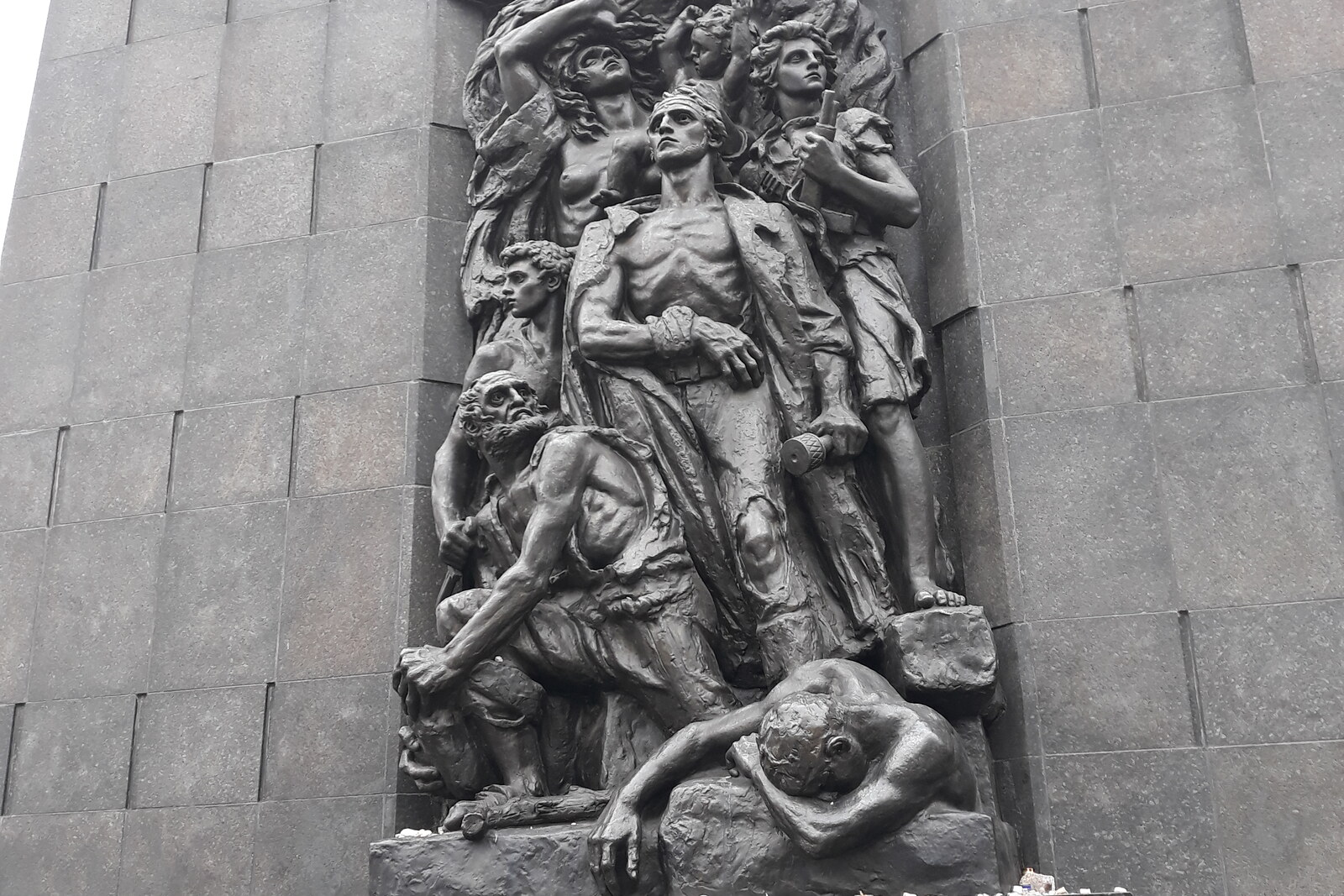
Look around first
What to notice
- The bronze group Struggle
- The relief The Last March
- Black stone slabs
- A slab with a kneeling figure
The story of the place
The black stone monument has two sides. Armed men and women project in bronze from the western side, while the eastern side is occupied by a relief with twelve barefoot people under guard. These two images place side by side the resistance of ghetto residents and the path of those taken away to extermination camps. After the war, Jewish survivors, including underground participants, collected money for its construction, and a dedication to fighters and martyrs in three languages was left on the slab.
On December seventh, nineteen seventy, Willy Brandt, chancellor of West Germany—the western part of Germany, which was divided at the time—laid a wreath at this monument. Protocol required him to straighten the ribbons, step back a few paces, and bow his head. Brandt stepped back, then, without warning, dropped to both knees.
He had come to Warsaw to sign a treaty with the Polish People's Republic, as the Polish state was called at the time. The two countries had had no diplomatic relations since the war. Brandt sought reconciliation and recognition of Poland's postwar border. For a West German chancellor, this meant clashing with many voters, especially Germans resettled from lands east of the new border.
Brandt himself had not taken part in the crimes of the Nazi regime. In nineteen thirty-three, he fled Germany and continued fighting Adolf Hitler from exile. It was such a man who decided to ask forgiveness on behalf of the state he now led. Later, he explained that, before the abyss of German history and the millions murdered, he did what people do when words fail.
Photographers captured the chancellor on his knees before the wreath. In West Germany, forty-eight percent of those surveyed called his act excessive; forty-one percent considered it appropriate. Brandt's opponents used the photograph in their campaign against the chancellor and his treaty with Poland. For a politician dependent on a parliamentary majority, a few minutes of silence here became a threat to lose his office. The treaty was ratified only two years later. Yet the following year, when the Norwegian Nobel Committee awarded Brandt the Peace Prize for reconciliation with neighboring countries, it specifically recalled his kneeling before the monument in the former ghetto.
Brandt stood before the monument's western side: the bronze group Struggle. At its center, the sculptor Nathan Rapoport placed a figure modeled on Mordechai Anielewicz, commander of the Jewish Combat Organization. Around him are men and women with pistols and bottles of incendiary mixture. These are the fighters who, in April nineteen forty-three, met with weapons the German units that had come to destroy the ghetto once and for all. They are the ones the monument calls heroes.
Rapoport survived the war in the Soviet Union and returned to ruined Warsaw. Jewish survivors, including a small number of underground participants, collected money for the monument. It was unveiled on April nineteenth, nineteen forty-eight, the fifth anniversary of the beginning of the uprising. On the black slab, they wrote in Polish, Yiddish, and Hebrew: “The Jewish people—to its fighters and martyrs.”
The last word explains the monument's other side. On the eastern relief, The Last March, there are no weapons. Twelve barefoot people walk under guard; among them are women, children, and an old man holding a Torah scroll to his chest. Rapoport depicted ghetto residents being led to the point of departure for extermination camps. At the unveiling, the front side was covered with white cloth, and the ceremony was directed primarily toward the armed fighters. The people on the reverse side remained behind the monument's stone wall.
A bronze slab showing Brandt on his knees now stands in the adjacent small park. It reproduces a photograph taken here. In the original photograph, the chancellor faces Struggle, and directly behind its figures, on the other side of the same mass of stone, is The Last March.
Useful on site
The open square is accessible around the clock; access may be restricted during state and commemorative ceremonies.
Checked: June 30, 2026. Check the official source before visiting.Walk all the way around the monument: its design cannot be read from a single point. Do not sit on the stone base.