 Guide On Map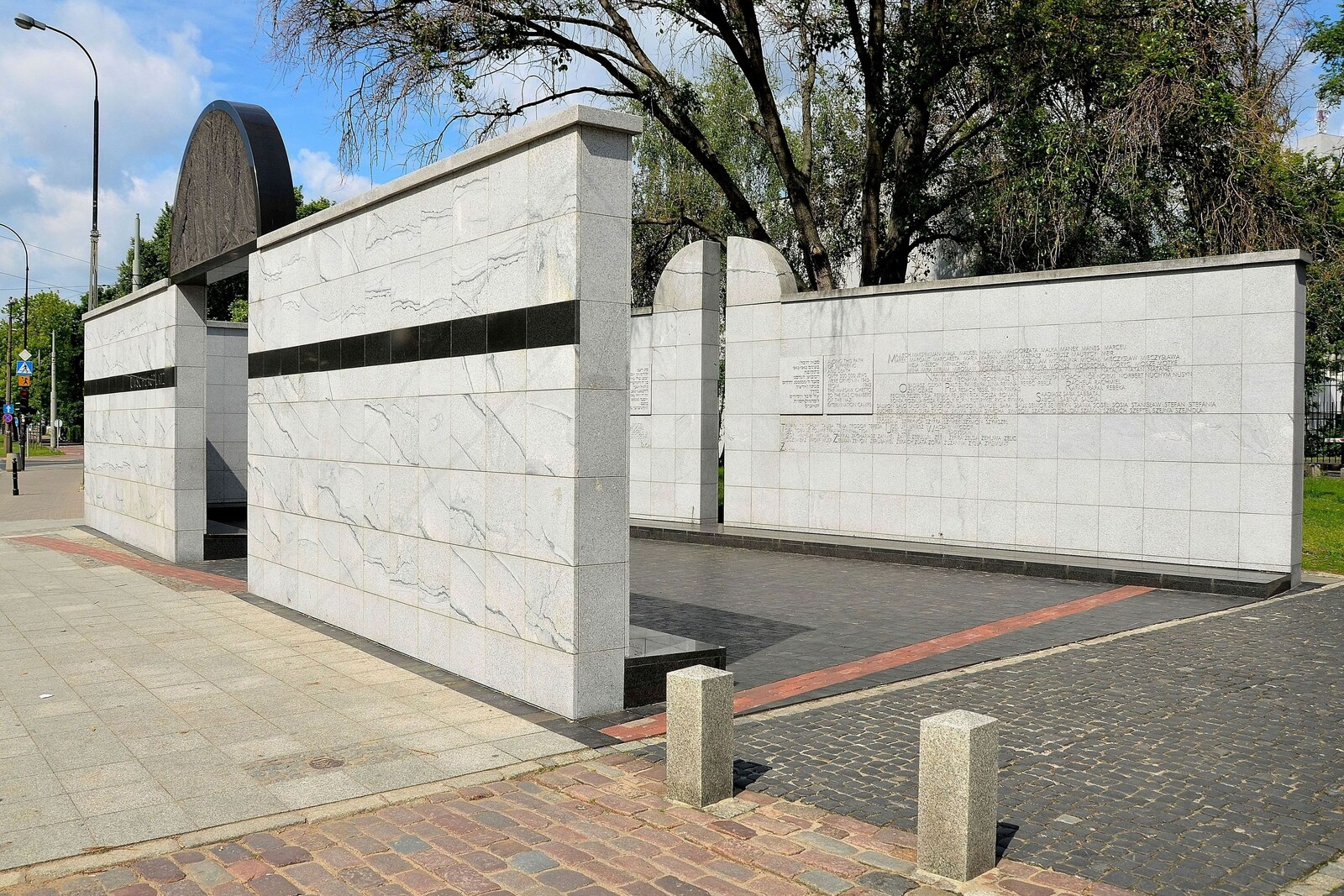
Look around first
What to notice
- White walls
- Black stripe
- Rows of carved names
- Passage between the walls
The story of the place
Umschlagplatz was the name for a transfer area by a railway siding. At first, all permitted exchange of goods between the Warsaw Ghetto and the rest of the city passed through it. Later, the courtyard and neighboring buildings served as the place from which people were led to freight cars. The ramp is long gone; white walls with a black stripe enclose the memorial, where four hundred common prewar Polish and Jewish names are carved on the inner sides.
In the summer of nineteen forty-two, Nachum Remba entered this courtyard in a white doctor's coat. He was not a doctor. Remba worked in the Schools Department and the secretariat of the Warsaw Jewish Council in the Warsaw Ghetto, and the coat allowed him to be there, where almost no one was any longer let out.
The name “Umschlagplatz” means a transfer area. Before the mass deportations, this was the only official point through which goods were passed between the Warsaw Ghetto and the rest of Warsaw. On July twenty-second, nineteen forty-two, the German occupation authorities began using the railway siding to send people away. Those arrested were held in the courtyard and neighboring buildings, then driven into freight cars and taken to the Treblinka extermination camp.
At the entrance, Remba set up something like a medical station. Among the detainees, he chose someone, declared that person too ill for the journey, and demanded that the person be handed over to doctors. The person he saved was laid on a cot, bandaged for effect, and taken back to the ghetto in an ambulance at the first opportunity.
One day, Maria Rotblat, the director of an orphanage, and eighty of her charges—girls aged ten to sixteen—found themselves at the ramp. Maria's son, the educator Lejb Rotblat, known as Lutek, sought their release. Together with Remba, he convinced the German officials that the girls sewed military uniforms and were needed by the workshop. White coats and a bribe helped. The whole group was led out of Umschlagplatz and returned to the orphanage on Twarda Street.
The rescue proved temporary. A few months later, the girls were nevertheless deported to Treblinka. In May nineteen forty-three, Remba himself was seized. Through this same point, he was sent to one of the camps in the Lublin District, where he was killed.
The old ramp has not survived. In nineteen eighty-eight, the architect Hanna Szmalenberg and the sculptor Władysław Klamerus erected here a rectangle of white walls with a black stripe at the top. On the inside, they carved in alphabetical order four hundred common prewar Polish and Jewish names—from Aba to Zhanna. This is not a list of four hundred identified victims: there are no surnames beside the names. At the ramp, where people were loaded into freight cars, only names now remain.
Useful on site
The open memorial is accessible without a ticket; on 22 July and on days of memorial ceremonies, access may be restricted.
Checked: June 30, 2026. Check the official source before visiting.Enter quietly, do not lean against the walls, and keep the narrow passage clear. It is best to listen to the finale without filming at the same time.