 Guide On Map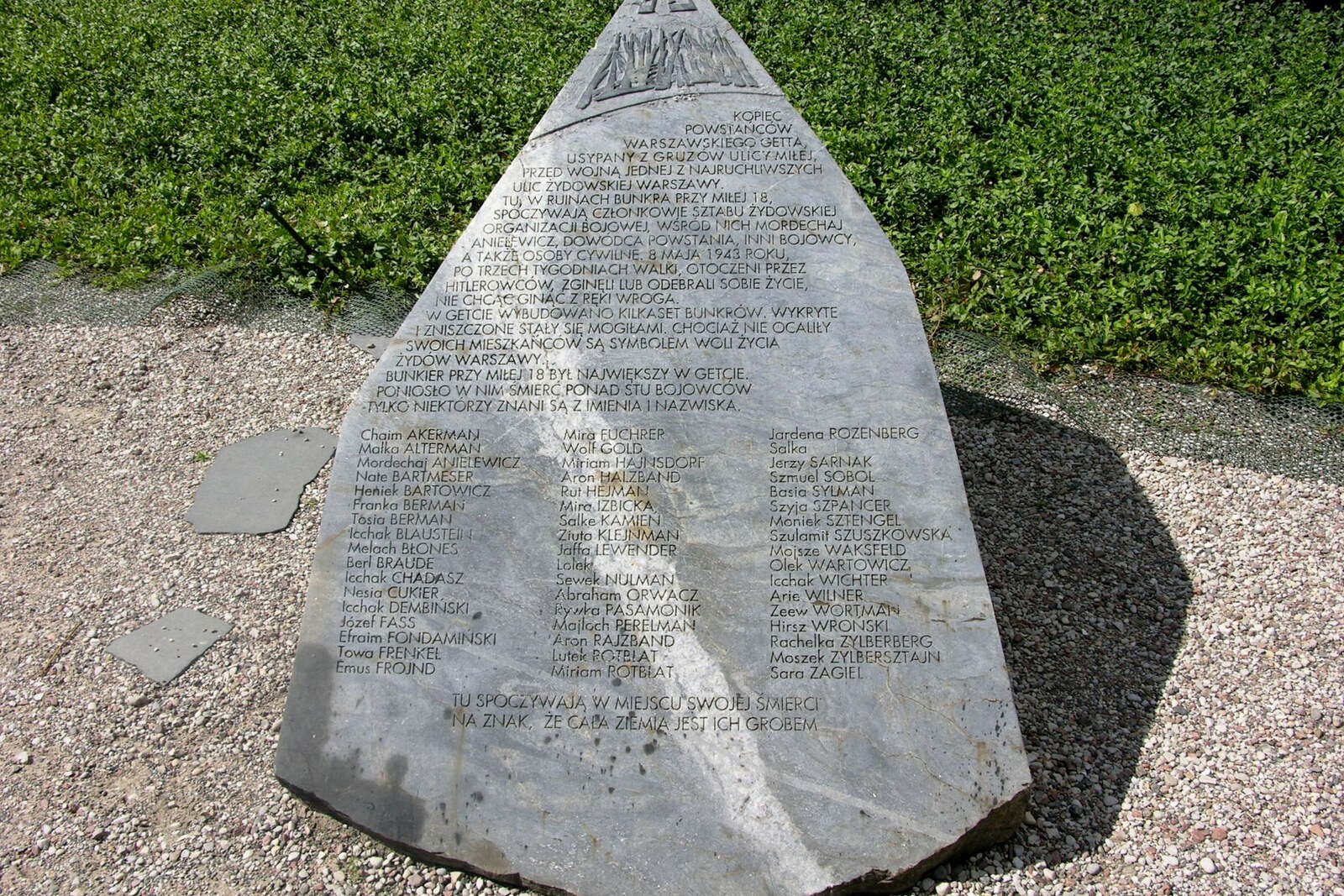
Look around first
What to notice
- Mound of rubble
- Memorial stone
- Plaque with names
The story of the place
The houses whose basements were joined here into a single shelter have long been gone. Water and electricity were installed below, along with a kitchen, sleeping places, and hidden exits; at first, the smugglers kept the shelter for their families and associates. After the war, a hill of rubble from neighboring buildings was raised over the empty space. A plaque by the memorial stone bears the names of those whose identities could be established, but the underground shelter itself can no longer be made out beneath the mound.
The address “Miła eighteen” is prewar. Today, this place corresponds to the plot at the intersection of Miła Street and Dubois Street; the present-day house numbered eighteen stands considerably farther west.
The underground shelter was built by smugglers from the Warsaw Ghetto. They connected the basements of several houses, installed electricity and water, and fitted out a kitchen, sleeping rooms, and several concealed exits. The shelter was intended for their families and associates in case of a roundup. When the Germans discovered the Jewish Combat Organization’s former headquarters at Miła twenty-nine, the owner of this bunker agreed to take in the insurgents’ command.
By the beginning of May nineteen forty-three, about three hundred fighters and civilians were crowded into rooms designed for several dozen people. Mordechai Anielewicz, the commander of the Warsaw Ghetto Uprising, was trying to preserve the remaining units and find a way out of the encircled ghetto. His partner and liaison, Mira Fuchrer, was here with him.
On May eighth, German units surrounded the house and blocked the five known exits. After a demand to surrender, about two hundred civilians came outside. The headquarters members and roughly one hundred twenty fighters remained. When the Germans began filling the shelter with gas, headquarters member Arie Wilner urged his comrades not to let themselves be taken alive and to save their last bullets for themselves. Some shot themselves or took poison.
The phrase “collective suicide” describes only part of what happened. Tosia Altman, a headquarters liaison who managed to get out, said that Anielewicz opposed collective suicide. He still hoped to hold out and advised people to cover their faces with wet cloth: he had read that soldiers protected themselves from gas this way during the First World War. Several dozen people found a sixth exit that the Germans had not noticed, escaped onto the neighboring ruins, and joined surviving fighters in another shelter.
Anielewicz, Mira Fuchrer, and most of those who remained here died. Some suffocated, others took their own lives; the exact circumstances of the commander’s own death are unknown.
After the war, the bodies were not exhumed. In nineteen forty-six, the Central Committee of Polish Jews raised a hill over the destroyed shelter from the rubble of nearby houses and placed a memorial stone on top. This is how Anielewicz Mound came into being: it is named after the commander who died here with the headquarters, and does not mark his individual grave.
Fifty-one names are engraved on the plaque at the foot of the mound. They are the names of fighters whose identities could be established, not a complete list of the dead. Nothing of the underground shelter can be seen now: the house, the entrances, and the rooms have disappeared, while the prewar address remains on the memorial plaque.
Useful on site
The open memorial in a residential neighborhood is accessible without a ticket; access to excavation areas may be blocked by barriers.
Checked: June 30, 2026. Check the official source before visiting.Stay on the accessible path and do not climb the mound: beneath it is the place where people died, not a viewpoint.