 Guide On Map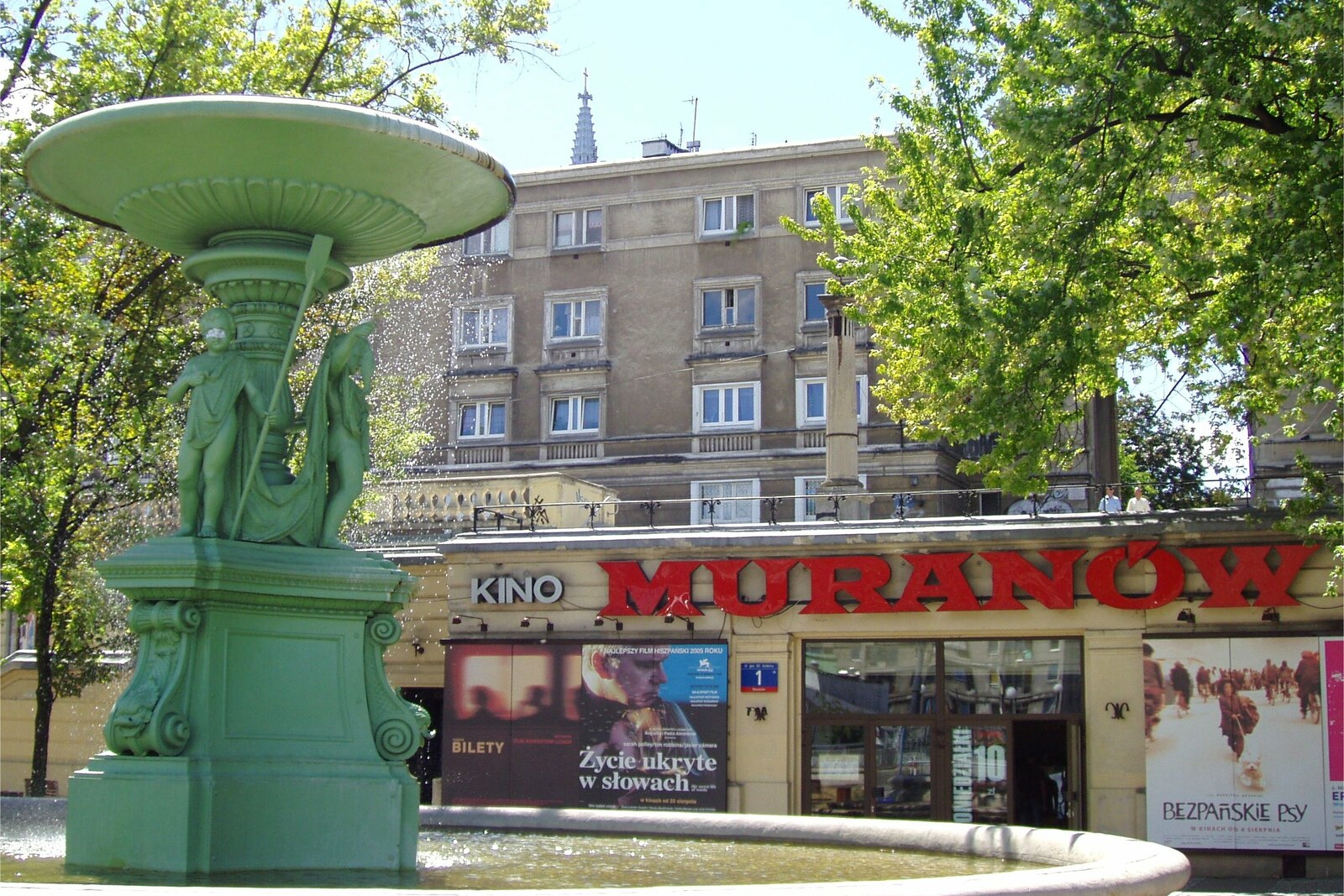
Look around first
What to notice
- Circular stone basin
- Three cast-iron figures
- Cinema entrance
The story of the place
The circular stone basin by the entrance supports three cast-iron boys with an oar, a trident, and a fish on an octagonal base. The fountain was made for the city waterworks, and it reached the cinema under construction after several moves around Warsaw. The cinema itself was built for residents of postwar Muranów, which rose on the land of the destroyed Warsaw Ghetto. Instead of the planned garages, the building was given two auditoriums, and when it opened, it was Poland’s first two-screen cinema.
In nineteen ninety-four, Roman Gutek would leave home in the evenings to go to a phone booth. He distributed art-house films, had just founded his own company, and leased Kino Muranów so that he could buy the rights to films he selected himself and show them in his own cinema. The family had no telephone at home. Gutek called the cashier and asked how many tickets had been sold that day. A full auditorium meant he could buy the next film; an empty one meant the money invested might not be recouped.
Gutek began with Wim Wenders’s Lisbon Story, then brought in films by Pedro Almodóvar, Jim Jarmusch, and David Lynch. The rights often had to be paid for before it became clear whether an audience would be found. Seven years later, the company had no money left for salaries. Gutek took out a loan secured by his car and took a chance on the French film Amélie. The film drew many viewers, the debts could be paid off, and Gutek again spent the earnings on buying small art-house films.
This choice explains the building’s present use. Kino Muranów shows Polish and foreign independent films, holds festivals and meetings with directors. Two smaller auditoriums were added to the two old ones, but Gutek’s company still runs the cinema.
The building itself was intended for residents of the new Muranów, built on the territory of the destroyed Warsaw Ghetto. The original plan was to build garages here. Architect Michał Ptasz-Borkowski placed two auditoriums there instead; when it opened, it was Poland’s first two-screen cinema. One auditorium was painted crimson, the other peach.
The fountain in front of the entrance appeared earlier, while the cinema was still under construction. Engineers Józef Orłowski and Alfons Grotowski created it in eighteen sixty-six for the city waterworks. Sculptor Leonard Marconi modeled three boys with an oar, a trident, and a fish; the figures were cast in iron. The fountain was first installed on Krakowskie Przedmieście.
In eighteen ninety-seven, city workers dismantled it: the site was needed for a monument to the Polish poet Adam Mickiewicz. For more than ten years, the parts lay in storage, then the fountain was assembled on Bank Square. There, the stone basin and cast-iron figures remained intact through both world wars.
In nineteen forty-seven, the square began to be rebuilt for the installation of a monument to Felix Dzerzhinsky, head of the first Soviet secret police. The fountain was dismantled again. In nineteen fifty-one, it was moved here, to the entrance of the cinema under construction. The circular stone basin, octagonal base, and three cast-iron boys are now at their third address.
Useful on site
The square is open around the clock; the fountain operates seasonally, and the cinema admits viewers according to its screening schedule.
Checked: June 30, 2026. Check the official source before visiting.Walk around the square and compare the street level with the entrances to the courtyards; do not enter residential stairwells to look around.