 Guide On Map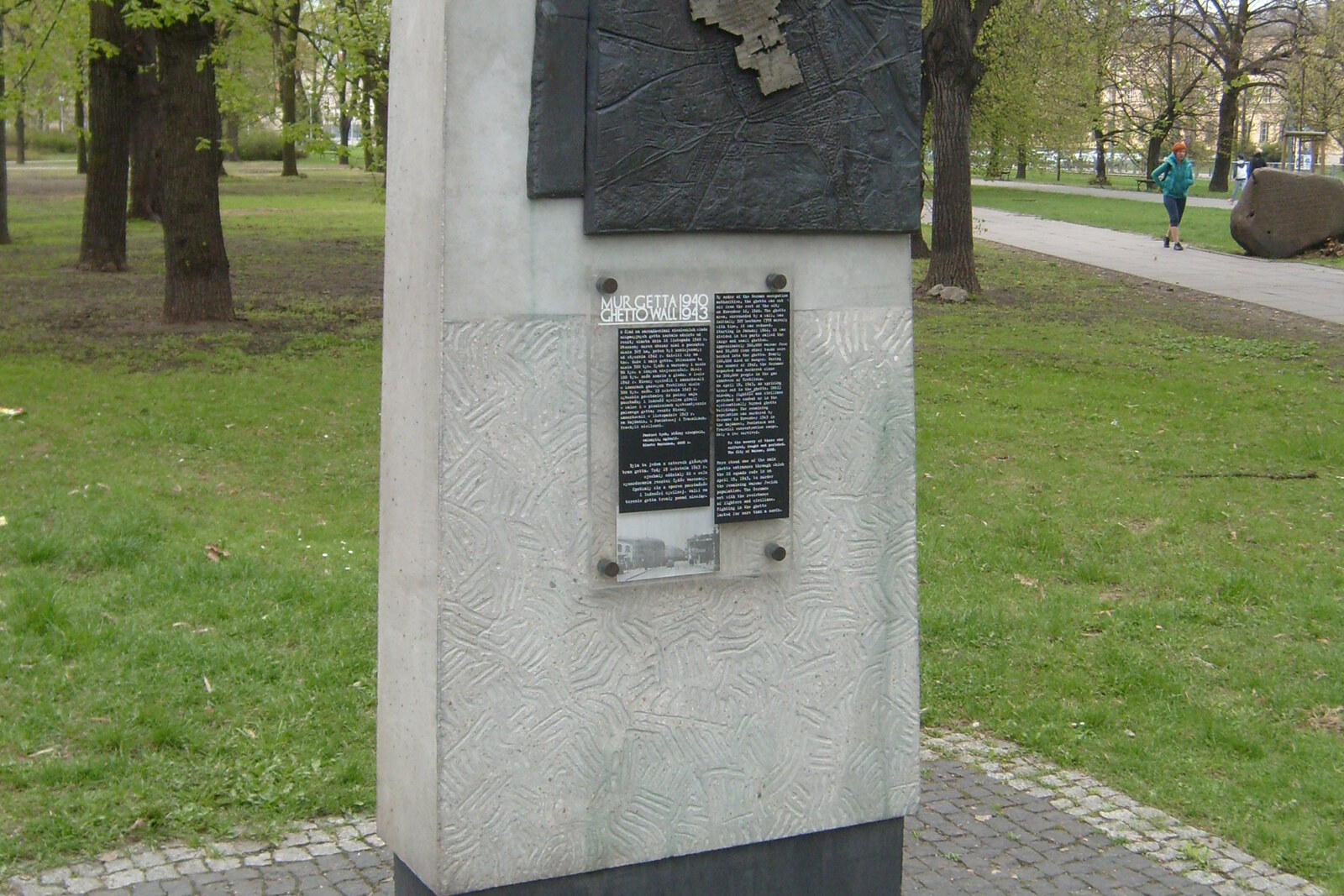
Look around first
What to notice
- Bronze strip in the pavement
- Memorial stele
- Edge of Krasiński Garden
The story of the place
In the autumn of nineteen forty, the engineer Adam Czerniaków, whom the German occupation administration had appointed to head the Warsaw Jewish Council, tried to secure the inclusion of Krasiński Garden in the ghetto then being created. The garden bore the surname of the Krasiński family, for whom the neighboring palace and park had once been built, but by the war it was already a public place. Czerniaków represented hundreds of thousands of people who were being herded into overcrowded blocks, and he asked that they be left at least one large green area.
He was refused. On November sixteenth, nineteen forty, the ghetto was closed; the garden remained outside, while inside there was almost no greenery. The boundary ran along its edge. On old Nalewki Street—the main commercial street of Jewish northern Warsaw, destroyed during the war—guarded gates were installed. Beyond them hung a German sign reading “typhus-infected zone”: the occupiers used the threat of disease to justify isolating people.
Through these gates, at dawn on April nineteenth, nineteen forty-three, a German column entered the ghetto. It was commanded by Ferdinand von Sammern-Frankenegg, the chief of police and the SS in the Warsaw district. Within three days, he was to capture the remaining residents and complete the liquidation of the district.
The people inside already knew what such an operation meant. The previous summer, the Germans had deported nearly three hundred thousand people from the ghetto and murdered them at the Treblinka extermination camp. Twenty-three-year-old Mordechai Anielewicz, commander of the Jewish Combat Organization, was preparing resistance to the next deportation. Several hundred fighters had mainly pistols, homemade grenades, and bottles containing incendiary mixture; there were few submachine guns and rifles. German units entered with machine guns, flamethrowers, armored vehicles, and a tank.
The column moved from the gates along Nalewki Street into the depths of the ghetto. The streets were empty: the residents had hidden in shelters prepared in advance. Several blocks farther on, Anielewicz's fighters attacked the soldiers from the upper floors. They threw grenades and bottles and fired from the windows. The German units withdrew beyond the ghetto boundary. That same day, Sammern-Frankenegg was relieved of command, and the operation was entrusted to Jürgen Stroop.
Stroop ordered houses set on fire one after another to force people out of the shelters. The resistance continued for nearly a month. On May eighth, Anielewicz and many of his comrades died in a surrounded bunker on Miła Street. On May sixteenth, Stroop declared the operation over; the Germans sent the captured residents to camps and to the Treblinka extermination camp, and destroyed the ghetto's buildings.
The old gates, the wall, and the former stretch of Nalewki Street are not here. After the war, the garden was expanded onto the territory of the destroyed blocks. In two thousand eight, the architectural historian Eleonora Bergman and the architect Tomasz Lec marked the vanished boundary with a bronze strip in the pavement and a memorial stele. The strip runs where, beside the garden, the road began along which the column entered the ghetto on the morning of April nineteenth.
Useful on site
The garden is open from April to October 5:00–24:00, from November to March 6:00–22:00; the marker by the sidewalk can be seen without entering the garden.
Checked: June 30, 2026. Check the official source before visiting.Do not stand on the line throughout the narration: let pedestrians pass, and look at it several times from both sides.