 Guide On Map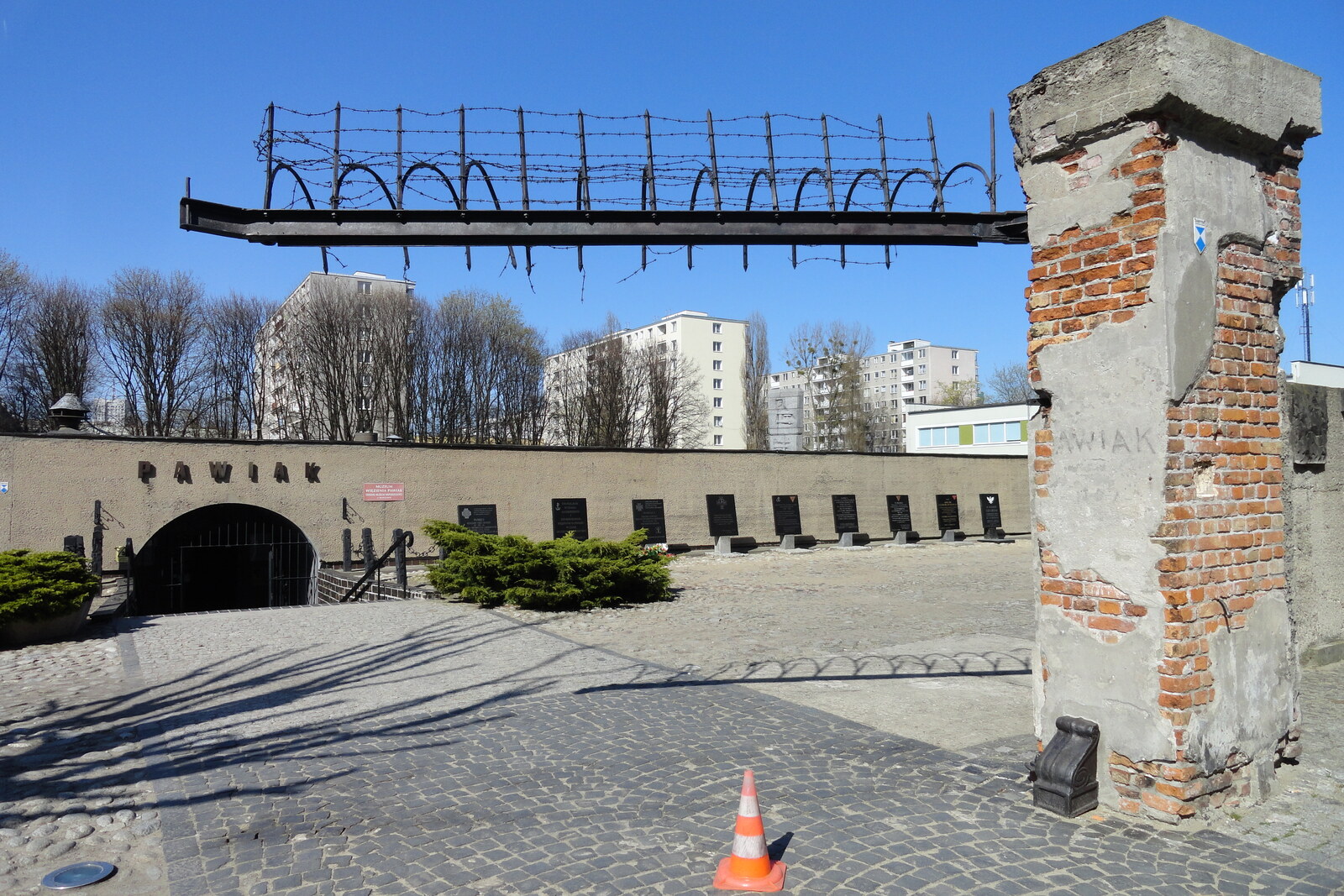
Look around first
What to notice
- Brick gate post
- Barbed wire
- Bronze elm
- Plaques with names
The story of the place
The brick post with barbed wire is a surviving part of the gate of the prison built between Dzielna Street and Pawia Street. The common name “Pawiak” came from Pawia Street—that is, Peahen Street. Criminal and political prisoners were held behind this gate, but one of the boldest escapes from here began when the guard itself handed the prisoners over to their rescuers.
On the night of April twenty-third to twenty-fourth, nineteen oh six, ten underground activists accused of attempted assassinations of representatives of the Russian administration faced the death penalty. Their comrade Jan Gorzechowski, known as Jur, commander of a combat group of the Polish Socialist Party, decided to get all ten out by posing as a legitimate escort.
First, Władysław Hempel, an underground activist who serviced Warsaw’s telephones in ordinary life, called the prison. He could imitate Russian officials and introduced himself as the head of the city police. Hempel ordered the ten prisoners to be prepared: supposedly, gendarmes would arrive for them in fifteen minutes and take them to Warsaw Citadel, where death sentences were carried out.
Then two carriages pulled up at Pawiak Prison. Gorzechowski put on the uniform of a gendarmerie captain and called himself Baron von Budberg. He spoke Russian with a noticeable accent, so he chose a German surname: among officers in Russian service, it was not expected to arouse suspicion. Six of his comrades posed as the escort. They learned drill commands, ordered uniforms, and brought a forged order bearing the seals of the police administration.
The duty officer checked the paper and ordered the prisoners released. The disguised underground activists roughly shoved them into the prison carriage: the prisoners did not yet know the plan and thought they were being taken to their execution. The guard opened the gate. Once away from Pawiak Prison, the escorts disarmed the driver and gave the freed prisoners civilian clothes, money, and passports. All ten people disappeared; throughout the entire operation, the rescuers did not have to fire a single shot.
During the German occupation, Pawiak Prison became the largest Gestapo political prison in occupied Poland. About one hundred thousand people passed through it. Approximately thirty-seven thousand were killed, died after interrogations, or died in detention; about sixty thousand were sent to camps. On August twenty-first, nineteen forty-four, German sappers blew up the prison blocks. Parts of the walls, the gate post, and an elm growing beside it remained above ground.
Already at the beginning of nineteen forty-five, relatives of the dead began nailing homemade plaques with names to its trunk. Thus the living tree became Pawiak Prison’s first memorial, even before the museum was established. In nineteen eighty-four, the elm died of disease. It was treated with protective compounds, its roots were reinforced with reinforced concrete, and it was preserved for another eleven years. Then the trunk was taken to Gliwice, and a bronze copy was cast from its shape.
On June eighth, two thousand five, the bronze elm was installed beside the surviving gate post. The plaques removed from the former tree were restored and returned to the grille surrounding the trunk. There is no living elm here any longer; the bronze preserves its form, and families still add to the bronze elm the names of Pawiak Prison prisoners.
Useful on site
The museum has been closed for renovations since 27 February 2026; the museum gives autumn 2026 as the estimated completion date, but this may change. Exterior elements are visible from the street; access inside the grounds depends on the work.
Checked: June 30, 2026. Check the official source before visiting.View the exterior elements from the accessible area and do not go beyond the fence. Check separately whether it is possible to enter the museum.