 Guide On Map
Vladimir’s Fortress and White-Stone Capital
From Golden Gate, across the cathedral hill, to the Nativity of the Theotokos Monastery
Guide On Map on your phone
Open the walk like a regular app
It takes about 10 seconds to install. No app store needed.
The whole path
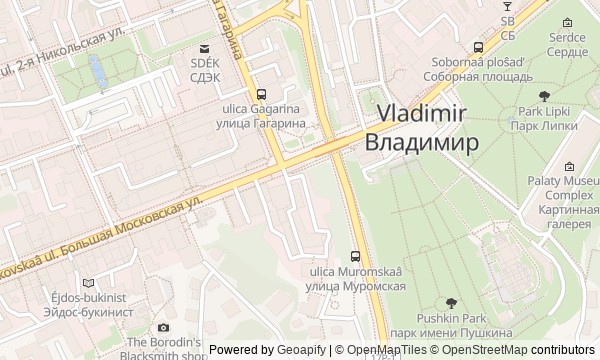
Route map
About the walk
You will cross ancient Vladimir from west to east: from Golden Gate and the earthen rampart to the princely hill, open Cathedral Square, white-stone cathedrals, and the monastery. At times the route follows the ridge, then drops toward the Klyazma, then returns to stone again.
This is not a walk through the “main sights” in general. It looks at how a princely capital built its defenses, churches, and memory—and what people later did with that inheritance. Why did shut gates fail to save the city? Whose surname outlived a garden and a boulevard? Why were ancient stairways dismantled for the sake of the right silhouette? And why does an emptied tomb matter more than a new cathedral?
The story will calmly separate chronicle testimony from later versions, and what survives from what has been restored. By the end, you will be able to read Vladimir in three materials: piled earth, white stone, and the empty places where power left its clearest mark.
Why this order
Golden Gate sets out the western line of the fortifications; Kozlov Rampart comes immediately after it because, beside the stone passage, it preserves the earthen section of the same defense. From the ridge, the route moves to Spassky Hill, where it becomes clear why strong gates did not decide the assault—the wall was bypassed near the neighboring princely court. From the breach, the walk passes through the former New Town to Cathedral Square, retracing the movement inward through Pecherny Gorod. The open square prepares you for Assumption Cathedral: first comes the dispute over the space before the church, then what happened inside it. From the cathedral, the route reaches the southern edge and Pushkin Park, where the direction toward the Klyazma remains after the rampart was leveled. Returning from the view to the Cathedral of Saint Demetrius sets the vanished earthen fortification beside a white-stone church that was also stripped of its ancient parts. Finally, the short walk to the monastery completes the theme of power through a transferred shrine: the route ends where capital status departed not through destruction, but by imperial order.
Those who want to understand princely Vladimir through its surviving traces Lovers of medieval history without heroic rhetoric Those interested in restoration mistakes and shifts in urban memory
Those looking for an easy overview walk without military and church history Those who care more about interiors and museum collections than urban terrain Those who dislike returning to a nearby stretch of the route after a viewpoint
Before you go
Expect to hear part of the story outdoors: the museum inside Golden Gate is closed for restoration, and access to the cathedrals depends on museum hours and services. The Cathedral of Saint Demetrius does not admit visitors on Wednesdays; on Sundays, museum visits to Assumption Cathedral begin later than usual. At active religious sites, choose clothing that covers your shoulders and knees, do not disturb services, and check photography rules on site. There are slopes along the rampart and near the park. Observe the barriers by the viewing platform: problems with the ground and retaining wall have been noted there. The exhibition in the water tower is closed, but you do not need to enter it to complete the route.
When to go
For an unhurried visit, choose a day when the Cathedral of Saint Demetrius is open and start after morning services. With interiors, the walk takes about three hours or a little longer; the outdoor version can be done in about two and a quarter hours. Allow extra time for the frescoes in Assumption Cathedral and a close look at the carving of the Cathedral of Saint Demetrius.
Backup plan
If you cannot get inside the cathedrals, do not shorten the route: the main connections can be read through the facades, the buildings’ positions, and the surrounding terrain. At Assumption Cathedral, focus on scale and silhouette; at the Cathedral of Saint Demetrius, focus on the exterior carving. View the closed Golden Gate from a safe point outside the roadway. If access to the edge of the viewing platform is blocked, stay on the permitted upper path: the Klyazma floodplain and the height of the cathedral hill are visible from there as well. If a service is underway at the monastery, turn your attention to the grounds, the new cathedral, and the memorial signs outside.
Route conditions
Surface. Paved — 2.8 km; unpaved — 8 m (data covers 96% of the route)
Stairs. Flights: 6, 32 m in total
Access. Wheelchair — no; stroller — limited (stairs)
Facilities. Toilets — 6
Elevation. Ascent — 34 m; descent — 44 m
OpenStreetMap extract of July 7, 2026: database data, not a check on the ground. Data © OpenStreetMap contributors, ODbL licence
Walk plan
Open in maps ↗- 1
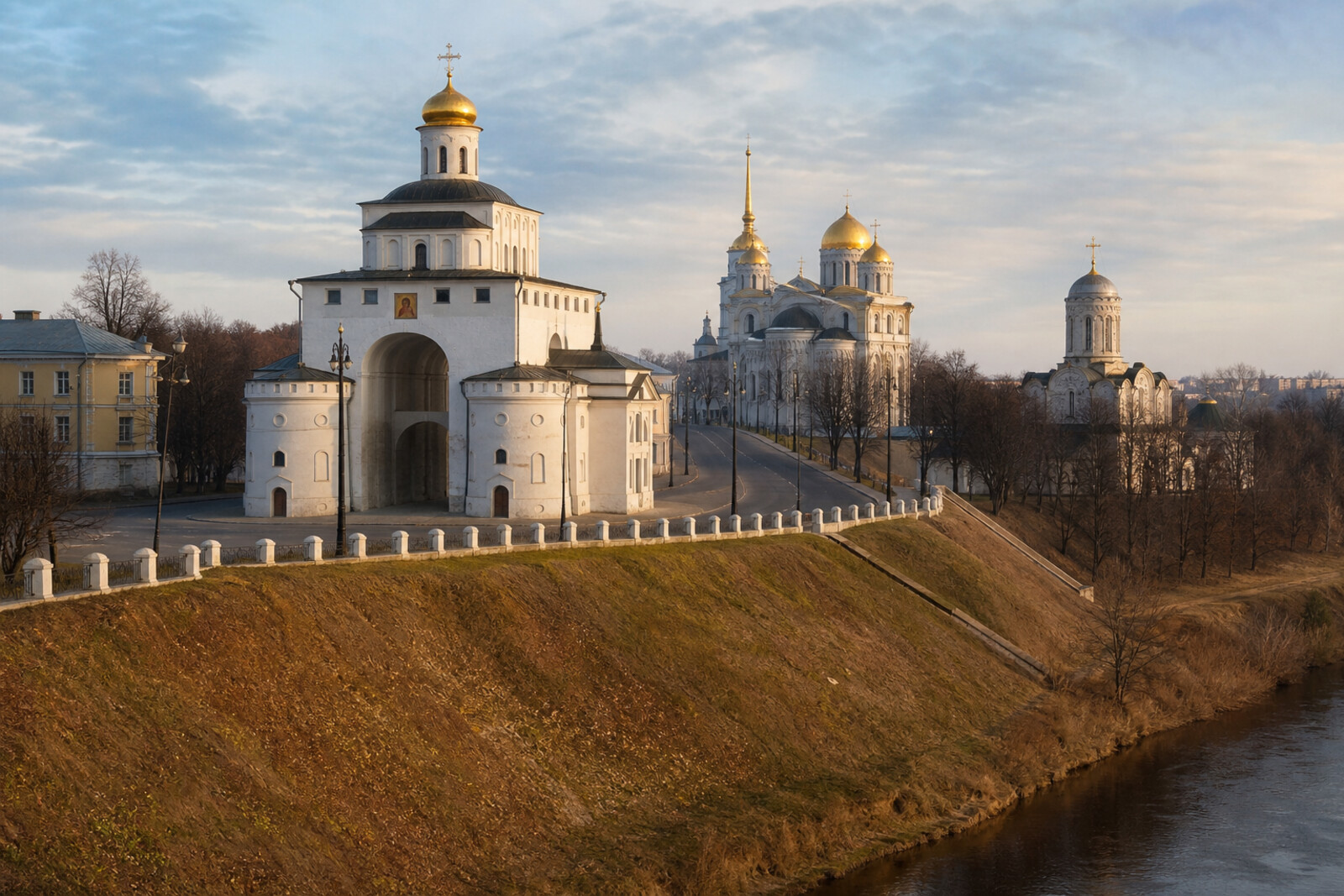
Golden Gate
Here, the first question of the route will be decided: what the city’s main gate could and could not protect. - 2
Kozlov Rampart
The embankment links medieval defenses with gardens, a paid boulevard, and a surname that remained on the map. - 3
Spassky Hill
This stop will explain why the city’s fate was decided not at the stone passageway, but at the neighboring wooden wall. - 4
Cathedral Square
The open space will help you see how prayer services and military formations proved stronger than the plan for a city garden. - 5
Assumption Cathedral
Here, the siege will become a family and human story, and the surviving walls will become the setting for its final episode. - 6
Pushkin Park and the View over the Klyazma
The viewing platform links today’s park with the rampart that was removed for the sake of one direction—toward the Klyazma. - 7
Cathedral of Saint Demetrius
The cathedral shows the cost of restoration, when restoring a desired silhouette destroys ancient parts of a building. - 8
Nativity of the Theotokos Monastery
The finale will show what remained in Vladimir after its chief sacred relic was moved to St Petersburg.
Route features
Everything you need stays in the browser
Progress, saves and your trip plan are stored on this device.
Add Guide On Map to your home screen so the walk opens outside the browser.
How we handle sources, maps and corrections: our editorial standards