 Guide On Map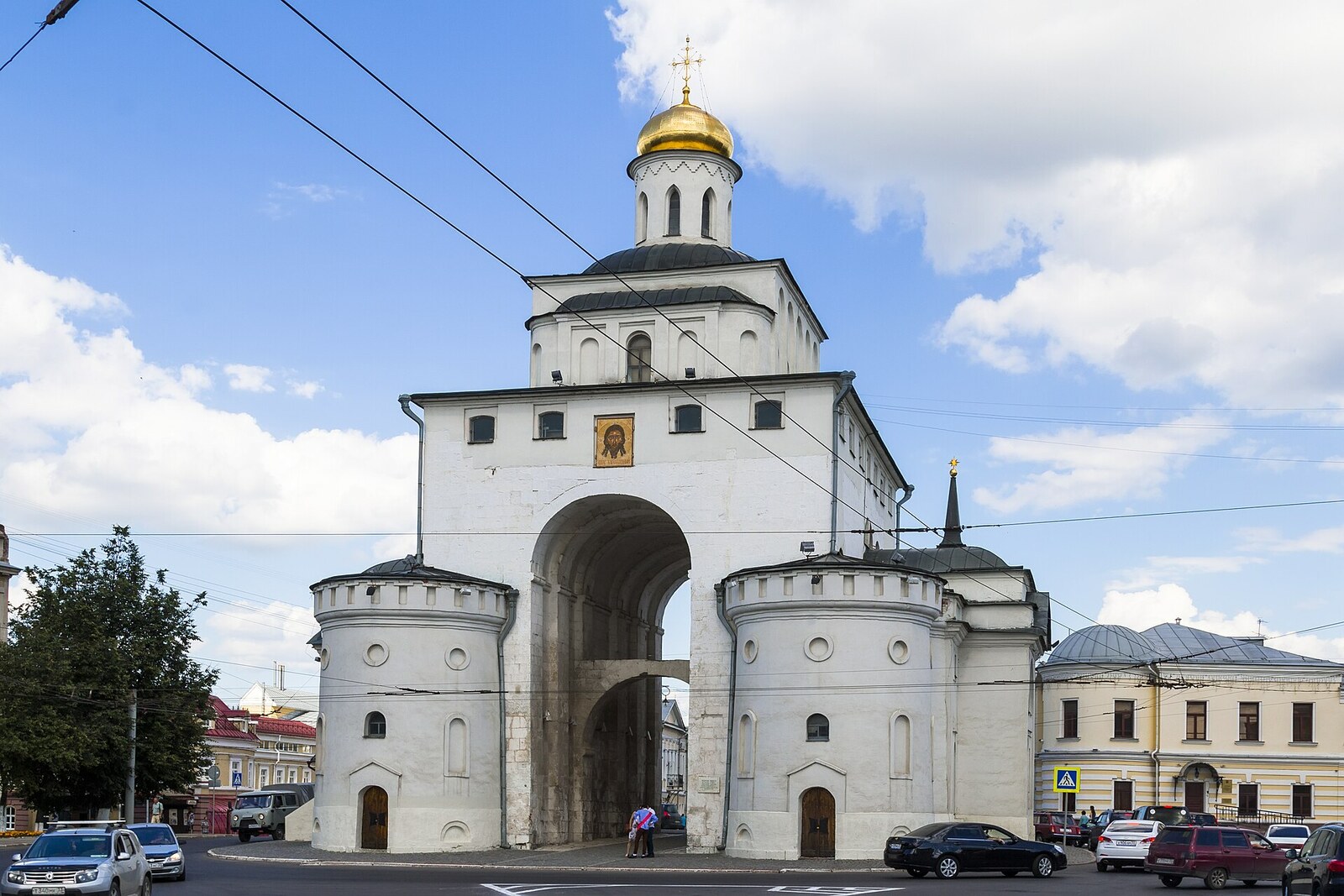
Look around first
What to notice
- White-stone tower
- Arched passageway
- Gate church
- Road on either side of the tower
The story of the place
The white-stone tower with its arched passageway and church above has survived from the old city gate. Earthen ramparts once extended along its sides; now a road runs in their place, and the tower seems like a separate island. The wooden door leaves and the sheets of gilded copper that covered them disappeared long ago, but the stone supports of the passageway remain. On the inner staircase, you can see the old graffito “Gyurgich” and a scratched cross; it is unknown who exactly made the inscription.
Today, the white-stone tower stands like an island in the middle of the street, with the road passing around it on both sides. In the twelfth century, there was no such detour. As Prince Andrei Bogolyubsky of Vladimir turned Vladimir into the principal city of his principality, he surrounded it with earthen ramparts topped with wooden walls. In the western line of fortifications, he ordered the main entrance to be built: a tall stone tower with a fighting platform and a church above the passageway. Its oak door leaves were clad in sheets of gilded copper. The gate received its name from them.
On February third, twelve thirty-eight, these door leaves were closed. Grand Prince Yuri Vsevolodovich left to gather an army, leaving his sons Vsevolod and Mstislav to defend Vladimir. The garrison was commanded by Pyotr Oslyadyukovich, a voevoda—that is, the city’s military leader.
By then, their younger brother Vladimir Yuryevich had already been captured. He ruled in Moscow and was responsible for its defense. The Mongols took the city, killed its defenders, but kept the young prince alive and brought him to his father’s capital.
At the Golden Gate, the two sides exchanged arrows. The attackers then asked for the shooting to stop, rode closer, and asked whether Grand Prince Yuri was in the city. After that, they showed the captive. The chronicler recorded his appearance: Vladimir was exhausted by captivity. Vsevolod and Mstislav stood on the platform above the gate and recognized their brother. Along with them, the retainers and townspeople saw him.
The chronicle does not name the terms for Vladimir’s release. The brothers decided to open the gate and go out to fight. They told the retinue that they would rather die before the Golden Gate, and asked the voevoda to lead the men outside. Pyotr Oslyadyukovich forbade the sortie. The garrison remained behind the door leaves.
Mongol detachments went around Vladimir, inspected the fortifications, and set up camp within sight of the Golden Gate. Several days later, they brought up siege engines. On February seventh, the assault began in several places at once. The stone passageway could not be taken: the attackers entered through the wooden wall farther south, near the Church of the Saviour, and also from the sides of the Lybed and the Klyazma. By noon, the outer part of the city had been captured. Vsevolod, Mstislav, and Voevoda Pyotr died in the fall of Vladimir. The captive Vladimir did not survive the siege either. Later chronicles report that he was killed before the Golden Gate; the early detailed account confirms the scene with the captive at the gate but does not describe the execution itself.
The earthen ramparts on either side of the tower were later razed, the gilded door leaves disappeared, but the white-stone supports of the passageway remained. An old graffito has survived on the inner staircase: “Gyurgich,” meaning “Yuryevich,” with a scratched cross beside it. The inscription is associated with the captive Vladimir, although this is only a hypothesis: neither his name nor a date appears on the stone. If this interpretation is correct, the person who stood above the closed gate left one word from the scene he witnessed here: son of Yuri.
Useful on site
Accessible from outside at all times; the museum inside is closed for restoration, and an opening date has not been announced.
Checked: June 24, 2026. Check the official source before visiting.View the gate from the sidewalk and do not step into the roadway. The interior exhibition is closed for restoration.