 Guide On Map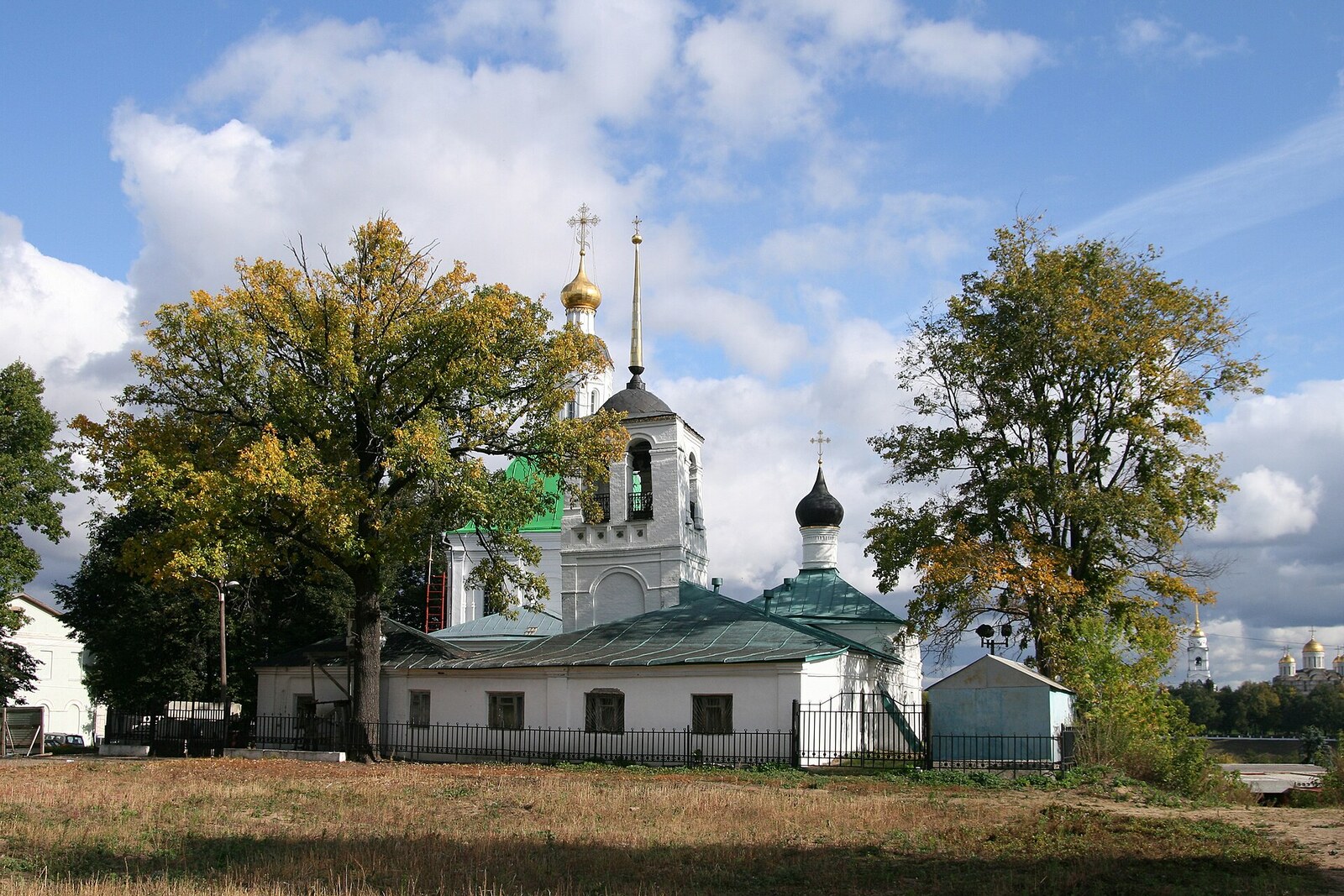
Look around first
What to notice
- The brick Church of the Saviour
- White stone in the lower part of the walls
- The slope of the hill
The story of the place
The brick Church of the Saviour stands on the slope of the hill, and ancient white stone survives at the base of its walls. The present church was erected on the foundation of the former white-stone church, which perished in a fire in seventeen seventy-eight. The edge of the fortified princely court once ran here. Beneath the church, archaeologists found old mortar and glazed tiles from its floor.
The Golden Gate remained closed. But Batu’s detachments, who had come to take Vladimir, entered the city beside them—through the wall near the Church of the Saviour.
This church was built by Prince Andrei Bogolyubsky, who sought to make Vladimir his principal residence. In eleven sixty-four, he completed the city’s western expansion: he enclosed a new district with earthen ramparts topped by wooden walls, created ceremonial gates, and beyond them laid out his own court with a white-stone church. The prince already had a court inherited from his father, but Andrei built a new one for himself. The Church of the Saviour stood inside the fortifications, almost at their southwestern edge. The hill took its name from the church.
Seventy-four years later, the location of the princely court determined the course of the assault. On the morning of February seventh, twelve thirty-eight, Mongol detachments attacked all the gates of the western district simultaneously, then called New Town. The garrison held the entrances, so the attackers began crossing the walls. Near the Church of the Saviour, they made a primyot—the name for an embankment or heap against a fortification that could be used to climb up to a wooden wall.
The chronicler identified the breach with utmost precision: from the Golden Gate, by the Holy Saviour. The attackers neither opened the gates themselves nor took them by storm. They were inside nearby. By noon, New Town had been captured, and Princes Vsevolod and Mstislav, with the surviving defenders, withdrew to Pecherny Gorod—the old central fortress of Vladimir. The closed leaves of the Golden Gate remained behind them.
The ancient wall is no longer here. Nor have Andrei Bogolyubsky’s court and its white-stone church survived. The church perished in a fire in seventeen seventy-eight. Eighteen years later, the present brick church was erected on its foundation; in the lower parts of its walls, the builders used ancient white stone. Later, archaeologists found remains of old mortar and glazed tiles from the princely floor beneath the building.
The exact line by which Batu’s detachments climbed over the wall can no longer be traced on the surface. The chronicle’s reference remains the same: by the Holy Saviour—near the church whose name the hill now bears.
Useful on site
The outdoor grounds are freely accessible; regular tourist entry hours for active churches have not been published.
Checked: June 24, 2026. Check the official source before visiting.Do not mistake the present church for a twelfth-century building: the ancient white-stone remains lie beneath the later structure.