 Guide On Map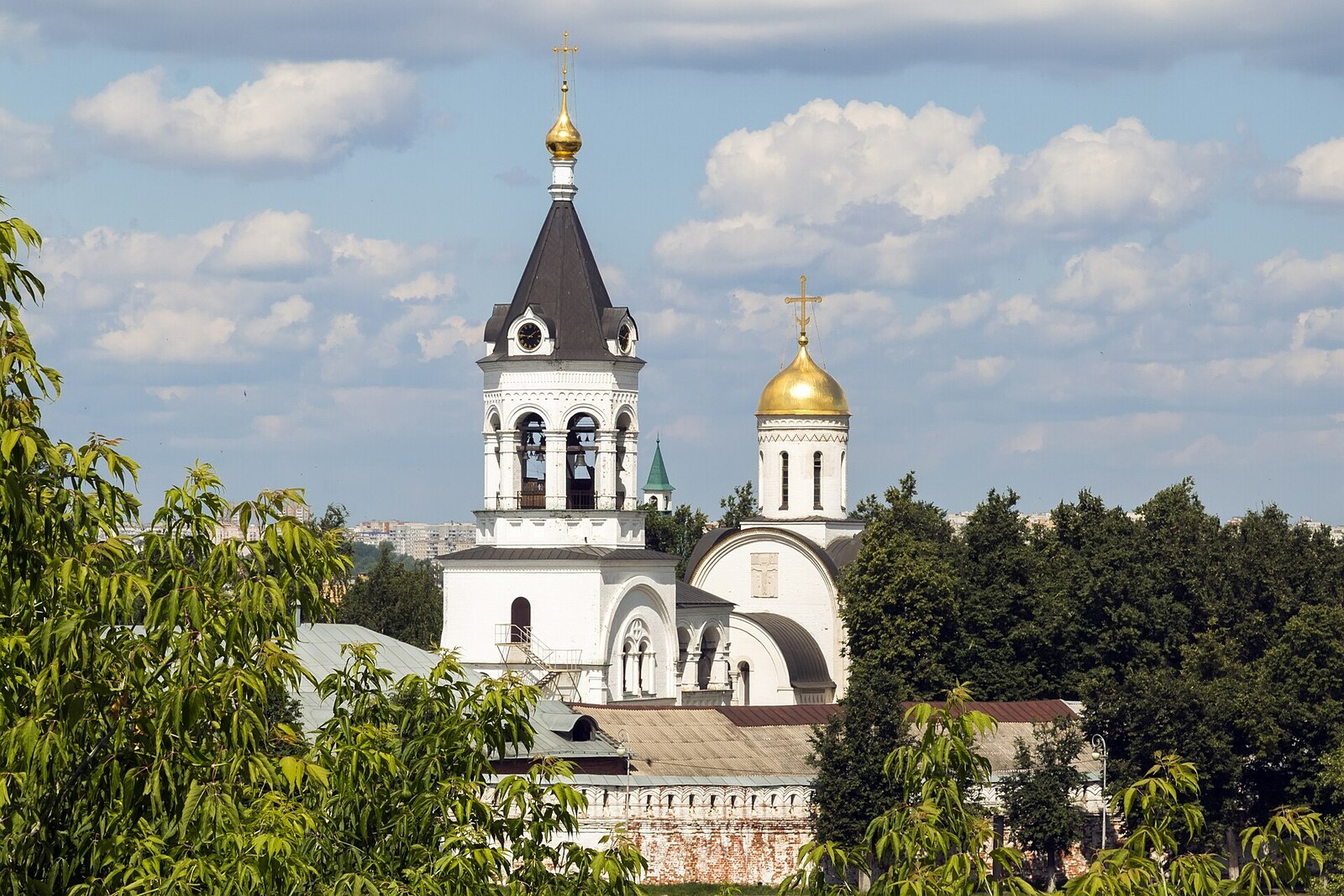
Look around first
What to notice
- White monastery walls
- Main cathedral
- Eastern gates
- Monastery buildings
The story of the place
The cathedral visible behind the white walls appeared in two thousand four on the site of an ancient church destroyed in Soviet times. The new building does not literally repeat the former one, and different layers of time now meet in a single monastery courtyard. The eastern opening in the wall was bricked up long ago, while the buildings of the active monastery stand nearby.
Behind the white walls is an active male monastery. Monastic services are held daily in the main cathedral. The cathedral is dedicated to the Nativity of the Most Holy Theotokos, the church feast celebrating the birth of the Virgin Mary; the monastery took its name from it. The first stone church here was founded in the eleven nineties by Vsevolod the Big Nest, prince of Vladimir. He set aside a site for the monastery beside his residence and endowed the brethren with villages, lands, rivers, and lakes. The monastery became the city's principal monastery and the residence of metropolitans.
In November, twelve sixty-three, the body of Aleksandr Nevsky, Grand Prince of Vladimir, was brought here. His right to rule as prince depended on recognition by the khan of the Horde, so Aleksandr personally traveled to Khan Berke and spent the winter there. The early Life reports that the prince tried to save his people from the misfortune threatening them; the sources are silent about the substance of the negotiations. On the way back, Aleksandr fell seriously ill. In Gorodets, he received the great monastic tonsure under the name Alexy and died that same night. His body was taken to the capital, Vladimir, and placed beneath the choir gallery of the Cathedral of the Nativity of the Theotokos.
Church tradition, recorded in the Life, links a miracle to the funeral. Metropolitan Kirill, who conducted the burial, wished to place a spiritual letter—a monastic farewell document—in the dead man's hand. According to the account, Aleksandr opened his palm himself and accepted the scroll. This is evidence of the faith of the Life's compilers, not a verifiable eyewitness record.
According to researchers, the Life itself was composed about twenty years later in the circle around Metropolitan Kirill, probably in this monastery. The monks wrote beside the tomb of a man they knew as a grand prince but buried as the schema-monk Alexy. His local veneration arose here; in fifteen forty-seven, the church canonized Aleksandr Nevsky for veneration throughout Russia.
Four and a half centuries later, Emperor Pyotr I decided to take the monastery's chief sacred relic. He was building a new capital on the Neva and wanted to give it a patron whose name was already associated with victory over the Swedes. On May twenty-ninth, seventeen twenty-three, Pyotr ordered Aleksandr's relics transferred from Vladimir to the Aleksandr Nevsky Monastery in St Petersburg.
For the journey, a reliquary was made beneath a velvet canopy. Ninety-two people lifted it from the ground, and no fewer than one hundred fifty were to carry it. On August eleventh, the procession left these walls, but it was late for the date appointed by Pyotr. The emperor wanted the relics brought into the new capital on the anniversary of the Treaty of Nystad, which ended the war with Sweden. The reliquary was therefore left in Shlisselburg for almost a year, to await the following August thirtieth.
During the wait, Aleksandr's image itself was changed. He had died as the monk Alexy and had previously been depicted in monastic robes. A Holy Synod decree of seventeen twenty-four forbade this image: the saint was to be depicted in princely clothing. When the required date arrived, Pyotr met the reliquary at the mouth of the Izhora, placed it on his galley, seated dignitaries at the oars, and took the helm himself. The relics were brought into the new church, and Aleksandr Nevsky became the heavenly patron of St Petersburg.
In Vladimir's cathedral, a grille in the shape of a coffin was placed where the empty tomb stood. The eastern monastery gates through which the relics had been carried out were bricked up. The ancient cathedral itself was demolished in nineteen thirty. The present cathedral was consecrated on the same site in two thousand four, and its builders did not try to reproduce the former building exactly. Aleksandr Nevsky's principal relics remained in St Petersburg; the Vladimir monastery now keeps two small particles.
Useful on site
Daily services are held at the monastery; the museum is listed as open daily, and tours run from 9:00 to 17:00. General fixed hours for unrestricted tourist entry have not been published.
Checked: June 24, 2026. Check the official source before visiting.This is an active monastery: observe the accepted clothing requirements, speak quietly, and do not film services without permission.