 Guide On Map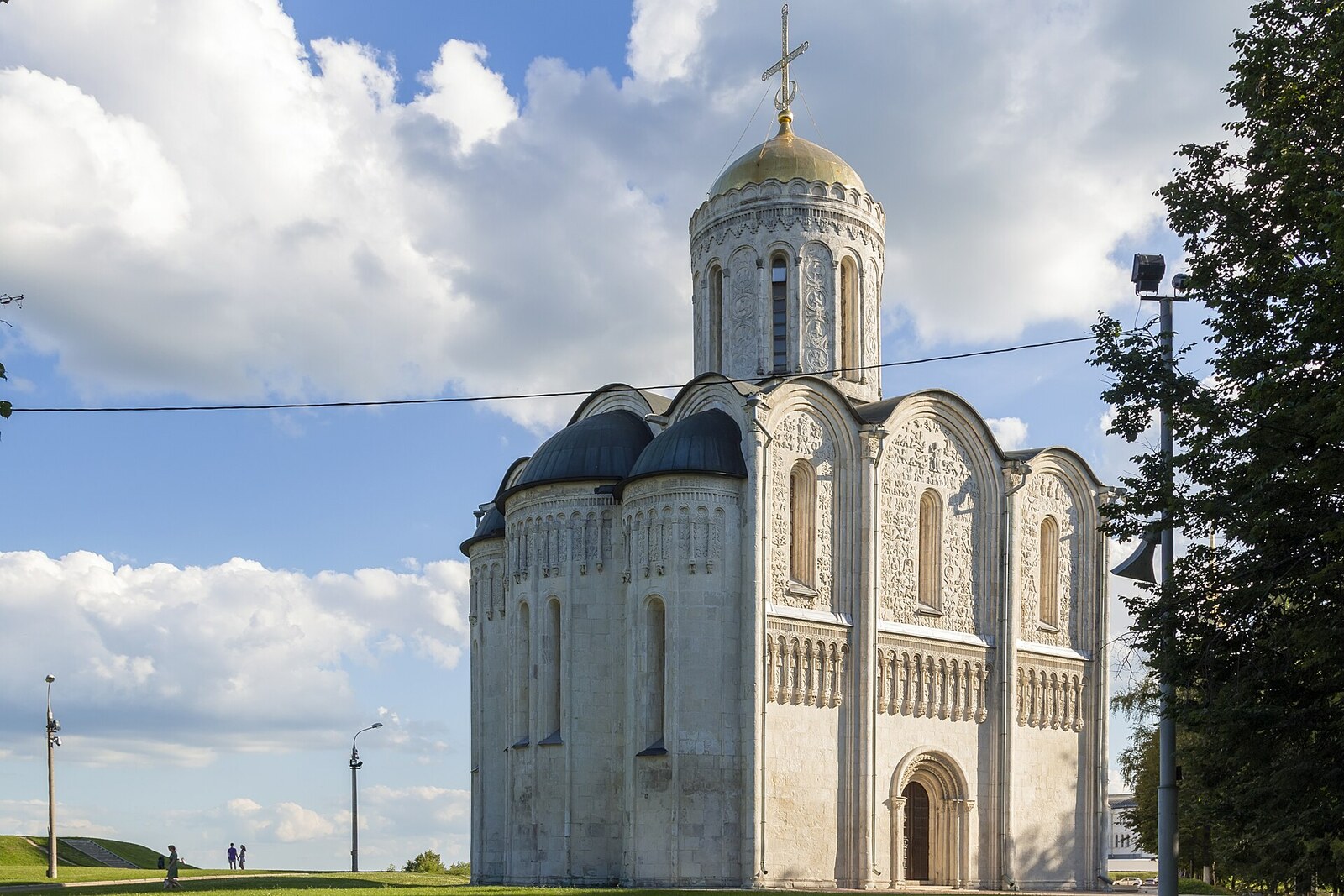
Look around first
What to notice
- White-stone facades
- Carved stones
- Dome
- Metal ties beneath the drum
The story of the place
The white-stone facades of the Cathedral of Saint Demetrius are covered with carvings on three sides, with the dome rising above them. Inside, metal ties are visible beneath its drum: in the twentieth century, they were used to hold the structure as it began to deform. There is now a museum exhibition here, and services are held only several times a year.
At the end of the twelfth century, Vsevolod Yuryevich, Grand Prince of Vladimir, built a church on his court—within the palace residence—for his family and closest circle. The prince's baptismal name was Dmitry. Dmitry of Thessaloniki, an early Christian martyr from Thessaloniki, was considered his heavenly patron, hence the cathedral's name.
The chronicle reports that Vsevolod placed here a “tomb board” brought from Thessaloniki—a large icon of the saint—and a silver reliquary casket with a “shirt,” a piece of fabric venerated as a relic of Dmitry. Ordinary townspeople were not invited to these services: the cathedral served the princely court. Later, white-stone galleries and stair towers adjoined the building on three sides. The stairs led up to the choir lofts—a platform above the western part of the church, intended for noble participants in worship.
A freestanding section appeared by the decision of another ruler. In eighteen thirty-four, Emperor Nikolai I inspected the cathedral and ordered that its “original appearance” be restored. Evgraf Petrov, the provincial architect responsible for state construction, prepared the drawings and cost estimate. His commission knew that the galleries and towers had been built in ancient times, but the masonry of the additions was not bonded to the masonry of the main building. This proved enough to deem them later additions and remove them in order to carry out the emperor's order.
The stonework was undertaken by Isidor Medvedkin, a peasant carver, with a crew of craftsmen. Their instructions required them to preserve every surviving relief: the blocks were carefully lowered down planks rather than thrown down. The craftsmen preserved one hundred seventy-one carved stones from the dismantled parts, moved them to the facades, and carved about fifty new reliefs in place of those that had been lost. The commissioners achieved the desired silhouette, but destroyed the ancient stairs and covered galleries that people had actually used.
After the demolition, the main structure lost its additional supports and began to deform. In the twentieth century, engineers had to secure the structures with metal and reinforced concrete; some of the ties are visible inside beneath the dome drum. There is now a museum exhibition here, and services are held only several times a year. On the northern, western, and southern facades, carvings from the end of the twelfth century stand alongside stones from the dismantled towers and inserts carved by Medvedkin and his companions after Nikolai I's order.
Useful on site
11:00–19:00, Wednesday closed; last entry at 18:30. Adult ticket — 300 rubles.
Checked: June 24, 2026. Check the official source before visiting.The main part of the story—the carved facades—is accessible from outside. A phone camera is useful for details; on Wednesdays, the interior is closed.