 Guide On Map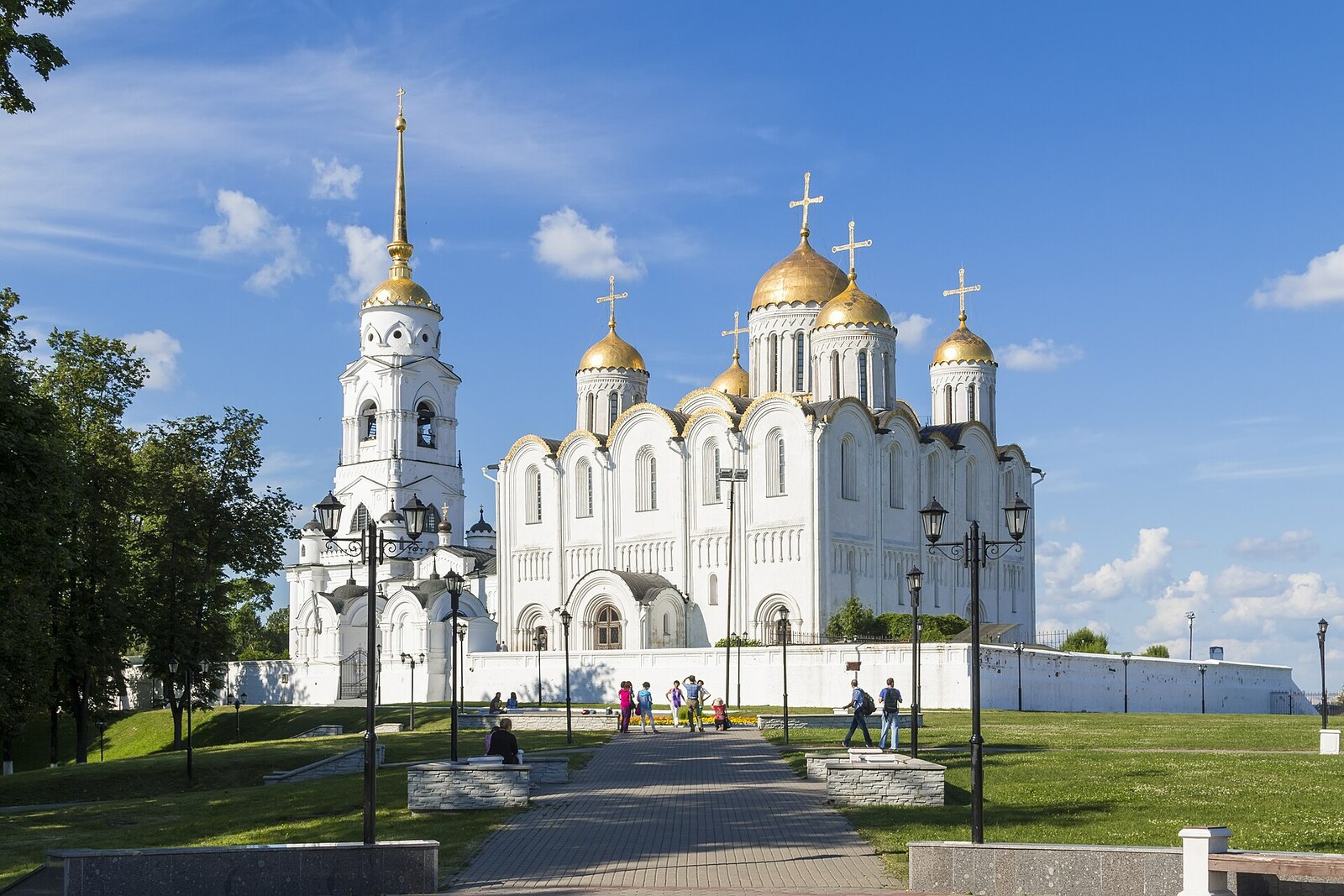
Look around first
What to notice
- White-stone walls
- Western entrance
- Upper choirs
- Princely tombs
The story of the place
The white-stone walls of the Assumption Cathedral conceal the upper level above the western entrance—the choirs, which in ancient times were called polati. This part of the building belongs to its old stone core and has survived to the present day. Inside are princely and episcopal tombs; services here stand alongside the museum’s ancient paintings.
“Dormition” is the church term for the death of the Mother of God, likened to falling asleep before resurrection. The cathedral was dedicated to this event. Prince Andrei Bogolyubsky ordered it built in the years eleven fifty-eight to eleven sixty as Vladimir’s principal church. It is called a cathedral because a bishop serves here. Services are still held inside it; at the same time, the cathedral remains a museum with ancient paintings and princely tombs.
After the fall of New Town, the survivors retreated to Pecherny Gorod, where the Assumption Cathedral stood. Agafya, the wife of Yuri Vsevolodovich, Prince of Vladimir, entered here. Yuri himself was outside Vladimir, gathering an army to come to the city’s aid. In the cathedral with Agafya were her daughter Feodora, her daughters-in-law, grandchildren, other princesses, boyar women, and many townspeople. Almost the entire family of the prince on whom the continuation of the dynasty depended gathered in one building.
The people were led by Mitrofan, Bishop of Vladimir and rector of the city’s principal church. They climbed up to the polati—the upper galleries now called choirs—and locked themselves in there. One chronicle account adds that Mitrofan tonsured as monks those who wished it. Tonsure meant renouncing one’s former status and property: princesses, boyars, and townspeople prepared to die without the distinctions that had structured their former lives.
On the seventh of February, twelve thirty-eight, Mongol warriors burst into this part of the city. They hacked apart the cathedral doors, piled wood around the walls, and set it alight. The people locked in upstairs suffocated in the smoke. Mitrofan, Agafya, her daughter, her daughters-in-law, grandchildren, and the other people who had taken shelter there died. The attackers then removed the precious cover from the principal icon, took the church vessels, chopped up some of the icons, and plundered the books.
The stone walls withstood the fire. In spring, after the army had left, Yaroslav Vsevolodovich, the new Prince of Vladimir, ordered the remains of those who had died to be found. Mitrofan and the members of the princely family were buried here.
The cathedral’s ancient core, together with the choirs, has survived. Inside are still the tombs of Mitrofan and Agafya’s family, and above the western entrance remains the upper space where they locked themselves in before the fire.
Useful on site
Monday–Saturday 10:00–17:00, Sunday 11:00–17:00; last entry at 16:30. Adult ticket — 400 rubles.
Checked: June 24, 2026. Check the official source before visiting.Keep quiet inside and take services into account. Do not use a flash when viewing the frescoes, and follow local photography rules.