 Guide On Map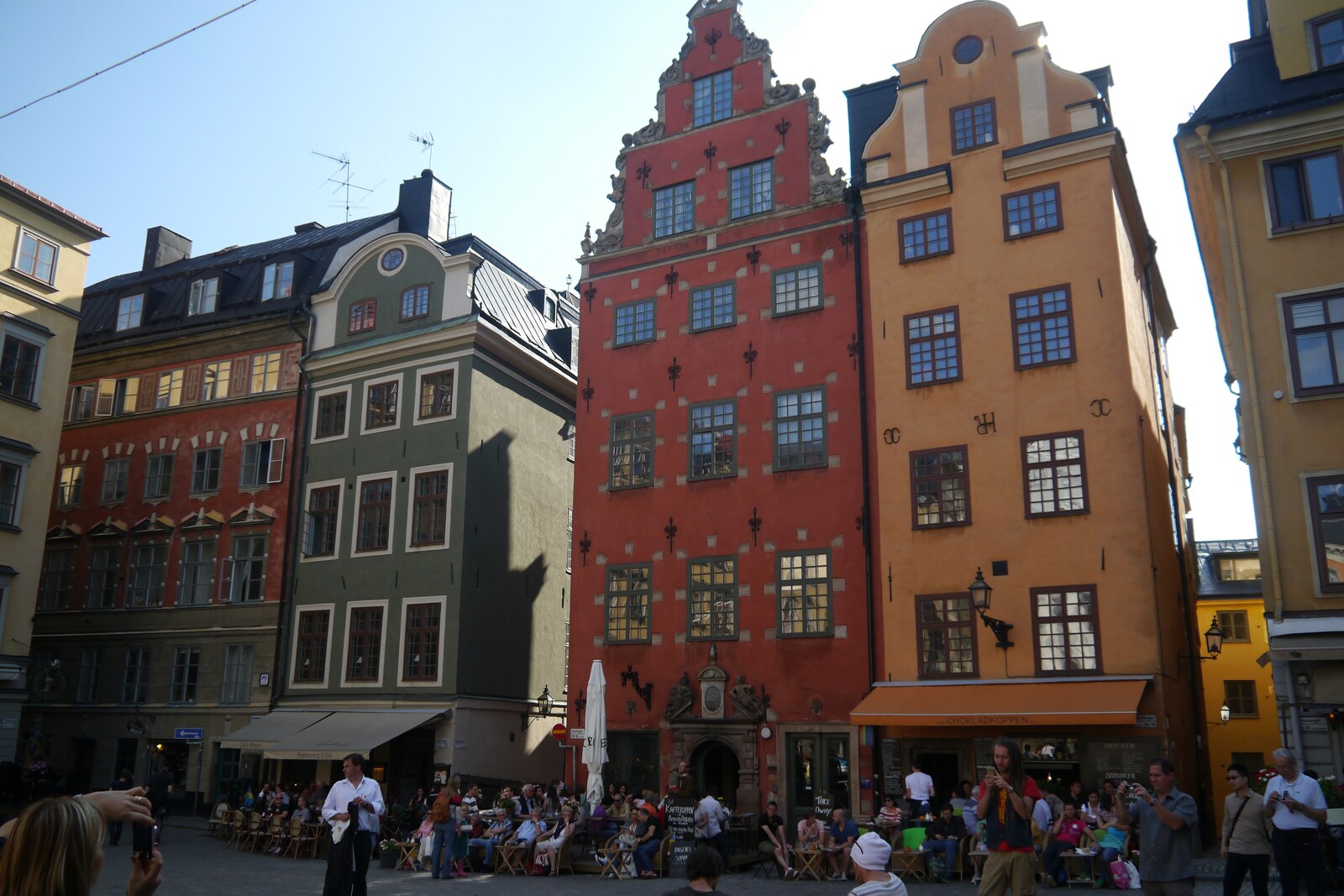
Look around first
What to notice
- The well
- Börshuset
- The square’s open space
The story of the place
At Stortorget, the well stands in the middle of the open space, and the pale façade of Börshuset is visible on one side. It occupies the site of the old town hall; the Nobel Prize Museum now operates inside. The town hall was dismantled back in the eighteenth century, but the square in front of it has remained undeveloped.
Stortorget means Big Square in Swedish. In medieval Stockholm, the name was accurate: food was traded here, and the town hall stood on the site of today’s pale Börshuset. The burgomasters and the city council met there, heard legal disputes, and held prisoners. That is why the public killing was carried out here, in front of the building of city government and in the square where townspeople came to attend to their ordinary business.
In the autumn of fifteen twenty, Stockholm was under siege by Christian II, the Danish king, who sought the Swedish crown and the restoration of the Kalmar Union—a union of Denmark, Norway, and Sweden under one monarch. The defense was led by Kristina Gyllenstierna, the widow of Sten Sture the Younger, the dead ruler of Sweden. She was about twenty-five years old; she had recently been widowed, was expecting a child, and was responsible for several young children. After seven months of resistance, Kristina agreed to open the gates: Christian promised her, the city’s defenders, and their supporters amnesty and complete forgetting of their former enmity in writing.
On November fourth, Christian was crowned in Storkyrkan, after which a feast continued for three days in Tre Kronor Castle, which stood on the site of today’s Royal Palace. Then the doors of the banquet hall were locked. Gustav Trolle, the archbishop whom Sten Sture’s supporters had deprived of his see and whose fortress they had destroyed, demanded compensation and punishment for those responsible. They included Kristina, Swedish nobles, and Stockholm’s leaders.
Christian’s promise protected them from revenge for resisting the king. Trolle called the destruction of his fortress a crime against the Church and accused his opponents of heresy. An ecclesiastical court declared that the royal amnesty did not extend to such an accusation. The sources do not allow us to establish who exactly conceived the mass killing—Christian, Trolle, or the royal advisers. One thing is known: those condemned were led out of the castle to Stortorget, and about eighty people were executed here on November eighth and ninth.
The first to be beheaded were two bishops, followed by noblemen. After them came the turn of three Stockholm burgomasters and fourteen members of the city council—people who had previously met in the town hall by this very square and had supported Trolle’s removal. Servants, craftsmen, and townspeople also died. Those executed included Kristina’s brother Eskil Nilsson and the castle steward Olof Björnsson. Her husband’s remains were dug out of the grave and burned together with the bodies of those killed. Kristina herself was not executed: she was first held captive in Stockholm, then taken to Denmark. She was not released until fifteen twenty-four.
Christian hoped to eliminate his opponents and retain the Swedish crown. Among those who escaped the invitation to the feast was the nobleman Gustav Eriksson Vasa, who intended to drive out the Danish king. His father, Erik Johansson, was executed at Stortorget. Gustav used the killings to gather supporters, led an uprising, and was elected king in fifteen twenty-three. Christian lost Sweden, and the Kalmar Union broke apart.
The scaffold has long been gone from the square. The well in the center stands approximately where the executions took place, and the medieval town hall was demolished in the eighteenth century. Börshuset, with the Nobel Prize Museum, now stands in its place. Nothing remains of the building from which the Stockholm burgomasters and councilors were led out; only the open square in front of it has survived.
Useful on site
Open city square, accessible at all times; crowd levels vary greatly by time of day and season.
Checked: June 17, 2026. Check the official source before visiting.This is an open urban space, but at busy times it is more convenient to listen to the story at the edge of the square, without blocking passageways and entrances.