 Guide On Map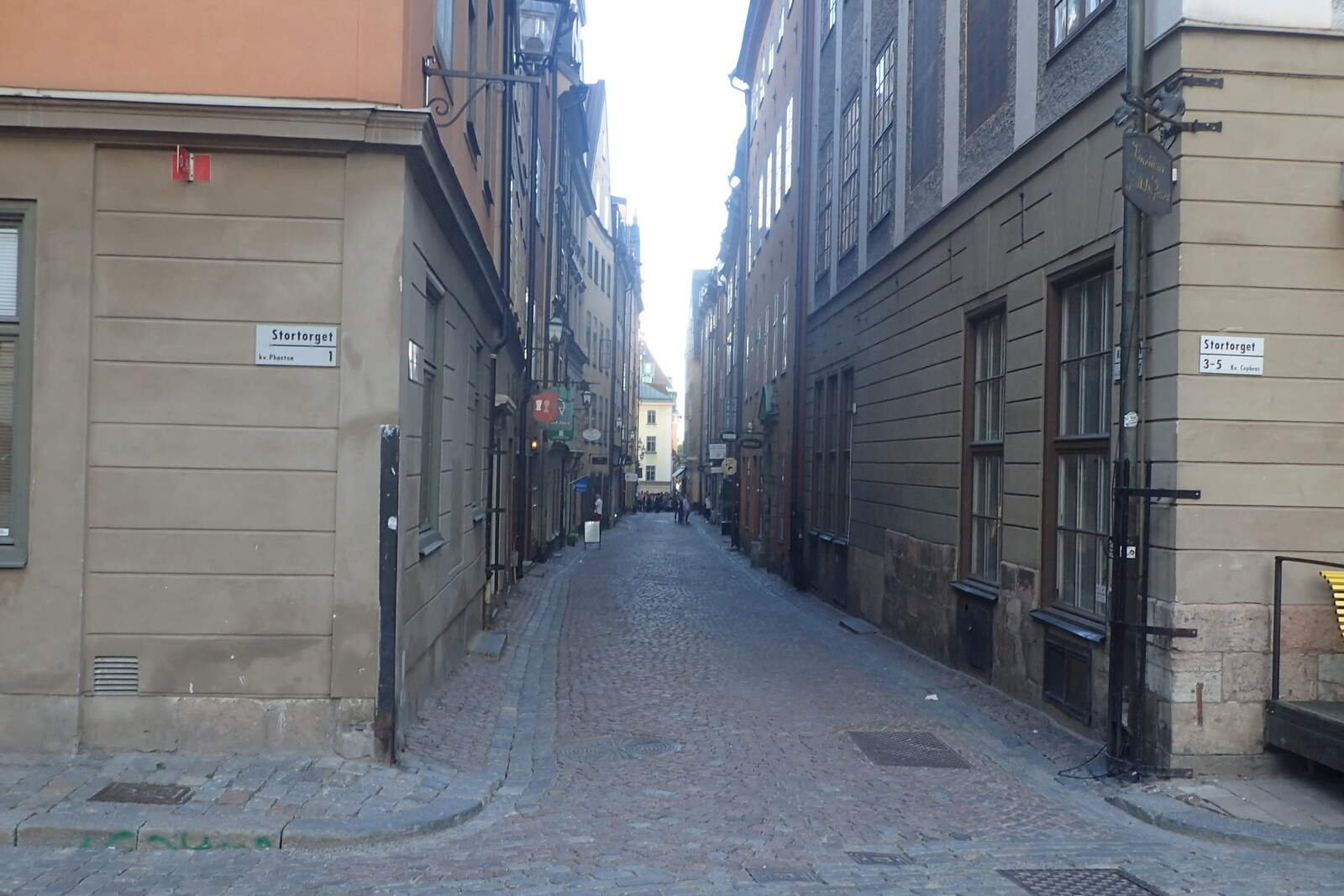
Look around first
What to notice
- The street sign reading “Köpmangatan”
- The facades along the short street
- Köpmantorget square
The story of the place
In the city’s eastern wall, there was a passage to a pier where boats arrived with fish and other goods. From it, a short street lined with shops stretched to the large market square: the seller stood inside, while the customer waited outside and collected the purchase through an open shutter in the wall. The wall with its passage was dismantled, the shore was built over, and all that remained of the former route were the facades along the street and a small square at its end.
Köpmangatan means “Merchants’ Street.” This was the name for traders who bought goods in large quantities and resold them in another town or country. There were Swedes among Stockholm’s merchants, but long-distance trade was for a long time conducted mainly by Germans from Lübeck and other cities of the Hanseatic League—a union of trading centers on the Baltic Sea.
In the early twelve fifties, Birger Jarl, the de facto ruler of Sweden, reached an agreement with Lübeck to concentrate Swedish-Hanseatic trade in Stockholm. German merchants were allowed to work here on favorable terms, including without duties or taxes, provided they obeyed Swedish laws. Their earnings depended on two cargoes: in Stockholm, they sold the salt, cloth, wine, glass, and spices they had brought, and for the return journey they bought iron, copper, furs, butter, and salted fish. Salt from Lüneburg was especially important: without it, meat and fish could not be stored for long.
The merchants were on this street because of its location. One end opened onto Stortorget, the city’s main market. The other led to Köpmansporten in the eastern wall, beyond which lay Fiskestrand—the fish shore where boats from the archipelago, the northern regions, and Finland docked. Goods arriving by water passed through the gates and reached Köpmangatan. Here, the merchants kept shops. A medieval shop resembled a kiosk: the customer stayed outside, while the seller handed over goods through an open shutter in the wall. Customers began to be invited inside the shop only in the seventeenth century.
By concentrating trade in Stockholm, Birger Jarl spared Hanseatic merchants trips to many separate piers. City officials gained the ability to inspect, weigh, and mark goods in one place. Stockholm quickly became Sweden’s largest city. By thirteen twenty-three, the name was already so familiar that a scribe in a legal document simply wrote: “in the middle of the street called Köpmangatan.” This is the earliest written attestation of the name of a Stockholm street that has survived to this day.
At the eastern end of Köpmangatan now opens the small square of Köpmantorget. There has never been a market there: the name was inherited from the street. Until sixteen eighty-five, Köpmansporten stood on the site of the square—an arched passage with a two-story house above it. The gates were demolished, the fish shore disappeared beneath later development, and the short route from Stortorget to the former exit from the city remained Köpmangatan.
Useful on site
An open street stop with no time restrictions.
Checked: June 17, 2026. Check the official source before visiting.Walk slowly and turn around from time to time: the shape of the former trade artery is easier to see along the street than from a single facade.