 Guide On Map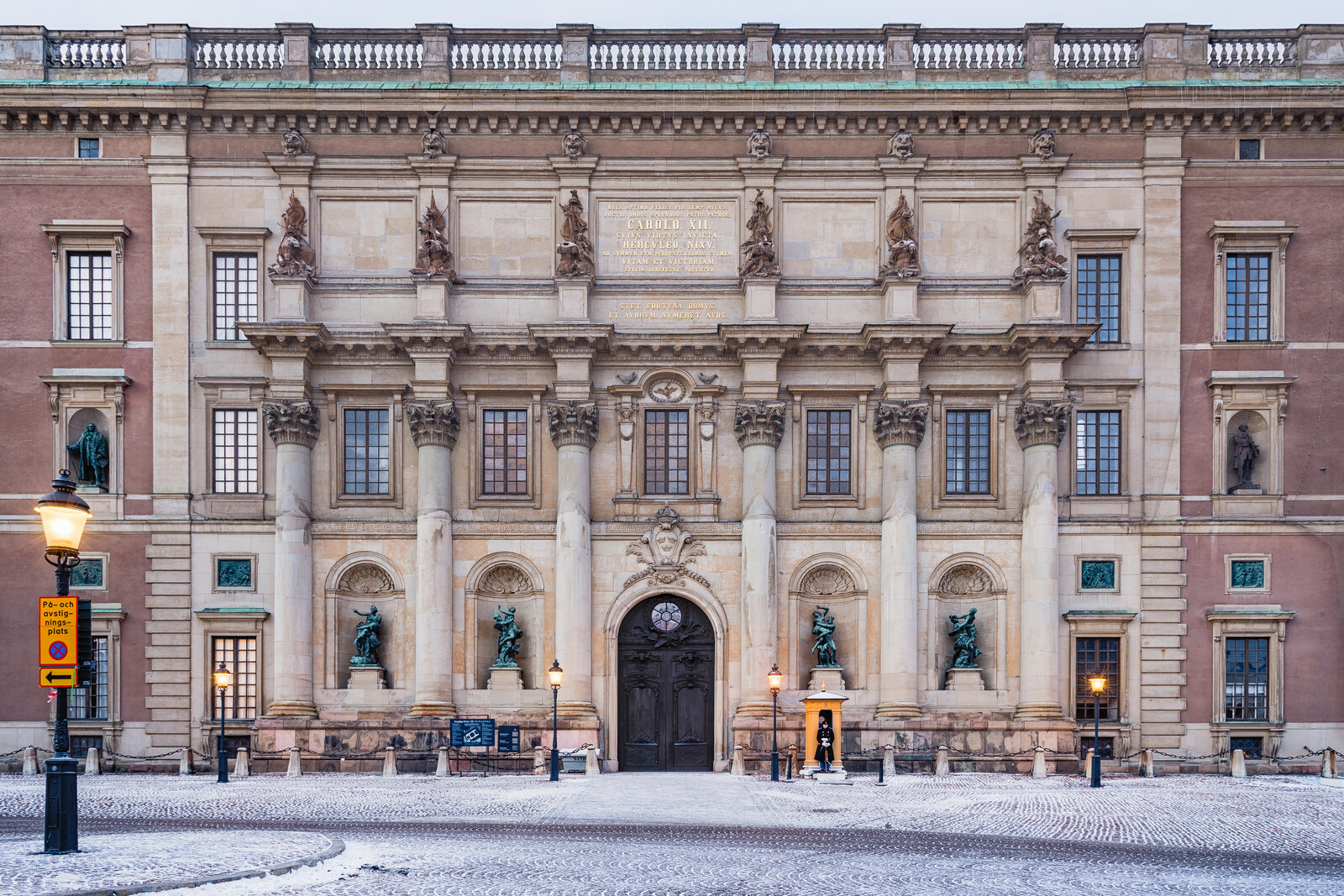
Look around first
What to notice
- The inner courtyard
- The four palace façades
The story of the place
Kungliga slottet means the Royal Palace in Swedish. Four façades form an enclosed inner courtyard, and behind them stretch ceremonial rooms, offices, and service corridors. The monarch’s family lives at Drottningholm, but the king and palace services still work here.
On March thirteenth, eighteen hundred nine, the Swedish king Gustav IV Adolf ran into this palace’s inner courtyard with someone else’s sword in his hand. He was born here and intended to leave the palace as sovereign. A few minutes later, he was carried back in as a prisoner.
Sweden was at war with Russia. Finland then belonged to Sweden, but Russian troops had already occupied it. Gustav IV Adolf wanted to raise a new army and continue the war. Part of the Western Army, which had previously guarded the border with Norway, rebelled and moved toward Stockholm to force the king to begin peace negotiations. When the king learned of this, he decided to leave southward with the capital’s garrison: he expected to find troops loyal to him there. The two armies could have met within the country itself.
Carl Johan Adlercreutz, a general recently returned from the Finnish front, took it upon himself to stop the departure. He feared that a clash between the royal troops and the rebel army would turn a military defeat into a civil war. In the morning, Adlercreutz went up to the royal apartments with only six officers. Guards, courtiers, and people preparing belongings for the departure were in this same building. If the king had reached the guard, the seven conspirators themselves would have been arrested.
Adlercreutz told Gustav IV Adolf that he was detained, and the officers took his sword from him. In the confusion that followed, the king seized one of their weapons, slipped through a secret door, and ran through the palace rooms toward the inner courtyard. There Johan Ludvig von Greiff saw him—a former cavalry officer who served as the court official in charge of the royal hunt. His position depended on the man he now had to stop.
Von Greiff blocked the king’s way. Gustav IV Adolf struck with his sword, pierced von Greiff’s sleeve, and wounded his arm. Even so, von Greiff seized the fugitive around the body; the officers who arrived helped carry the king back upstairs. Von Greiff later wrote that he had met him running, wearing a hat, carrying a sword, and heading for the palace guard. Whether the king would manage to lead the garrison out of the capital depended on the outcome of this brief struggle in the courtyard.
That same night, Gustav IV Adolf was taken from the palace. He was first held at Drottningholm, then transferred to Gripsholm Castle. On March twenty-ninth, he signed an abdication, trying to preserve the crown for his ten-year-old son. The Estates Parliament rejected this condition and deprived both the king and his heirs of the right to the throne. On Christmas Eve, the former royal family left Sweden. His wife and children stayed with her relatives in Baden, while Gustav traveled alone under the name Colonel Gustafsson. He died in a room in a small hotel in St. Gallen, Switzerland.
A year later, Adlercreutz joined the new government. Von Greiff received an annual pension and later became Chief Master of the Hunt—the head of the royal hunting department. The vacant throne was taken by the childless uncle of the deposed king, Karl XIII. After the death of the first chosen heir, parliament invited another: the French marshal Jean Baptiste Bernadotte, who agreed to become Swedish crown prince. The present royal family descends from him.
Kungliga slottet means “the Royal Palace.” The royal family lives at Drottningholm, but the king’s official residence, his working offices, and palace services are still here. Behind the four façades, the inner courtyard remains, where von Greiff stopped the last Swedish king of the former dynasty. The current king’s office is occupied by that king’s successor from the House of Bernadotte.
Useful on site
As of the check, the palace was open 10:00–17:00; entrance was through the West Vault from the outer courtyard. Schedule and access depend on the day and the site’s program.
Checked: June 17, 2026. Check the official source before visiting.An exterior view is enough for this story. The underground remains of Tre Kronor and the ceremonial rooms belong to a separate visit to the palace.