 Guide On Map
Old Shanghai: From the City Wall to Yu Garden
From Dajing Ge along Fangbang Middle Road to the temple, bazaar, and Yu Garden
Guide On Map on your phone
Open the walk like a regular app
It takes about 10 seconds to install. No app store needed.
The whole path
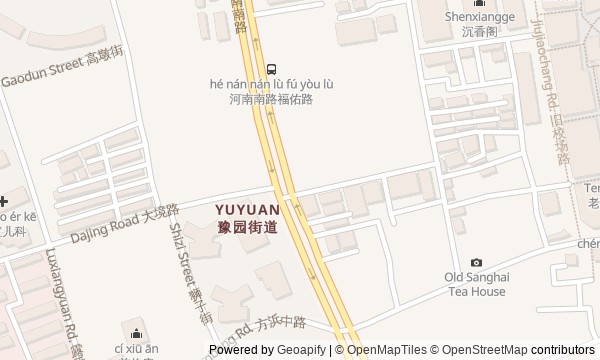
Route map
About the walk
You will begin beside the last fifty meters of Shanghai Old City Wall, then follow the former canal bed toward a temple, bazaar, winding bridge, and Yu Garden.
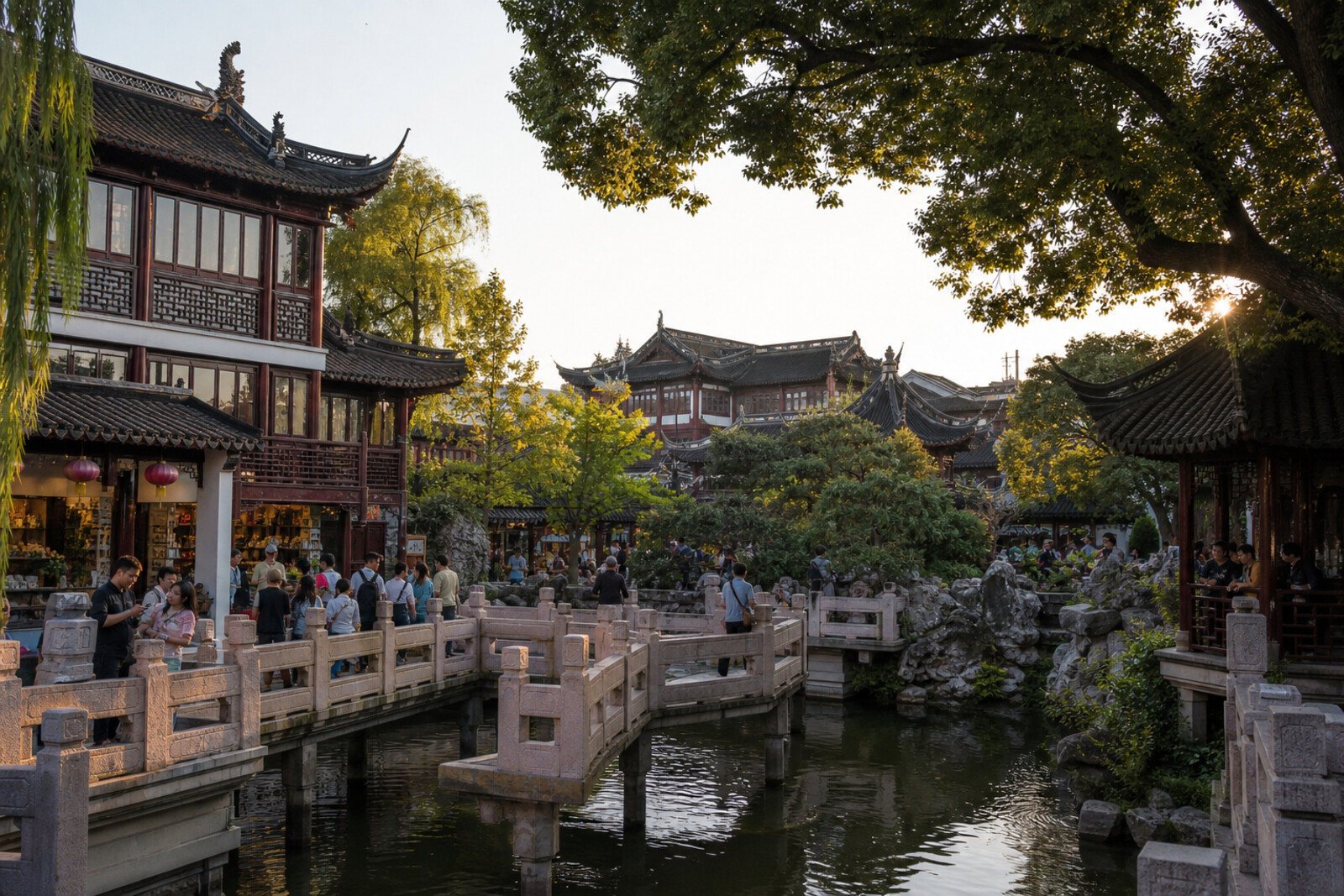
At first, the route runs through shops given the look of different eras. Then the shopping street leads to a temple with an official's desk for a judge of the afterlife. Beyond the temple gates, trade grows into an entire district, while a pond, Huxinting, and a bridge with turns remain at its center.
Why did the demolition administration set up on a surviving wall? What was discovered after a truck struck it? Why was an old pavilion printed on the stock market's first share certificate?
The story will separate document from legend, old masonry from later reconstruction, and the garden's original design from commercial scenery. By the end, you will be able to explain which parts of Yu Garden truly remain from the earlier garden and which Shanghai rebuilt anew.
Why this order
Dajing Ge sets the vanished boundary of the old city, while the descent to Fangbang Middle Road shows what replaced the wall and canal for the sake of traffic and trade. Along the former channel, you will approach the temple: water once separated the earthly administration from its heavenly double, and a market grew up beside the sanctuary. From the temple district, the route continues through Yuyuan Bazaar to trace how individual shops became a joint-stock commercial district. Among the new buildings, the old layout of the pond, Huxinting, and the Nine Zigzag Bridge becomes especially clear. From the bridge, the road leads into the garden, from whose broken-up estates this commercial district once grew; there, the route ends by examining what was preserved and what was rebuilt from descriptions.
Those who want to see the Chinese part of old Shanghai Those interested in the line between genuine antiquity and reconstruction Those who enjoy stories of trade, city administration, and the fate of buildings
Those looking for a route along the waterfront and through concession districts Those uninterested in the details of urban redevelopment Those who want only a garden walk without the surrounding old city
Before you go
Wear shoes comfortable for long pauses and slow movement through crowds: distances here are short, but the stops are packed with detail.
Before setting out, check the current visiting conditions for Shanghai City God Temple, Huxinting, and Yu Garden: outdoor spaces are accessible differently from interiors, the teahouse, or the garden grounds.
Do not build your walk around a required purchase or one perfect photograph. The bazaar remains a working commercial district, and the temple is a place of worship, so at entrances, altars, and queues, act like a guest rather than a spectator on a set.
When to go
Choose a time when you are ready to look closely rather than rush between stops. The beginning of the day is usually better for the details of the wall, temple halls, and garden; save the busier period for the bazaar and pond, where the flow of visitors itself continues the district's story.
Backup plan
If you cannot enter Dajing Ge, view the surviving masonry and pavilion from the street: the stop's main story is read precisely in the exterior fragment of the wall.
If the temple halls, teahouse, or garden are unavailable, do not try to replace them with random interiors. Follow the remaining sequence outside, ending at the pond and bridge, and move a separate visit to Yu Garden to a day when you can check entry conditions in advance.
Route conditions
Surface. Paved — 355 m (data covers 23% of the route)
Facilities. Toilets — 8
Elevation. Ascent — 8 m; descent — 16 m
OpenStreetMap extract of July 9, 2026: database data, not a check on the ground. Data © OpenStreetMap contributors, ODbL licence
Walk plan
Open in maps ↗- 1
Dajing Ge
Here you will learn why merchants needed to remove the old boundary of the city and how one section of it escaped dismantling. - 2
Fangbang Middle Road
This stop will show how a former canal was turned first into a road, and then into a sequence of carefully designed commercial eras. - 3
Shanghai City God Temple
Here, the temple will be revealed as a parallel municipal service, with its own chief, seal, assistants, and archive. - 4
Yuyuan Bazaar
This stop connects the familiar tourist market with Shanghai’s first experience of restructuring trade through a joint-stock company. - 5
Nine Zigzag Bridge and Huxinting
Here, the trading office of one industry becomes a public tea house, while a route across the water devised by merchants outlives their association. - 6
Yu Garden
The finale will make it possible to distinguish the first owner's design, authentic stonework, and parts of the garden reconstructed from old records.
Route features
Everything you need stays in the browser
Progress, saves and your trip plan are stored on this device.
Add Guide On Map to your home screen so the walk opens outside the browser.
How we handle sources, maps and corrections: our editorial standards