 Guide On Map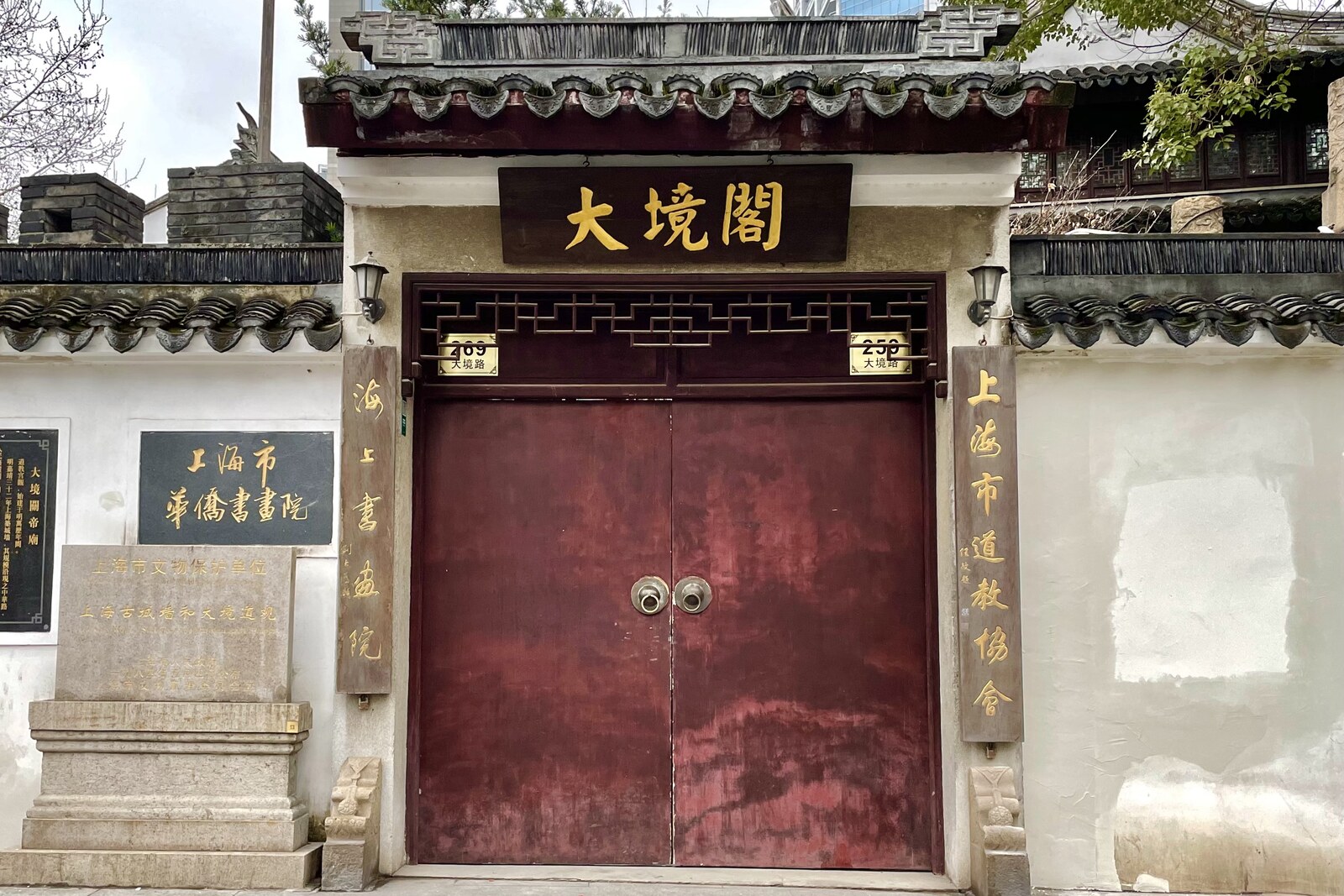
Look around first
What to notice
- Pavilion above the wall
- Section of brick masonry
- Stone arch with an inscription
- Stone plaque in front of the temple
The story of the place
Dajing Ge stands on a remnant of the Shanghai Old City Wall, which the residents of Shanghai once built around the entire Chinese city. About fifty meters of masonry remain here from the fortifications. Above it rises a pavilion containing the Guan Yu Temple, while Renmin Road runs beside it. This street lies on the site of the wall and the filled-in moat.
The wall was built in fifteen fifty-three, after five pirate raids in a single spring. The attackers burned the county administrative office, homes, and grain-carrying vessels; one official fled and two were killed. The imperial court allowed the city to be fortified but provided no money. Local families donated silver, grain, and land, dismantled their own homes where the line of fortifications was planned, and carried earth and stone. The work was completed in less than three months. Later bands of raiders reached the walls but could no longer get inside.
When the raids stopped, townspeople set up a shrine to Guan Yu on this firing platform—a military commander revered as Guan Yu, the patron of warriors and the embodiment of loyalty to duty. In eighteen fifteen, a three-story pavilion was built above the wall. Twenty-one years later, the governor-general Chen Luan had the words “Da qian sheng jing”—“boundless beautiful world”—inscribed on its stone arch. Townspeople shortened the inscription to two syllables: Da-jing. “Ge” means pavilion.
By the beginning of the twentieth century, the military wall still marked the boundary of the Chinese county city, but trade had long since spread beyond it. Carts could barely pass through the low gates. Merchants, shop owners, and carriers made their living from exchange between the river wharves, the old city, and the neighboring foreign concessions—districts with separate administrations. While goods were delayed at the gates, businesses in the Shanghai French Concession gained customers faster.
In nineteen oh three, the French administration proposed moving the Chinese county administrative office far to the south, to Minhang, demolishing the wall, and annexing the freed-up territory to the concession. Li Pingshu, a local civic leader who headed the city engineering services, entered the dispute. He worked on the water supply, fire protection, and transport in the Chinese part of Shanghai, and pressed for it to manage its own streets. Li argued bluntly: if the wall was going to be used as a pretext for expanding the concession anyway, it should be dismantled by the Chinese administration and the land left to the city.
Opponents of demolition answered with the same fear: without the wall, French territory would come even closer. They created the Society for the Preservation of the City Walls and secured a compromise. In nineteen oh nine, builders cut three additional passageways through the wall. One of them, the Small North Gate, was near Dajing Ge. This eased the congestion, but merchants continued to lose customers.
After the Revolution of nineteen eleven, Li Pingshu headed the civil administration of the new Shanghai government. In January of the following year, he assembled more than two thousand merchants, representatives of craft associations, and city elders. The majority voted for demolition. Workers were ordered to dismantle the masonry with hammers, chisels, and farming tools, immediately dumping the bricks and earth into the moat.
The leaders set up the Wall and Moat Administration in Dajing Ge itself. From here, they assigned the work sections through which, by the end of nineteen fourteen, they had destroyed almost the entire ring of fortifications. On its northern half they laid out Minguo Road—the Republic Road, now Renmin Road; the southern half was named Zhonghua Road. Merchants gained a circular road and unobstructed passageways, although the old Chinese city never caught up with the neighboring concessions in amenities and business activity.
The masonry beneath Dajing Ge was not dismantled: the temple and the demolition administration stood on it, and townspeople asked for the well-known shrine to be preserved. The pavilion was later restored, but some of the old bricks and the line of the wall remained in their original place. The stone plaque in front of the temple still praises Guan Yu’s loyalty. Beyond its edge, the fortification ends at the point from which Li Pingshu directed its dismantling.
Useful on site
The official city tourism website as of 2026-07-01 states that the interior is not open. The outdoor section of the wall and the facade can be viewed from Dajing Road; temporary openings must be checked on site.
Checked: July 1, 2026. Check the official source before visiting.Even if the entrance is closed, this stop works from outside: there is no need to look for an alternative or try to get beyond the barriers.