 Guide On Map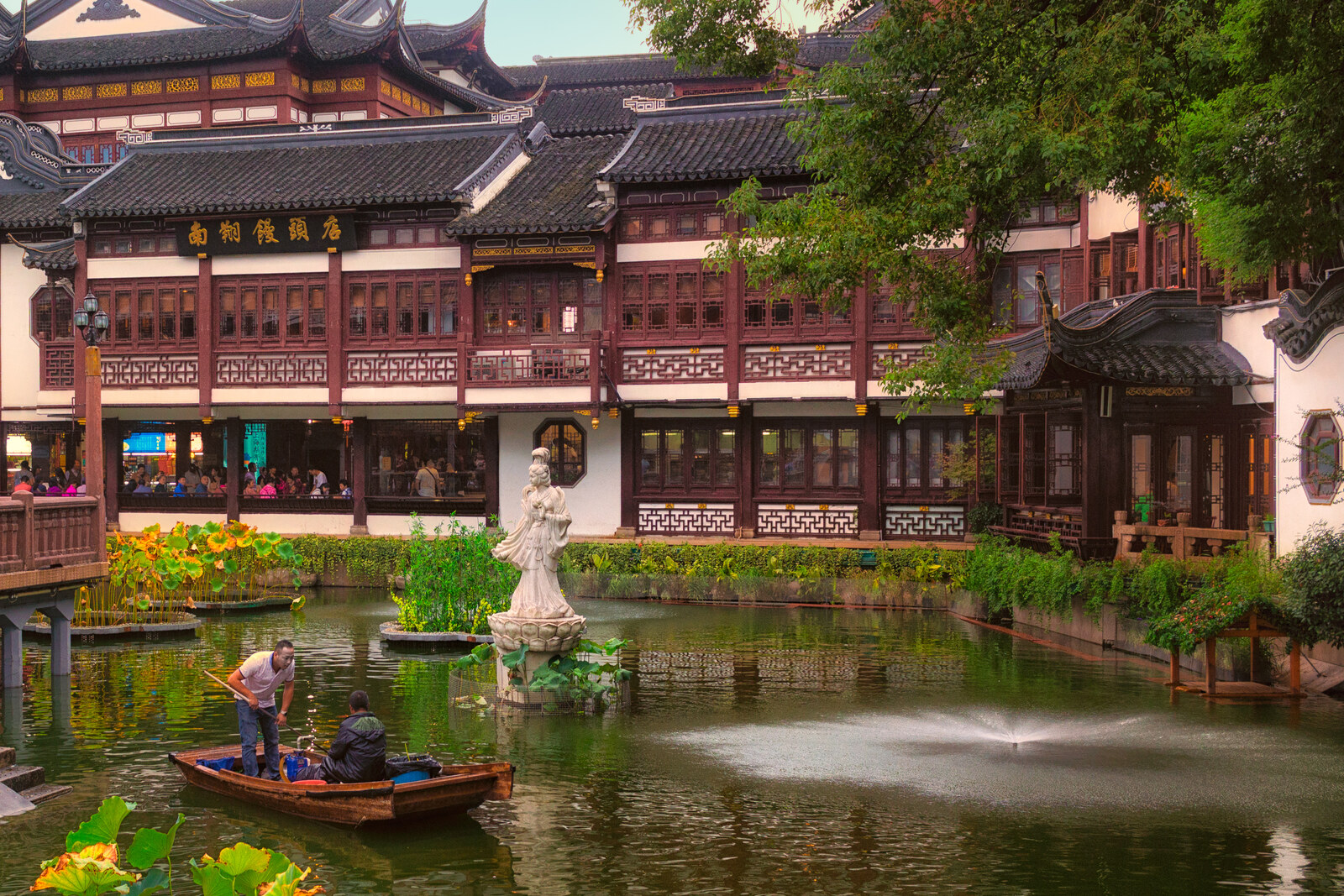
Look around first
What to notice
- The Great Rockery of yellow stone
- Yuhua Hall
- The Exquisite Jade Rock
- Ponds and stone rockeries
The story of the place
Within the dense commercial quarter, Yu Garden is arranged as a small landscape with water, winding banks, and stone hills. The long building along the eastern boundary separated it from the commercial city, while Leshou Hall was intended for the owner's elderly father. The garden's most conspicuous feature, the Great Rockery of yellow stone, is assembled with narrow gorges, caves, and ledges. Later, shops, schools, residents, and trade associations occupied the pavilions and plots.
In the spring of fifteen fifty-nine, Pan Yunduan failed the capital examinations that opened the way to the highest official posts. Back in Shanghai, he began piling up stones and digging a pond in the vegetable gardens near the family home. Three years later, Pan did earn a scholarly degree and left to serve in office. The garden had to be built in fits and starts: for almost twenty years, he would hire craftsmen, then stop the work.
In fifteen seventy-seven, Pan Yunduan lost his post as head of the financial administration of Sichuan Province and returned home. Now the garden acquired a precise purpose. His father, Pan En, an elderly former minister, was to spend his final years here. The word “yu” meant peace and joy; the name “Yuyuan” was read as a promise to bring joy to one's aged parents.
Real family money went into that promise. Pan wrote that he gave all the income from the annual harvest to the construction. He invited Zhang Nanyang, a master of garden rockeries, who assembled the Great Rockery from yellow stone—an artificial mountain landscape with gorges, caves, and cliffs. Along the eastern boundary, they erected a long building that shielded the garden from the commercial city. Leshou Hall, the Hall of Joy and Longevity, was intended for his father.
Pan En did get to visit the unfinished garden: his son served him wine, and together they wrote poetry. But money and time ran short, and the work dragged on. The father died without ever seeing the hall built especially for him completed. In his own description of Yu Garden, Pan Yunduan called this a sorrow for the rest of his life. After Pan Yunduan's death, his heirs could no longer maintain the enormous estate. Plots were sold off, and pavilions were occupied by trade associations, schools, shops, and residents.
By the middle of the twentieth century, all that remained of Pan Yunduan's garden were scattered buildings, silted-up bodies of water, and crumbling stone rockeries. One of the halls was destroyed by Japanese bombing in nineteen thirty-seven. Stones from here were already being removed for other city parks, and there was a proposal to turn the Great Rockery into part of an ordinary entertainment venue.
Yang Jiayu, an employee of the city's cultural administration, insisted on a different decision: if Yu Garden was to be restored, it had to be restored specifically as a historic garden. In nineteen fifty-six, Chen Congzhou, a researcher of Chinese gardens, was brought into the work. He assembled engineers, old carpenters, stonemasons, and rockery masters. They rehoused occupants of the occupied rooms, removed later partitions, reinforced the surviving structures, and laid the water system again.
The plan could not simply be found beneath the rubble. Chen compared the remains of walls and stonework with the text left by Pan Yunduan. By the composition of the mortar, the joints, and the lower stones, the craftsmen determined where Zhang Nanyang's work lay and where later repairs began. Lost parts were built from old descriptions and surviving traces. In nineteen sixty-one, the garden opened to visitors; Chen and his students put together the eastern section in the nineteen eighties.
The Great Rockery remains an authentic work by Zhang Nanyang. Yuhua Hall, in front of the Exquisite Jade Rock, was built by Chen Congzhou's team, which chose the site from a note by the first owner. The rock is older than the present hall; the hall stands opposite it because Pan Yunduan had managed to describe this pair before his garden fell apart.
Useful on site
Current ticketing platforms list Tuesday–Sunday 09:00–16:30, entry until 16:00, and closure on Mondays except official holidays; tickets are sold by ID document for a morning or afternoon timed entry slot. The price is usually 40 yuan in high season and 30 yuan in low season. The city tourist guide gives a seasonal daily schedule, so a final check should be made before publication.
Checked: July 1, 2026. Check the official source before visiting.Check the garden's entry conditions separately. Inside, do not try to see everything at a glance: let groups pass ahead and take in the space through turns and views framed by walls.