 Guide On Map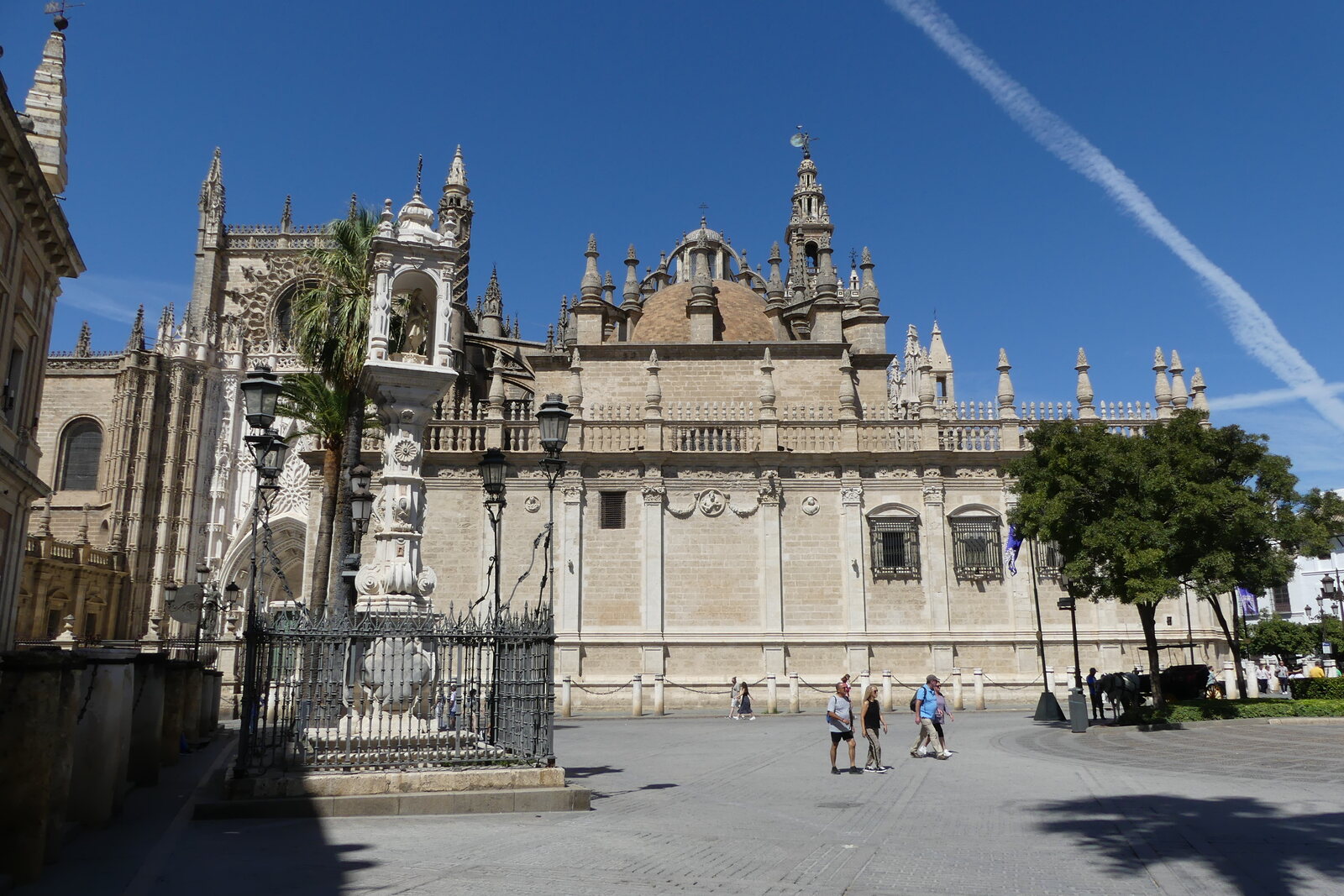
Look around first
What to notice
- Marble column beneath an arched canopy
- Iron grille
- Four lanterns
- Façade of the General Archive of the Indies
The story of the place
Between the cathedral and the General Archive of the Indies lay an open plot behind the commercial exchange; it was called either after the stones for cathedral work or after neighboring buildings. By the façade of the former exchange stands a small triumph: a slender marble column beneath an arched canopy, surrounded by an iron grille. This was what the clergy called a religious monument with a sacred image, and they wanted to protect this patch of the square from ordinary street life. The city council ordered the structure to be made lower so that it would not obscure the façade of the exchange, and four lanterns were placed at the corners of the grille, with orders for them to be lit day and night.
On the morning of November first, seventeen fifty-five, a solemn Mass for All Saints’ Day was underway in Seville Cathedral. As the choir sang “Gloria in excelsis Deo,” the earthquake that destroyed Lisbon reached the city. Stones and debris fell from the upper parts of the tower and the vaults. Priests and parishioners ran outside.
They did not disperse. When the tremors stopped, the clergy gathered the people here, on the open plot behind the commercial exchange—now the General Archive of the Indies—and finished the interrupted Mass. The participants then went through the city in a thanksgiving procession. In the cathedral, despite the debris and the large crowd, no one died; elsewhere in Seville there were casualties and serious damage.
The cathedral chapter—a council of clergy that managed the cathedral—explained the parishioners’ survival as the protection of the Virgin Mary. On November twenty-eighth, the chapter resolved to mark the exact place where the Mass had ended and protect it from ordinary street use. To do this, it commissioned a “triumph,” as a religious monument in the form of a tall support bearing a sacred image was called. Here it referred to victory over the disaster, which the clergy attributed to the Virgin Mary, rather than to military success.
At first, the chapter wanted to build a small chapel around a donated statue of the Virgin Mary. The city council provided the land but required the structure to be as low as possible: the chapel was not to obscure the façade of the exchange. After the design was reworked, it became a narrow marble column beneath a small arched canopy, surrounded by an iron grille. The church clergy received a memorial altar, while the city kept the view of the commercial building open.
The triumph was unveiled on October thirty-first of the following year. Before the earthquake, this space had no established name: it was called either after the stones piled here for cathedral work or after the hospital, palace, or exchange. After the monument was installed, the name “Plaza del Triunfo” became established.
The tall monument to the Immaculate Conception in the center of the square appeared only in nineteen eighteen and did not give the square its name. The monument you need is smaller and stands by the façade of the General Archive of the Indies. Its pedestal still says that the Mass was concluded here after the earthquake; at the corners of the grille stand four lanterns, which the chapter ordered to be kept lit day and night.
Useful on site
A public outdoor site without ticketed hours; temporary square closures, security, and event restrictions are possible. Checked 2026-06-29.
Checked: June 29, 2026. Check the official source before visiting.Stand closer to the center of the square and find in turn the cathedral, the General Archive of the Indies, and the wall of the Royal Alcázar of Seville; do not block passages for groups.