 Guide On Map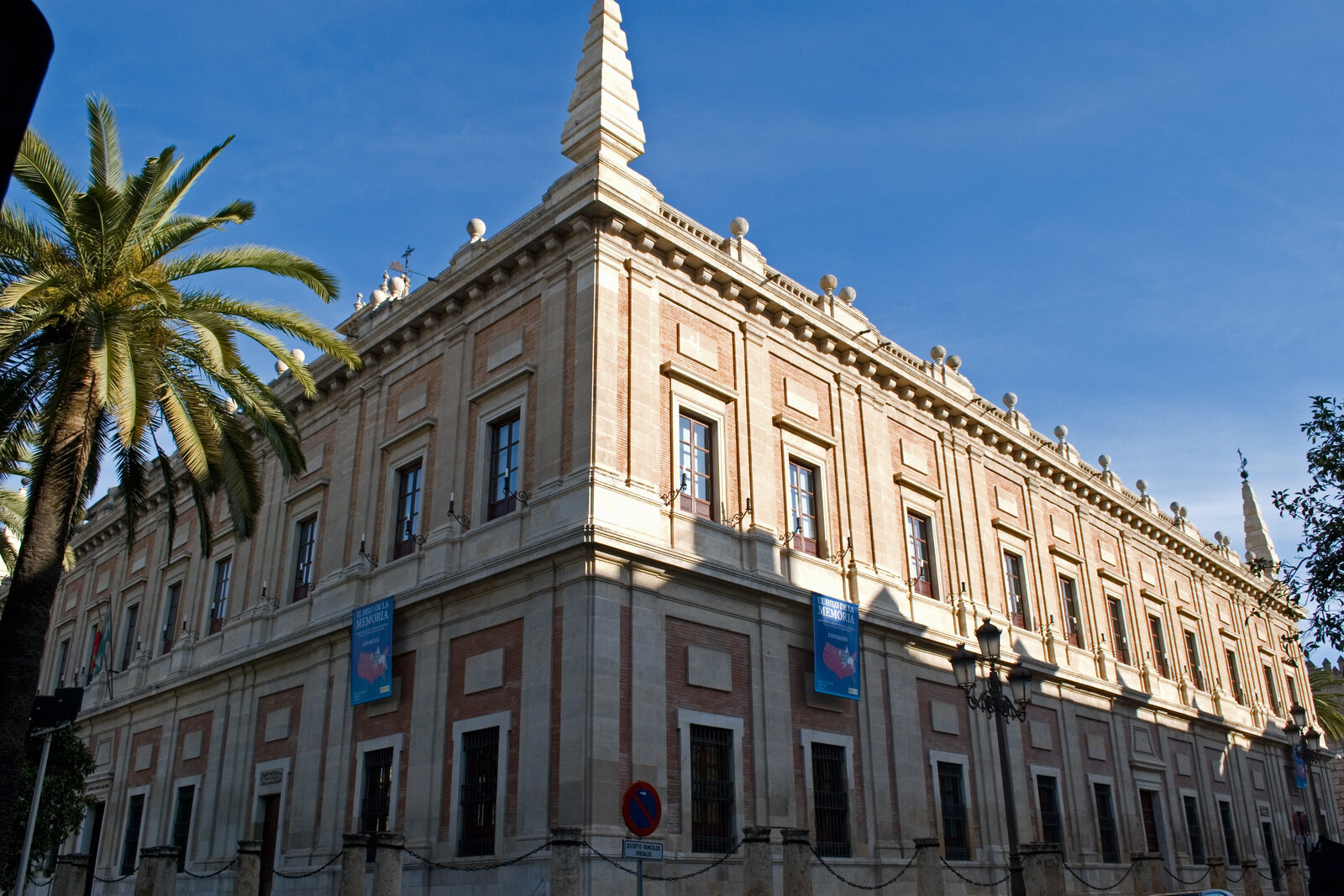
Look around first
What to notice
- Façade of the former exchange
- Central courtyard
- Stone floors
- Wooden shelving in the upper galleries
The story of the place
The upper galleries around the central courtyard are occupied by long cedar shelving veneered in Cuban mahogany. Records concerning Spanish possessions beyond the Atlantic and in the Pacific Ocean are kept here; “the Indies” in the name refers precisely to these lands, not to peoples. The building was constructed for Seville merchants trading with overseas territories, but after the main trading institutions moved to Cadiz, it was left half-empty. When it was converted into an archive, workers removed the interior partitions, altered the staircase, and laid stone floors.
On October fourteenth, seventeen eighty-five, twenty-four carts arrived at this former exchange. In two hundred fifty-seven crates were the papers of the Council of the Indies—the chief authority that administered Spain's possessions in the Americas and the Philippines. The carts came from the fortress of Simancas, where the General Archive of Simancas could no longer hold the accumulated records.
The transfer was undertaken for the sake of a book. The Scottish historian William Robertson published his The History of America without access to Spanish state archives. José de Gálvez, secretary for the Indies, considered Robertson's account of colonization hostile and insufficiently substantiated. Carlos III of Spain instructed the court historian Juan Bautista Muñoz to write a response based on authentic documents.
For Muñoz, this was an official assignment on which his salary depended. He held the post of chief cosmographer of the Indies: he checked information about overseas territories and navigation. In seventeen eighty-three, this post was declared obsolete and abolished. The king allowed Muñoz to keep his title and salary temporarily on one condition: that he continue sorting through archives and preparing a new history.
Muñoz worked in Simancas, Madrid, and Seville, copying and comparing thousands of papers. Gradually, it became clear that fulfilling the commission while traveling among different repositories was almost impossible. Documents from one institution could be kept in several cities, and the archive in Simancas was overcrowded. Muñoz and Gálvez secured a different solution: to bring old records concerning the Indies together in one place.
For this, they chose Seville's exchange. It had been built for merchants trading with those same overseas possessions, but after the main trading institutions moved to Cadiz, its large rooms were used only partly. Carlos III of Spain ordered the upper floor to be given over to the papers. Workers removed partitions, rebuilt the staircase, and laid stone floors. Long cedar shelving veneered in Cuban mahogany was made for the galleries. In the autumn of seventeen eighty-five, they began placing in it the records delivered by the first carts. Then new consignments arrived from Madrid, Cadiz, and Seville itself. Muñoz arranged the documents and drafted rules for the staff of the new institution—the General Archive of the Indies. In its name, “the Indies” refers not to peoples but to territories the Spanish monarchy administered beyond the Atlantic and in the Pacific Ocean.
Muñoz never finished the history commissioned by the king. In seventeen ninety-three, he published the first volume, taking the account only as far as the year fifteen hundred. The second volume remained in manuscript when the historian died six years later. And the cedar shelving with Cuban veneer made for his archive still runs along the galleries of the upper floor.
Useful on site
The tourist area of the General Archive of the Indies is free according to the official schedule; exhibitions and access may change. Checked 2026-06-29.
Checked: June 29, 2026. Check the official source before visiting.Even without going inside, inspect the building from several sides; treat the interior visit as an addition, not an essential condition of the route.