 Guide On Map
Santa Cruz neighbourhood and Seville’s former Jewish Quarter
From Murillo Gardens along the Royal Alcázar of Seville wall to Hospital de los Venerables
Guide On Map on your phone
Open the walk like a regular app
It takes about 10 seconds to install. No app store needed.
The whole path
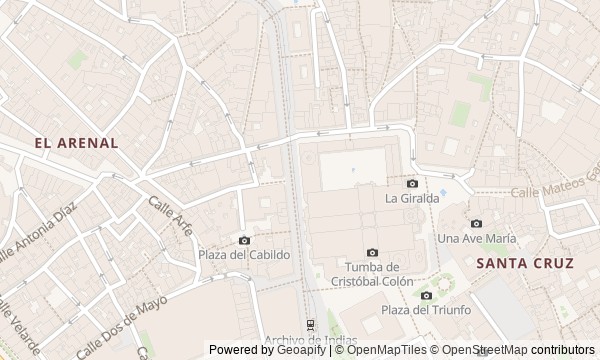
Route map
About the walk
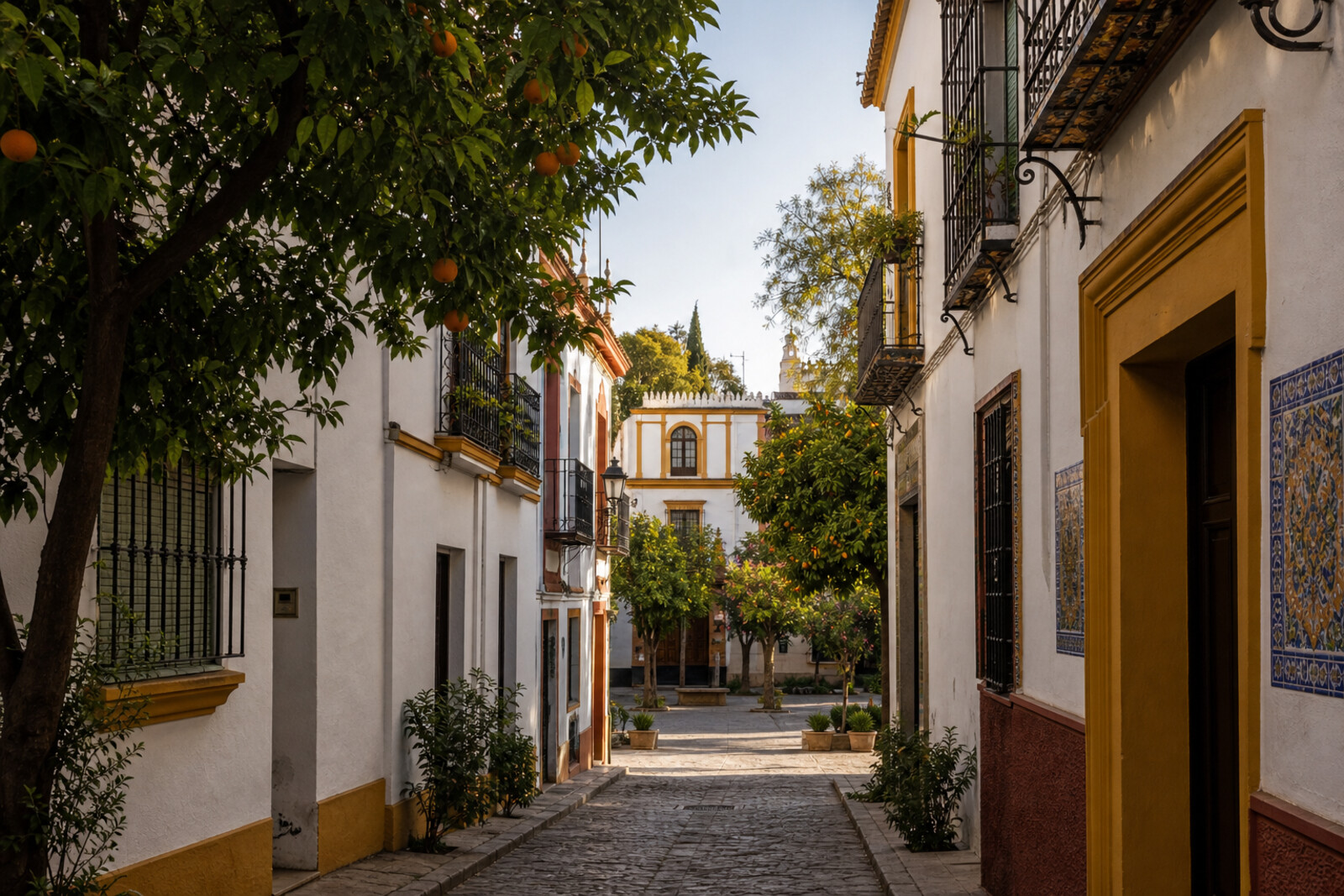
You will enter Santa Cruz neighbourhood from Murillo Gardens. The route follows the Royal Alcázar of Seville wall, turns into the narrow Callejón del Agua, emerges onto small squares, and ends in the courtyard of a former home for priests.
There will be gardens, ceramic benches, an iron cross, a white-and-gold church, and a street with a direct view of the Giralda. But this walk is not about a “charming maze.” You will see who opened up this neighborhood, what disappeared to make way for new passages, and why so many empty spaces remain behind the dressed-up façades.
The stories rest on contracts, debts, and awkward details. Two clay pipes run inside the fortress wall. An investor waits to recover money from every performance. Paintings return from Paris, but not home. The answers come on the spot, with documents instead of legends.
After the walk, you will be able to read Santa Cruz neighbourhood by its seams: to tell a medieval trace from later decoration, and to understand whose decisions created this familiar neighborhood.
Why this order
Murillo Gardens establish the starting boundary: a public passage appeared at the edge of palace land. The new Royal Alcázar of Seville wall leads to Callejón del Agua, where an old water system appears inside that same boundary. At the end of the lane, Calle Vida takes you to Plaza de Doña Elvira: after hidden infrastructure, the route moves to the void left by a vanished theater. Through Calle Susona and Calle Pimienta, the route reaches neighboring Plaza de Santa Cruz, where a church disappeared—and with it the exact burial place of Bartolomé Esteban Murillo. Calle Santa Teresa and Calle Jiménez de Enciso connect that loss to the surviving Church of Santa María la Blanca, from which paintings commissioned for it vanished. Calle Fabiola leads to the widened Calle Mateos Gago: after losses within buildings, the remaking of the urban fabric itself comes into view. Finally, Calle Jamerdana takes you from the broad street back into the tight neighborhood, to the hospital on the land of Doña Elvira’s Corral de Comedias. The ending returns the route to the site of a vanished theater, but shows a building that was completed after all.
Those who want to understand how Santa Cruz neighbourhood works, not just walk its beautiful streets Those interested in urban remaking, vanished buildings, and the fates of works of art Those who enjoy dense stories tied to visible details
Those looking for an overview of Seville’s main sights Those seeking only the history of the Jewish community, without the neighborhood’s later layers Those who prefer broad avenues to narrow pedestrian lanes
Before you go
Wear comfortable shoes: the route includes stone paving, narrow lanes, and stretches with heavy foot traffic. In hot weather, bring water and leave longer breaks for the gardens and shaded spots, not open squares. You can follow the main route from the street, but the interiors of Church of Santa María la Blanca, the rooms of Bar Giralda, and Hospital de los Venerables depend on the opening hours of active venues; check ahead whether each can be visited. Do not expect to see every painting mentioned in its original location: some works are in museums in Madrid and London.
When to go
2–3 hours for 2,4 km. An exterior-only visit without long stops takes around two hours; accessible interiors, breaks in the gardens, and a close look at details bring the walk closer to three.
Backup plan
If Church of Santa María la Blanca is closed, stay by the façade and focus on the surviving parts of the early building: the story still explains the changes in religion and the fate of the paintings made for the church. If Bar Giralda is unavailable, listen to the hammam story from outside without lingering by the entrance or disturbing visitors. A closed Hospital de los Venerables can be understood through the story of the lost unity between the house and its paintings. In intense heat, shorten stops on the squares and Calle Mateos Gago; in tight spots, first move away from doorways, terraces, and the main flow of people, then start the audio.
Route conditions
Surface. Paved — 2.2 km (data covers 92% of the route)
Stairs. Flights: 1, 3 m in total
Access. Wheelchair — no; stroller — limited (stairs)
Facilities. Toilets — 4; drinking water — 3
Elevation. Ascent — 16 m; descent — 16 m
OpenStreetMap extract of June 18, 2026: database data, not a check on the ground. Data © OpenStreetMap contributors, ODbL licence
Walk plan
Open in maps ↗- 1
Murillo Gardens
Here, the boundary that was moved back to open the neighbourhood to city traffic will come into view. - 2
Callejón del Agua
This stop will link the fortress wall to the workings of the medieval city water supply. - 3
Plaza de Doña Elvira
This present-day small square will take its place in the history of Seville theater, its debts, and its complete disappearance. - 4
Plaza de Santa Cruz
This stop will show how, after the church was demolished, the square preserved its memory without preserving the exact location of the main burial. - 5
Church of Santa María la Blanca
Here, medieval walls, a Baroque commission, and the empty spaces left by Murillo’s originals come together. - 6
Calle Mateos Gago
The width of the street will become tangible evidence of the old neighbourhood's struggle with the new procession route. - 7
Hospital de los Venerables
At the end, you will see the permanent home that was created after decades of temporary shelters.
Route features
Everything you need stays in the browser
Progress, saves and your trip plan are stored on this device.
Add Guide On Map to your home screen so the walk opens outside the browser.
How we handle sources, maps and corrections: our editorial standards