 Guide On Map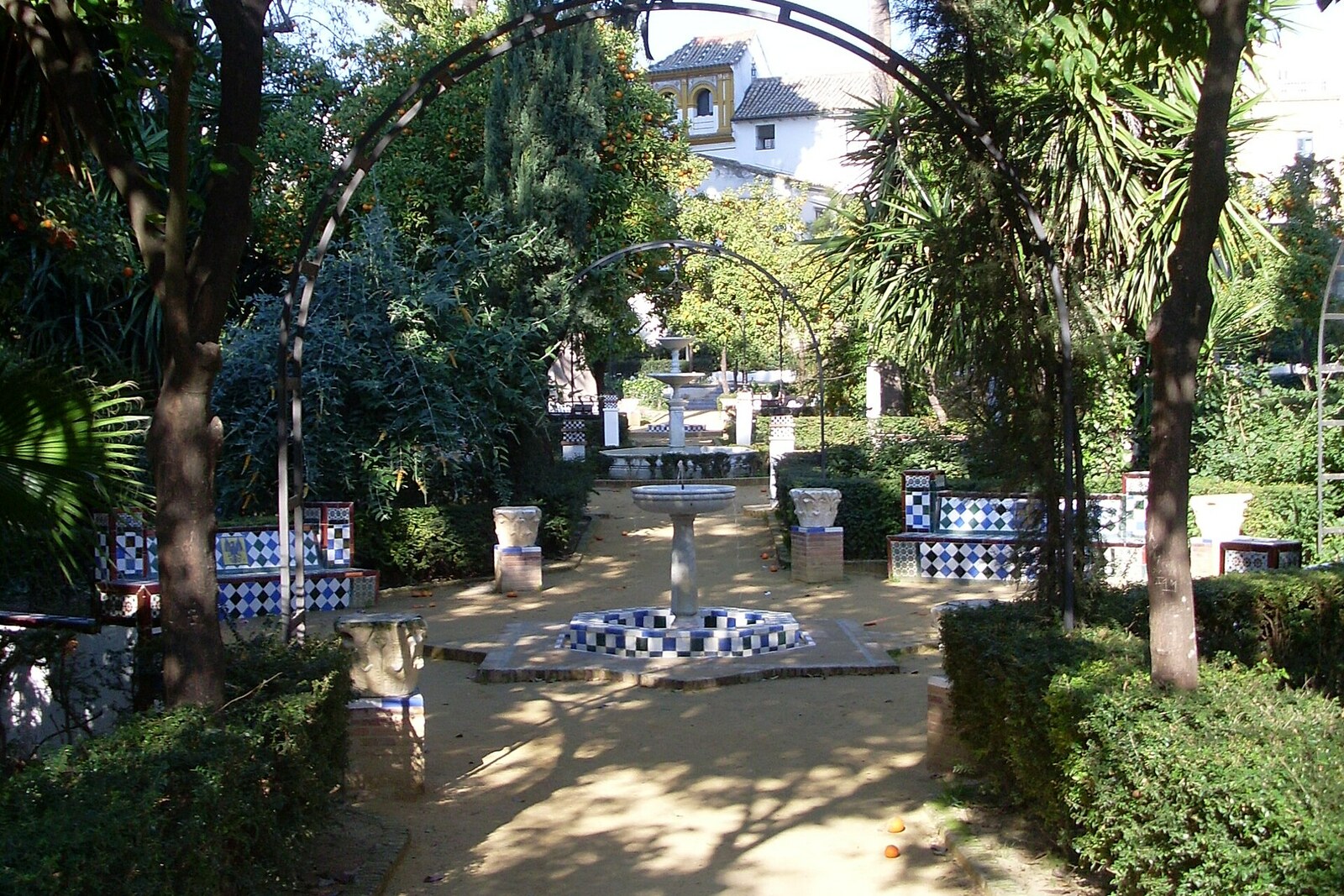
Look around first
What to notice
- The crenellated wall of the Royal Alcázar of Seville
- Octagonal spaces with fountains
- Brick benches with ceramic tiles
- Hedges
The story of the place
Along the crenellated wall of the Royal Alcázar of Seville runs a strip of garden between the palace stone and the houses of Santa Cruz. Its layout alternates small octagonal spaces with fountains, hedges, and brick benches with ceramic facing; paths link the greenery to the neighbourhood's streets. The site once belonged to the palace and came to the city on the condition that it remain a garden, with no new houses. The name recalls the artist Bartolomé Esteban Murillo, but it is connected to the neighboring vanished church where he was buried, not to a burial among the trees.
Even at the beginning of the twentieth century, it was impossible to pass through here. Behind the wall stretched Huerta del Retiro—the Royal Alcázar of Seville's palace land, with gardens and vegetable plots. The wall enclosed the southeastern edge of the Santa Cruz neighbourhood. Residents heading to the railway station then being built in the suburb of San Bernardo had to find a detour.
Municipal planners proposed cutting a direct exit from here to the city's ring road, but the land belonged to the Royal Estate. Seville's municipality appealed to Alfonso XIII: the king had to relinquish part of the palace grounds, otherwise the new passage would remain only on the drawing board. The transfer was formally completed in January nineteen eleven. The document included a condition: about eight and a half thousand square meters could be used exclusively for a garden or park, with no right to build on them.
After that, the municipal architect Juan Talavera y Heredia moved back the boundary of the palace land. The old sections of the enclosure were dismantled, and the new wall of the Royal Alcázar of Seville was laid out from Callejón del Agua to Paseo de Catalina de Ribera. Between it and the houses of Santa Cruz, Juan Talavera y Heredia laid out streets and garden paths. By nineteen fifteen, octagonal spaces with fountains, hedges, and brick benches faced with ceramic tiles had appeared. The garden was arranged so that people could cross the neighbourhood's former boundary through it.
At first it was called Retiro Gardens, sometimes Talavera Gardens. The name Murillo was proposed by José Laguillo, director of the Seville newspaper El Liberal. He sought to ensure that the new public place recalled the artist Bartolomé Esteban Murillo, who spent the last year of his life in Santa Cruz and was buried in the local parish church in sixteen eighty-two. The Church of Santa Cruz stood on the site of the neighboring Plaza de Santa Cruz, but it was demolished in eighteen eleven; the exact location of the artist's grave was lost. In nineteen eighteen, the municipality accepted the newspaperman's proposal and gave the gardens their current name.
Bartolomé Esteban Murillo's grave is not here. His name was attached to a strip of former palace land beside the burial site. And the new crenellated edge of the Royal Alcázar of Seville, the paths between it and the houses, and the garden left undeveloped preserve the terms of that deal: the king ceded the land, Juan Talavera y Heredia opened the passage, and the city gained the right to walk where a wall had previously blocked the way.
Useful on site
Visit Sevilla lists 08:00-22:00 in winter and 08:00-00:00 in summer; access to the garden may still change because of maintenance, works, or city events.
Checked: June 27, 2026. Check the official source before visiting.The stop is entirely accessible from outside; choose a spot away from the paths and bicycle traffic.