 Guide On Map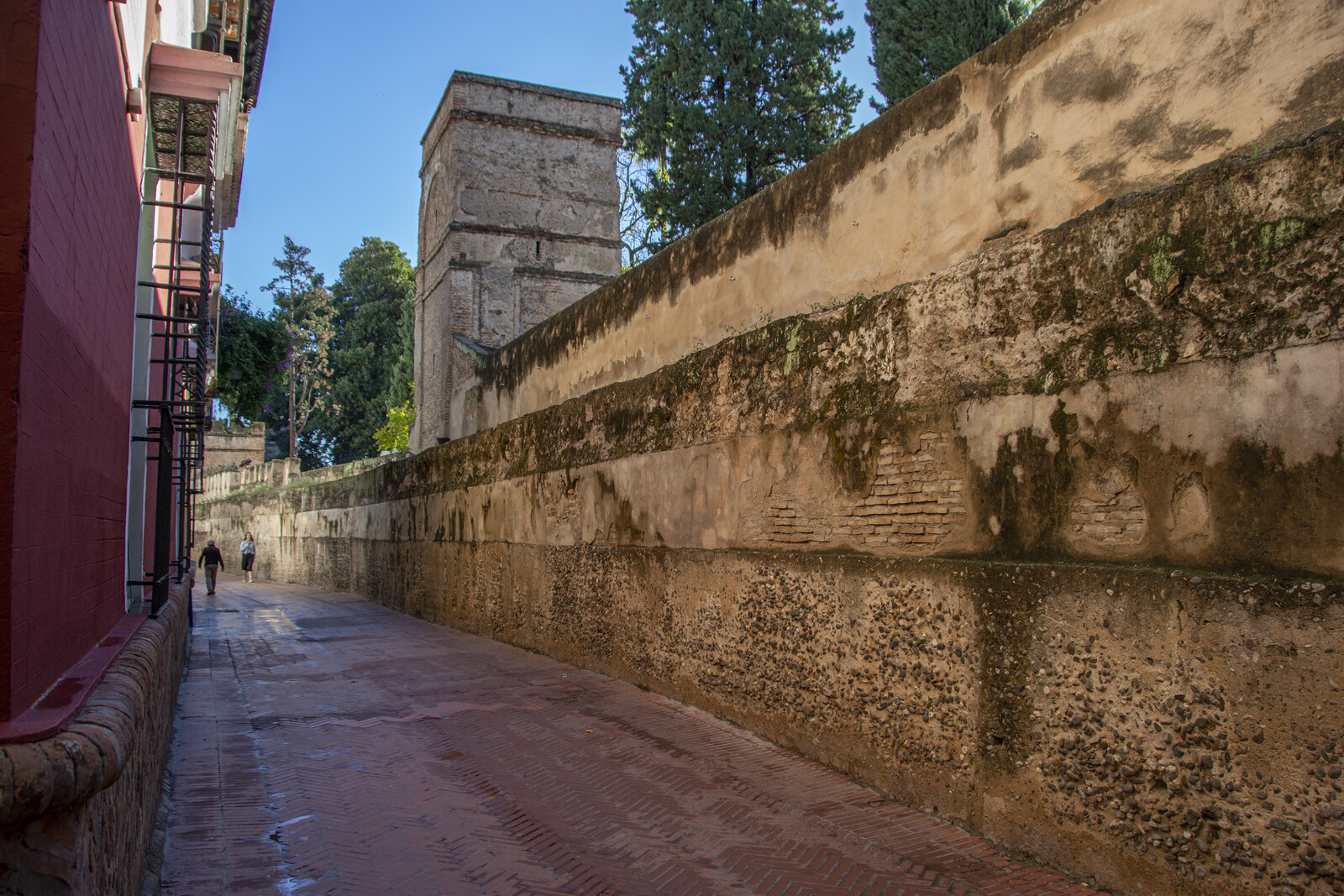
Look around first
What to notice
- Fortress wall
- Gaps in the masonry
- Two ceramic pipes
- The narrow line of the alley
The story of the place
In this narrow passage by the Royal Alcázar of Seville ended an old city water conduit that supplied water to the city reservoir and the palaces. At first, it carried water to the gardens of Buhayra, and then its route was extended into Seville. Outside the city, the structure stood on arches, but in the early twentieth century almost all of them were dismantled. The alley’s narrow line survived as the city end of this long route.
The alley was once called Muro del Agua—“Water Wall.” The water did not run along the pavement here: it was carried inside the fortress wall through two ceramic pipes. The route of those pipes began with a line of stones whose purpose no one understood anymore.
In eleven seventy-one, the Almohad caliph Abu Yaqub Yusuf completed the suburban palace of Buhayra and wanted to water the gardens laid out around it. He assigned the search for water to al-Hajj Ya’ish, a geometer from Málaga and an engineer in the service of the Almohad Caliphate. Ya’ish earned his living designing fortifications and mechanisms; now the new residence’s water supply depended on his calculations.
Beyond the Carmona Gate, the engineer noticed old stones protruding from the ground. He ordered digging along them. Miners and hundreds of workers uncovered a buried canal and followed it toward Alcalá de Guadaíra, not yet knowing whether the ancient trace would lead to a working spring.
The answer came at a place residents considered al-Gabar Spring. When the excavation reached it, the spring suddenly dried up. Ya’ish understood: people had been taking water from a breach in a forgotten water conduit. He continued the work and found a water intake near the fortress of Alcalá de Guadaíra. The canal was cleared, leveled, and put back into use.
At first, the water reached the gardens of Buhayra. After that, Yusuf expanded the task: to bring water into Seville, to the city reservoir and the palaces of the Royal Alcázar of Seville. The chronicle records the exact day—February thirteenth, eleven seventy-two—when water entered the city. From the Carmona Gate, one branch ran along the wall toward the Royal Alcázar of Seville; on this stretch, the flow was divided between two clay pipes.
Most of the outer arcade of the water conduit was dismantled in the early twentieth century. Its city end survives here. In gaps in the wall, you can see two pipes, nearly thirty centimeters in diameter, laid one above the other. There has been no water in them for a long time, but the wall’s former arrangement remains in the name Callejón del Agua—the alley of water.
Useful on site
Public alley, free exterior passage; comfort depends on the crowds, nearby work, and respect for residential windows.
Checked: June 27, 2026. Check the official source before visiting.The alley is narrow: find a wider spot to listen, and do not stop in the middle of oncoming foot traffic.