 Guide On Map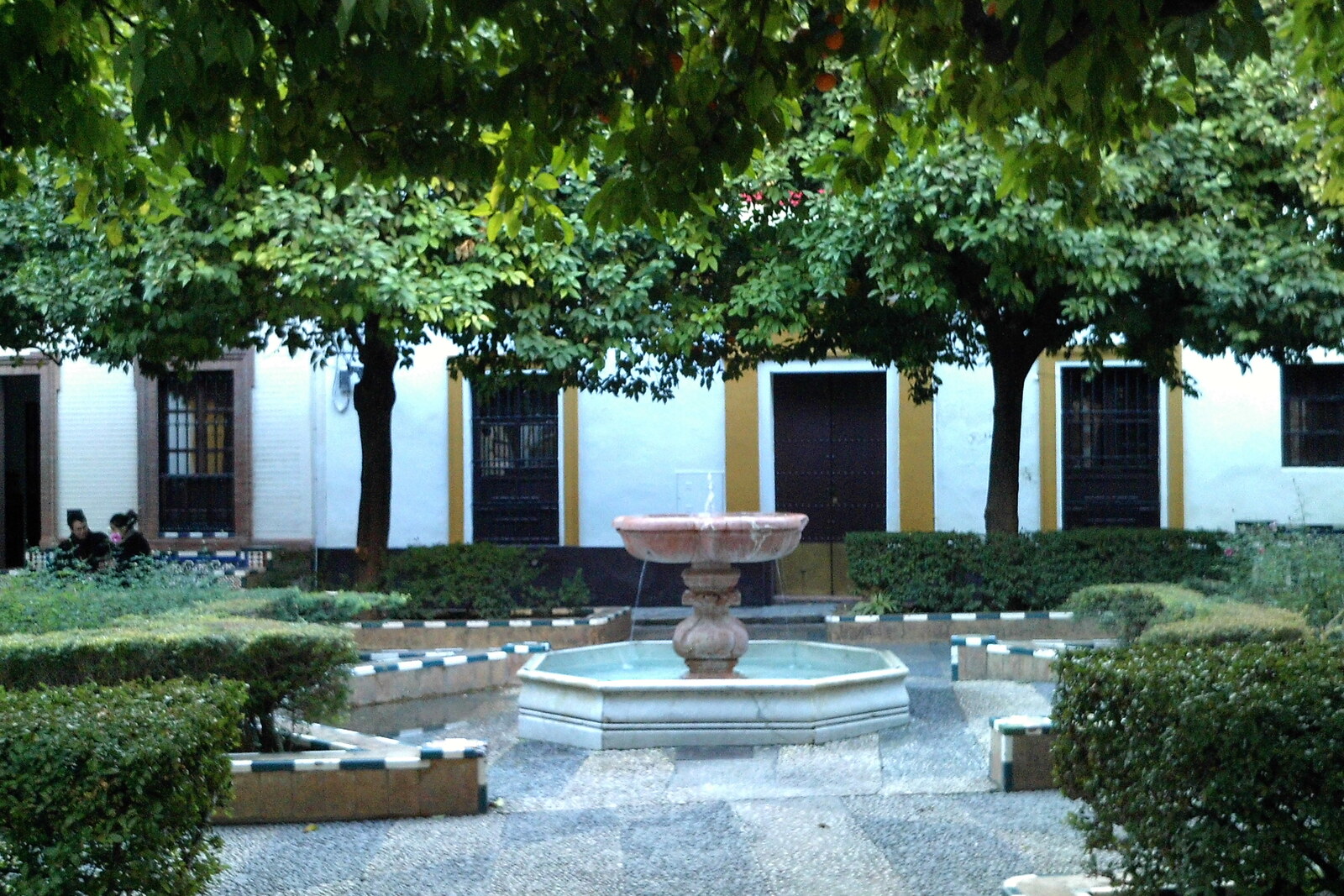
Look around first
What to notice
- Central fountain
- Raised platform with flower beds
- Orange trees
- Brick benches with tiles
The story of the place
The city authorities cleared this plot, which was occupied by residential houses, and set it aside for an open city square. The central fountain, raised flower bed, orange trees, and brick benches with tiles make up its present-day garden appearance. This design appeared when the Santa Cruz neighbourhood began to be prepared to receive visitors.
The name on the signs belongs to Doña Elvira López de Ayala, a Castilian noblewoman from the turn of the fourteenth and fifteenth centuries. She inherited from her father property in the former Jewish quarter. Doña Elvira López de Ayala died long before the square appeared, but houses, a garden, and a stable yard here continued to be called after her. The name then passed to a theater.
Part of the present-day square and the neighboring plot were occupied by a corral de comedias—a theater set up in a courtyard. Galleries and boxes ran around the stage, and spectators sat on benches or rented chairs. At the beginning of the seventeenth century, this establishment was managed by Isabel López. The old structures were already falling apart, and its income depended on every performance staged. Isabel decided to build a covered two-story theater, but she did not want to invest her own money.
The funds came from Juan Cano, a wine merchant. He expected to recoup his investment at two ducats from each performance and collect the box fees. They first agreed on five hundred ducats. Cano hired craftsmen and had new galleries, seating, paving, and roofing installed. The money ran out, and Isabel persuaded him to invest another equal amount.
The roof protected the audience from sun and rain, but before long an old wall collapsed along with the gallery adjoining it and part of the roof. For Cano, stopping the work meant losing what he had already invested. He paid again for walls, corridors, and a roof. By sixteen oh five, the debt to him had reached twenty-six thousand three hundred seventy-five reals. In his marriage contract, Cano separately recorded two thousand ducats that had still not been repaid to him for work in Doña Elvira López de Ayala’s garden. As long as the debt remained, the wine merchant controlled the income from the theater boxes.
The investments did not disappear at once. Doña Elvira’s Corral de Comedias became a favorite stage for Sevillians: from spring sixteen eleven to spring sixteen fourteen alone, two hundred sixty-eight plays were performed here. But in sixteen thirty-one, the aging walls and competition from new theaters finally forced it to close. Later, the premises were used as a warehouse, and by sixteen seventy-six documents described the plot as already empty, with no buildings.
The present-day square was opened in eighteen twenty-six by the city governor José Manuel de Arjona: to create a new public space, he ordered the demolition of the block of houses that stood here. Doña Elvira López de Ayala’s name was restored to the square in eighteen forty-five. The fountain, raised central area, flower beds, orange trees, and brick benches with tiles appeared in nineteen twenty-four, when tourism commissioner Benigno de la Vega-Inclán tasked the municipal architect Juan Talavera y Heredia with preparing this corner of the Santa Cruz neighbourhood to receive visitors.
Not one wall of Juan Cano’s theater remains here. Its exact location has to be reconstructed from notarial contracts, and only the name of Doña Elvira López de Ayala’s old property survives in the square.
Useful on site
Public square, free outdoor access; restaurants and terraces follow their own schedules.
Checked: June 27, 2026. Check the official source before visiting.Do not look for a surviving stage or theater markings—the corral has disappeared; listen without blocking the entrances to the houses.