 Guide On Map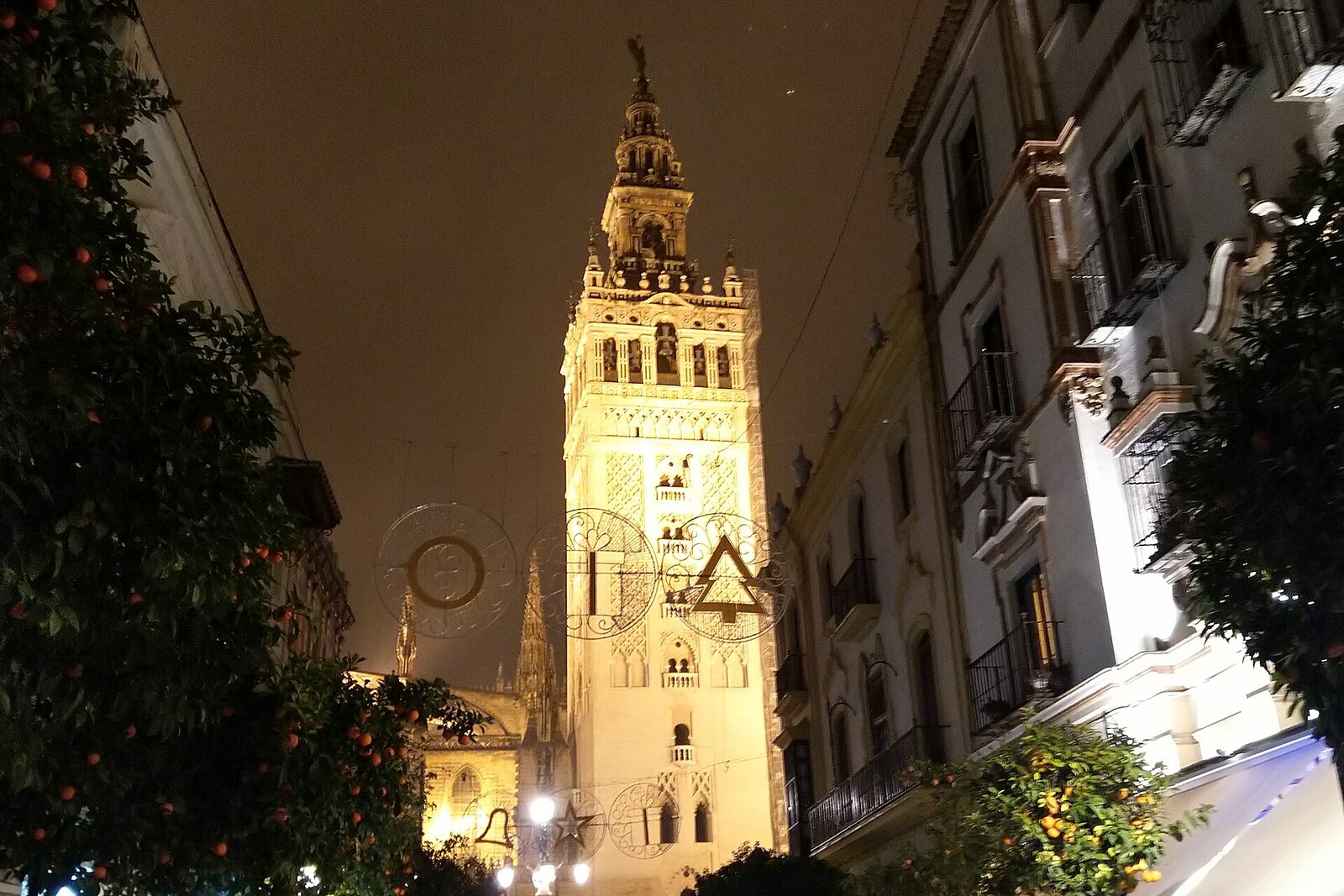
Look around first
What to notice
- Opening toward the Giralda
- Broad roadway
- Façades along the new street line
- Main façade of the Church of Santa Cruz
The story of the place
Calle Mateos Gago runs from the main façade of the Church of Santa Cruz to Seville Cathedral. Its broad roadway, façades aligned along a single line, and opening toward the Giralda set it apart from the narrow streets around it. Workshops of makers of leather shoes once stood here, and the street was called Calle Borceguinería. Its present name recalls the cathedral canon who lived nearby and served in Santa Cruz Parish.
A broad opening toward the Giralda was created here to accommodate a heavy procession. In nineteen oh four, parishioners of the Church of Santa Cruz founded a religious brotherhood: every Holy Tuesday, they wanted to carry out a sculptural scene of the Crucifixion and join the common Holy Week route at Seville Cathedral.
The very first procession showed just how narrow the streets here were for this. In nineteen oh five, the borrowed platform carrying the sculptures could not even pass through the church doorway, and the brotherhood had to begin the procession from another monastery. Later, it acquired its own, more compact platform, but it still could not travel along the entire street directly to Seville Cathedral. The procession turned onto Calle Guzmán el Bueno and Calle Segovias; at the narrowest point, the lower carved panels were removed from the platform, it was carried through, and then reassembled.
The brotherhood sought to have the street widened. At the same time, city councillors were preparing Seville for the Ibero-American Exposition and intended to remove the narrow passageways in the center. Under mayors Antonio Halcón and Federico Amores, expropriation and demolition began. Owners and residents lost the buildings that projected beyond the new façade line; a roadway took their place. By nineteen twenty-three, the main section had been widened, and the brotherhood had a short route to Seville Cathedral, which it used for several decades.
The Church of Santa Cruz links this redevelopment to the man whose surname appears on the street signs. The street was formerly called Calle Borceguinería: makers of leather shoes kept workshops here. On June second, eighteen ninety-three, the city council unanimously named it after Francisco Mateos Gago, who had died three years earlier.
Mateos Gago was a cathedral canon and a professor of theology; his church income and university salary allowed him to collect ancient coins and pursue archaeology. But when cholera arrived, he performed a different kind of work here. The epidemic had already taken his parents when he was seven. During the outbreaks of eighteen fifty-four and eighteen sixty-five, the priest proposed to the rector of Santa Cruz that he visit the sick, although with every visit he risked infection himself. The diocesan obituary recalled that at night he waited for a call by the window, keeping beside him a small box of holy oil for anointing the seriously ill.
Mateos Gago survived both epidemics and served in Santa Cruz Parish until his death, living on the nearby streets of Calle Cruces and Calle Santa Teresa. The nearby Calle Borceguinería was therefore chosen for posthumous municipal honor. Almost nothing remains here of the old workshops and the houses demolished for the processions; what remains is the parish priest's surname and the width of the street between his church and Seville Cathedral.
Useful on site
Open city street; bars, shops, deliveries, and crowd density vary with the time of day.
Checked: June 27, 2026. Check the official source before visiting.Bar Giralda remains an establishment, not a freely accessible museum. View the interior only when the entrance is open, be mindful of staff at work, and ask before taking photographs.