 Guide On Map
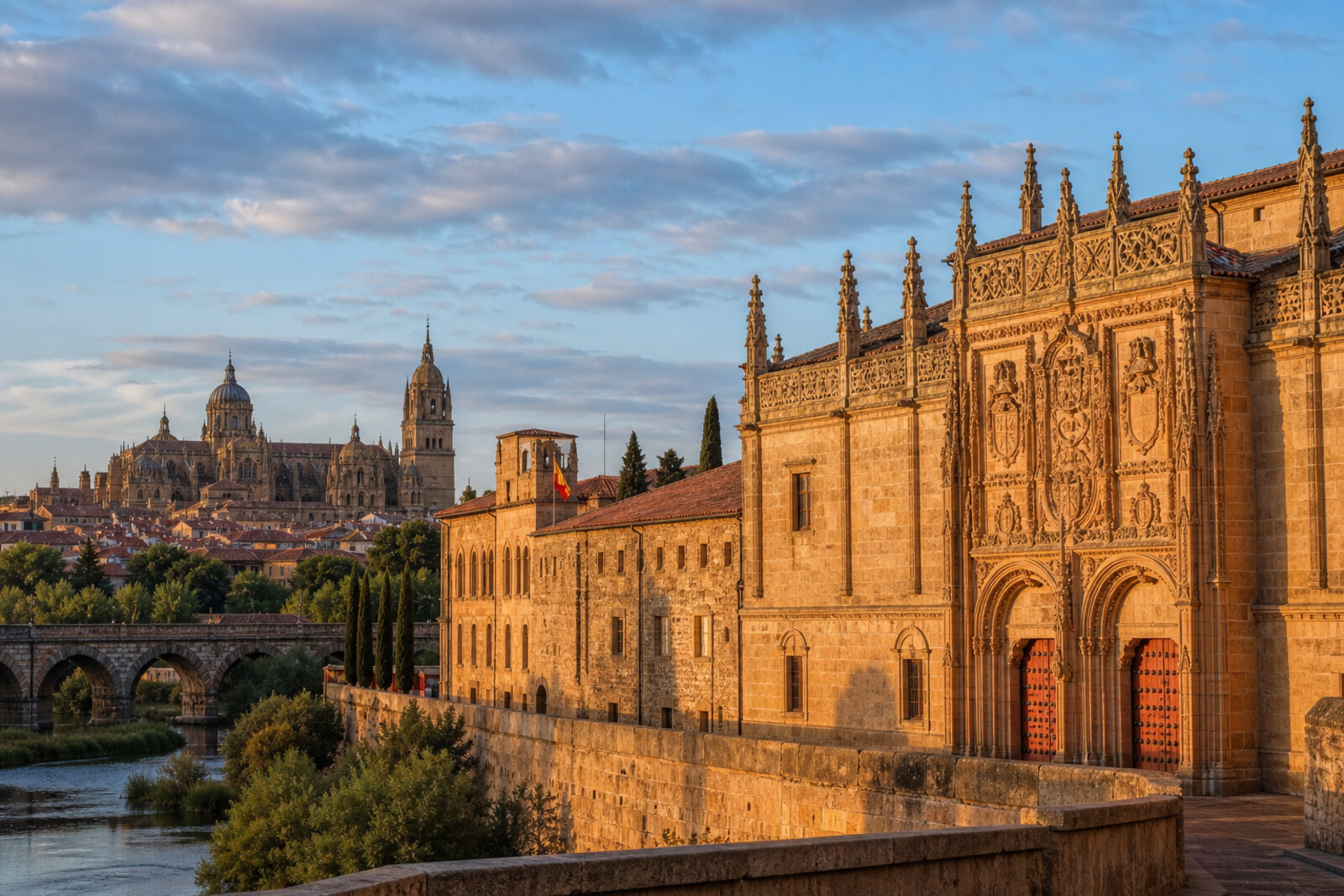
Golden Salamanca: University, Cathedrals, and the Tormes
From Plaza Mayor through the university quarter to the Roman Bridge of Salamanca
Guide On Map on your phone
Open the walk like a regular app
It takes about 10 seconds to install. No app store needed.
The whole path
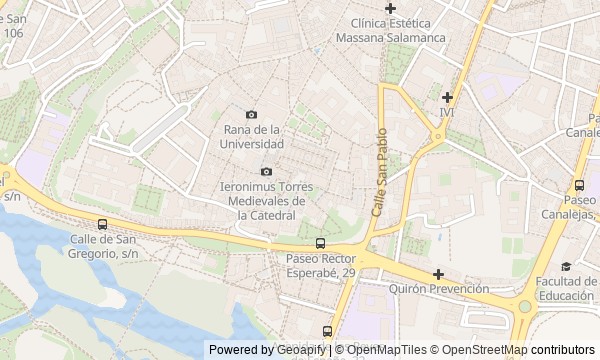
Route map
About the walk
You will begin in Plaza Mayor, among arcades, balconies, and stone medallions. Then you will make your way to Casa de las Conchas and enter the university quarter: small courtyards, carved façades, old lecture halls, and two cathedrals joined by their walls and tower.
The route will then bring you back to La Clerecía, lead you down to an underground sacristy, take you to a Dominican convent, and descend toward the Tormes. By the bridge, an ancient stone figure will be waiting, with a seam running across its body.
The story rests on documents, family calculations, and objects with unexpectedly complicated fates. You will find out why people paid for two balconies regardless of festivities, why a painted sky ended up on a wooden vault, and how a legend could bring a broken stone back to the bridge.
After this walk, you will read Salamanca's golden façades as traces of particular deals, lawsuits, expulsions, and rescues.
Why this order
Plaza Mayor first presents the city as a shared space whose owners fought over it; nearby Casa de las Conchas moves that same conflict inside one family and one fortified palace. From its façade, Rúa Antigua leads to two university courtyards: first to the rescued painting at Escuelas Menores, then to the institution that originally owned it. From Patio de Escuelas, the cathedrals come into view, where centuries of building work quite literally joined the old structure to the new one. Returning by Plaza de Anaya to La Clerecía continues the theme of education, while showing how a teaching complex changed hands after a royal order. Beyond the grand buildings, the route descends to the remains of a small church sacristy that tradition turned into a secret school. Nearby Convent of San Esteban sets real monastic scholarly disputes and advocacy at court against that legend. From the convent, the road goes downhill to the Tormes, where an ancient verraco ties the final stop back to the route's opening theme: the city once again decides the fate of a stone object, this time under the influence of a book.
Those who want to see the old center's major landmarks in one coherent walk Those interested in university history and the fates of buildings Those who prefer verified accounts to urban legends retold as fact
Those looking only for a light survey of façades Those who do not enjoy long historical narratives Those wanting a route entirely through the modern city
Before you go
Decide in advance which interiors you want to enter: the university buildings, cathedrals, La Clerecía, and Convent of San Esteban may each have their own visiting rules, access checks, and separate entrances. On the day of your walk, check the official pages for the places you choose, especially if you hope to see the Sky of Salamanca or climb the towers. Do not tie the entire route to access to the Cave of Salamanca: its story still makes sense from outside, and the interior may be closed. Charge your phone and bring headphones—Plaza Mayor and the university façade can be noisy. A camera with zoom will help with the small carvings, but first try to spot the details with your own eyes.
When to go
Allow about 4 hours for the route without rushing. If you explore both cathedrals in detail or add a climb and a guided visit to La Clerecía, plan for roughly 4 hours 30 minutes. Try not to squeeze the time inside the university buildings and Convent of San Esteban: there, a short stop can easily turn into a rewarding visit. Leave a little extra time for lines and possible access restrictions.
Backup plan
If interiors are closed, follow the whole sequence from outside: the square, Casa de las Conchas, La Clerecía, the university courtyard, the cathedral façades, Convent of San Esteban, the site of the Cave of Salamanca, and the bridge. At the university, focus on the façade's composition and the figure of Fray Luis de León; at the cathedrals, find the late details of the north portal and walk around the complex to where the two churches can be seen together. Listen to the story of the Sky of Salamanca at Escuelas Menores even if the painting itself is closed. At the Cave, do not look for a literal grotto: what matters is the surviving fragment of a vanished church. This version loses some interiors, but it preserves the movement from the official stages of learning to legend and a finale above the Tormes.
Route conditions
Surface. Paved — 2.6 km (data covers 76% of the route)
Stairs. Flights: 2, 7 m in total
Access. Wheelchair — no; stroller — limited (stairs)
Facilities. Toilets — 3; drinking water — 3
Elevation. Ascent — 46 m; descent — 77 m
OpenStreetMap extract of July 4, 2026: database data, not a check on the ground. Data © OpenStreetMap contributors, ODbL licence
Walk plan
Open in maps ↗- 1
Plaza Mayor
Here it becomes clear how lawsuits, balcony leases, and city revenues determined the form of the city's principal square. - 2
Casa de las Conchas
The palace will show how a dispute over a country estate determined the fate of a city house and its owners. - 3
Escuelas Menores and the Sky of Salamanca
This stop explains why the final part of the university mural had to be removed from the wall and reassembled on a new backing. - 4
Escuelas Mayores of the University of Salamanca
In the university assembly hall, a documented confrontation is distinguished from a later, polished legend. - 5
Old and New Cathedrals
The two churches reveal the result of a temporary building decision that stretched across generations. - 6
La Clerecía and the Pontifical University of Salamanca
The complex reveals what remained after a secret order, a nighttime cordon, and a change of owners. - 7
Cave of Salamanca
Here, a church service room is set apart from the legend of a seven-year school of magic and a clever escape. - 8
Convent of San Esteban
The convent connects university calculations with years of attempts to advance a disputed project at the royal court. - 9
Roman Bridge and the Verraco
The final stop traces how an official's order, a museum, and a literary scene changed the fate of an ancient figure.
Route features
Everything you need stays in the browser
Progress, saves and your trip plan are stored on this device.
Add Guide On Map to your home screen so the walk opens outside the browser.
How we handle sources, maps and corrections: our editorial standards