 Guide On Map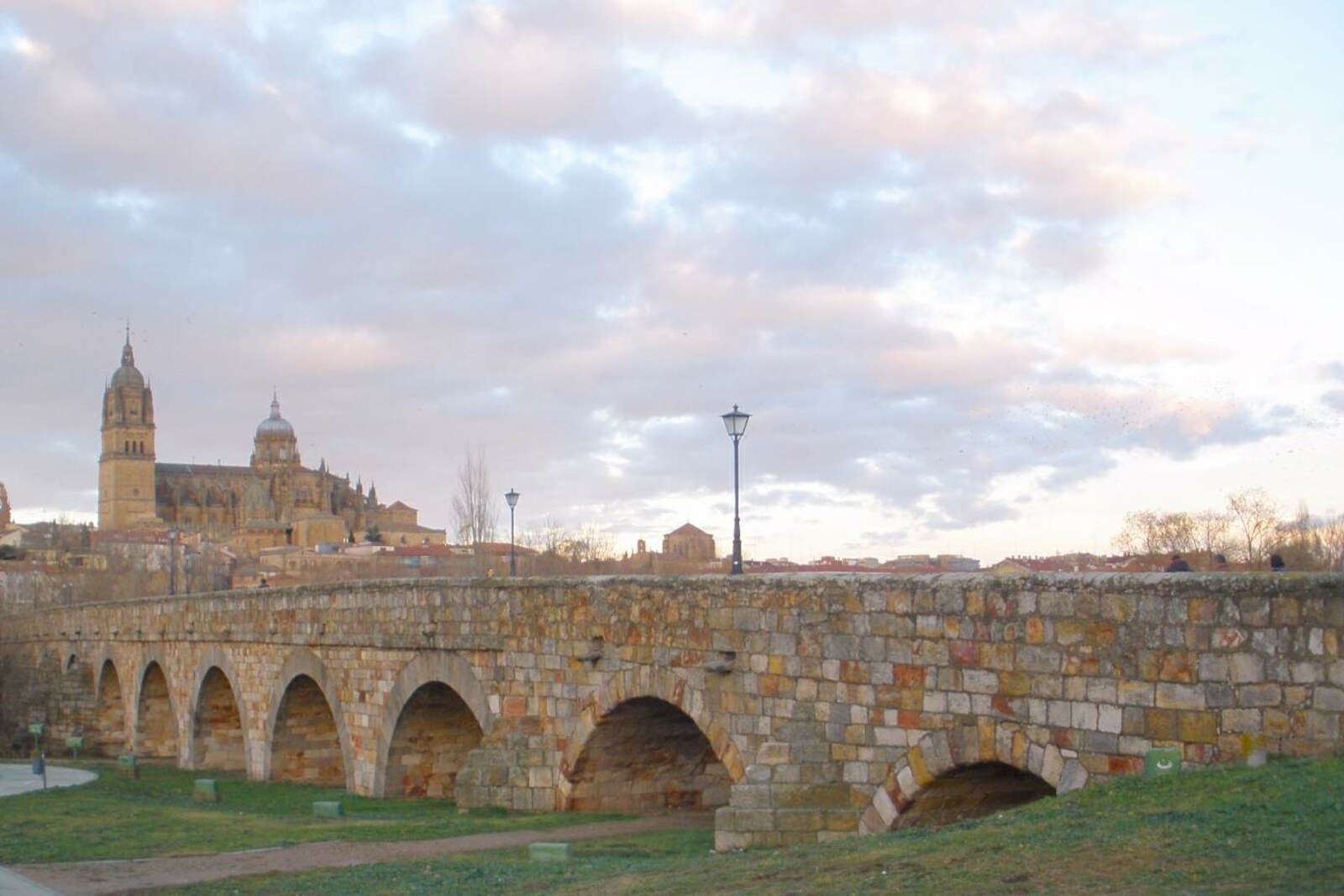
Look around first
What to notice
- Fifteen ancient arches
- Rebuilt arches
- Headless verraco
- Seam on the stone body
The story of the place
The Roman Bridge of Salamanca was the southern entrance to Roman Salamanca. Here, the Vía de la Plata crossed the Tormes and continued to the city gates. Fifteen of its twenty-six arches, those nearest the old center, retain Roman masonry; the rest had to be rebuilt after floods. At the city end of the bridge stands a headless granite animal, its body joined back together after it broke apart.
Archaeologists call such figures verracos. They were carved by the Vettones, who inhabited these lands before the Romans and raised livestock. The stone represents either a bull or a boar. Exactly why the Vettones set up such animals is unknown: perhaps they marked pastures and boundaries, or were associated with the protection of herds. The original location of this verraco is also unknown, but the medieval city charter already mentions the “bull of the bridge.”
In the autumn of eighteen thirty-four, the civil governor José María Cambronero ordered it thrown from the parapet. The governor was the province's chief government official and sought to destroy signs of vassal dependence. As early as eighteen thirteen, deputies of the Cortes of Cádiz had ordered the removal of monuments by which former lords marked their right to judge inhabitants and demand obligations from them. Cambronero extended this order to stone animals as well.
A later version claimed that the governor mistook the verraco for an insulting sign erected by Charles V after the uprising of the Castilian cities. Neither the king nor the uprising is named in Cambronero's surviving orders. The story of the humiliation of rebellious Salamanca was printed only in eighteen forty-six.
By the governor's order, the figure was pushed down toward the Tormes. It broke apart and lay almost buried by the bridge for more than thirty years. Then members of the provincial commission for the protection of monuments obtained permission to retrieve the fragments and sent them to the museum then housed in the Convent of San Esteban.
The verraco was returned to the bridge because of a book. In the anonymous novel Lazarillo de Tormes, first printed in fifteen fifty-four, Lázaro begins his service with the blind man at this stone bull. This is a literary scene, not a record of a real event.
Lázaro was an orphan whom his poor mother gave to a traveling blind man as his guide. The blind man earned money by reading prayers, telling fortunes, and giving advice about treatment, while the boy depended on him for food. When the collections in Salamanca seemed too small to the master, the two set off toward Toledo. At the bridge, the blind man told Lázaro that a hum could be heard inside the stone bull, ordered him to put his ear to it, and struck the boy's head against the granite. In this way, the master wanted to teach his new guide distrust and cunning from the start.
Lázaro took the lesson literally. He learned to steal bread and money from his master, and in Escalona he persuaded the blind man to run and jump over a supposedly flooded stream. A stone pillar stood in his path. The blind man struck his head against it, and Lázaro left him in the care of the people who had gathered and went away. The narrator does not know what became of his master afterward.
In nineteen fifty-four, for the four-hundredth anniversary of the novel's first editions, the verraco was installed near the bridge again. It has stood in its present location since nineteen ninety-three. Its head is lost, and the join between the fragments remains visible on its body.
Useful on site
The pedestrian bridge and its approaches are accessible around the clock; admission is free.
Checked: June 24, 2026. Check the official source before visiting.First, examine the figures at the entrance, then walk onto the bridge and look back: the change in distance helps reveal where a single silhouette conceals work from different eras.