 Guide On Map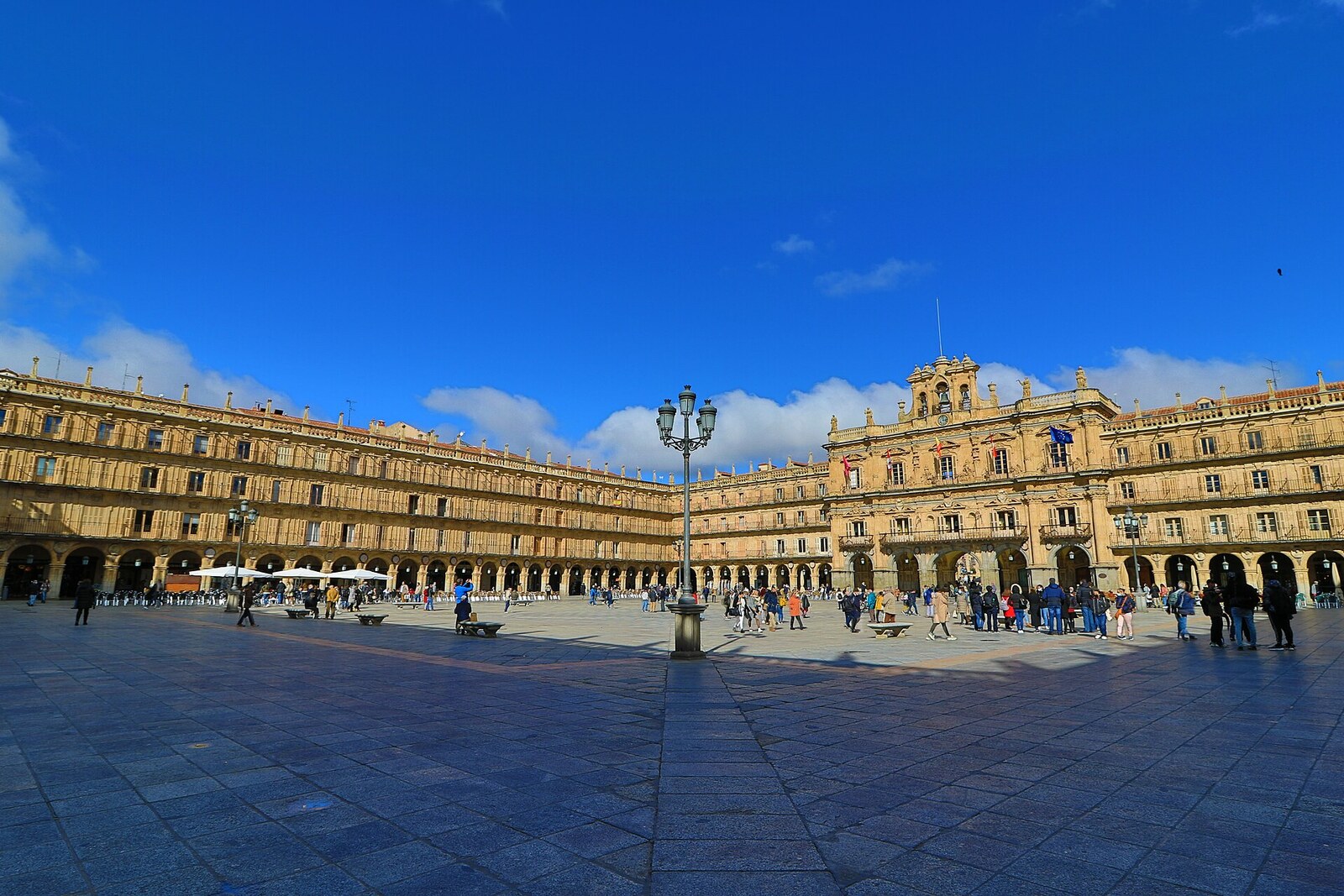
Look around first
What to notice
- Eighty-eight arches
- Continuous rows of balconies
- Salamanca City Hall with its clock
- Stone medallions
The story of the place
On June ninth, seventeen forty-seven, city councilors leased two balconies on Plaza Mayor to the university's Archbishop's College. The fee was six hundred reales per year. The contract stated separately that the money was due whether bullfights were held that year or not. The college was seeking a permanent place from which its members could attend city celebrations. At that time, one well-positioned balcony was valued almost like part of a house.
This contract explains the rows of identical balconies above the arcades. They were built for spectators, and their future income was calculated in advance.
Until the eighteenth century, Plaza de San Martín—Saint Martin's Square—extended here, named after the Church of San Martín, which survives beyond the passage to the neighboring Plaza del Corrillo. The old space was almost four times larger than the present one. Roads from different parts of the city converged here, so trade took place here every day. For festivities, wooden stands were put up, bulls were released, performances and processions were held. The municipality rented out seats and the windows of nearby houses to spectators.
In seventeen twenty-six, Rodrigo Caballero y Llanes arrived in Salamanca as royal corregidor—the monarch-appointed head of the city administration and court. He wanted to organize the market and replace the temporary stands with an enclosed stone space suitable for trade and major festivities. Caballero proposed surrounding part of the old square with arcades, adding three residential floors above them, and turning as many balconies as possible toward the center. Income from apartments and spectator seats was meant to reimburse the costs.
King Philip V approved the project and the cost estimate in seventeen twenty-nine, but provided no money. The councilors had to seek it in the city treasury and from house owners.
On two sides, the land belonged to the municipality and the parish of Saint Martin, so work could begin there immediately. On the other two stood houses of noble families, clergy, and university colleges. A shared gallery was to be built in front of them, after which the owners would have to pay their share and receive new premises—or sell their property to the city. For the owners, this meant a concrete choice: pay a substantial sum, lose some light and air because of the addition, or part with the house.
Some sold. Others appealed to the Council of Castile and began litigation. Work stopped for fifteen years. While the stone ring remained open, the balconies already completed brought in money: that same Archbishop's College agreed to pay for two places even in years without bullfights. Other colleges sought a perpetual right to a balcony and offered to build it at their own expense.
Caballero did not live to see the completion. He died in seventeen forty, ten years before work resumed. The councilors nevertheless brought the lawsuits to an end and, by seventeen fifty-five, enclosed the square. Behind some of the even façades, there were still no fully finished rooms for a long time; the last residential premises were completed only thirty years later.
The enormous Plaza de San Martín became several separate squares. The market rows moved to the present-day market, the church remained by Plaza del Corrillo, and here appeared eighty-eight arches, Salamanca City Hall, and continuous tiers of spectator seats. Among the stone medallions, the face of Rodrigo Caballero was later carved as well.
Bullfights were moved to a separate arena. Concerts and city festivities are now held on Plaza Mayor, meetings are arranged beneath the clock of Salamanca City Hall, and the former paid spectator seats still face the center.
Useful on site
Open city square, accessible around the clock.
Checked: June 24, 2026. Check the official source before visiting.Enter beneath an arch and first cross the square, then look at it from a corner: its geometry and the division of roles can be read from different points.