 Guide On Map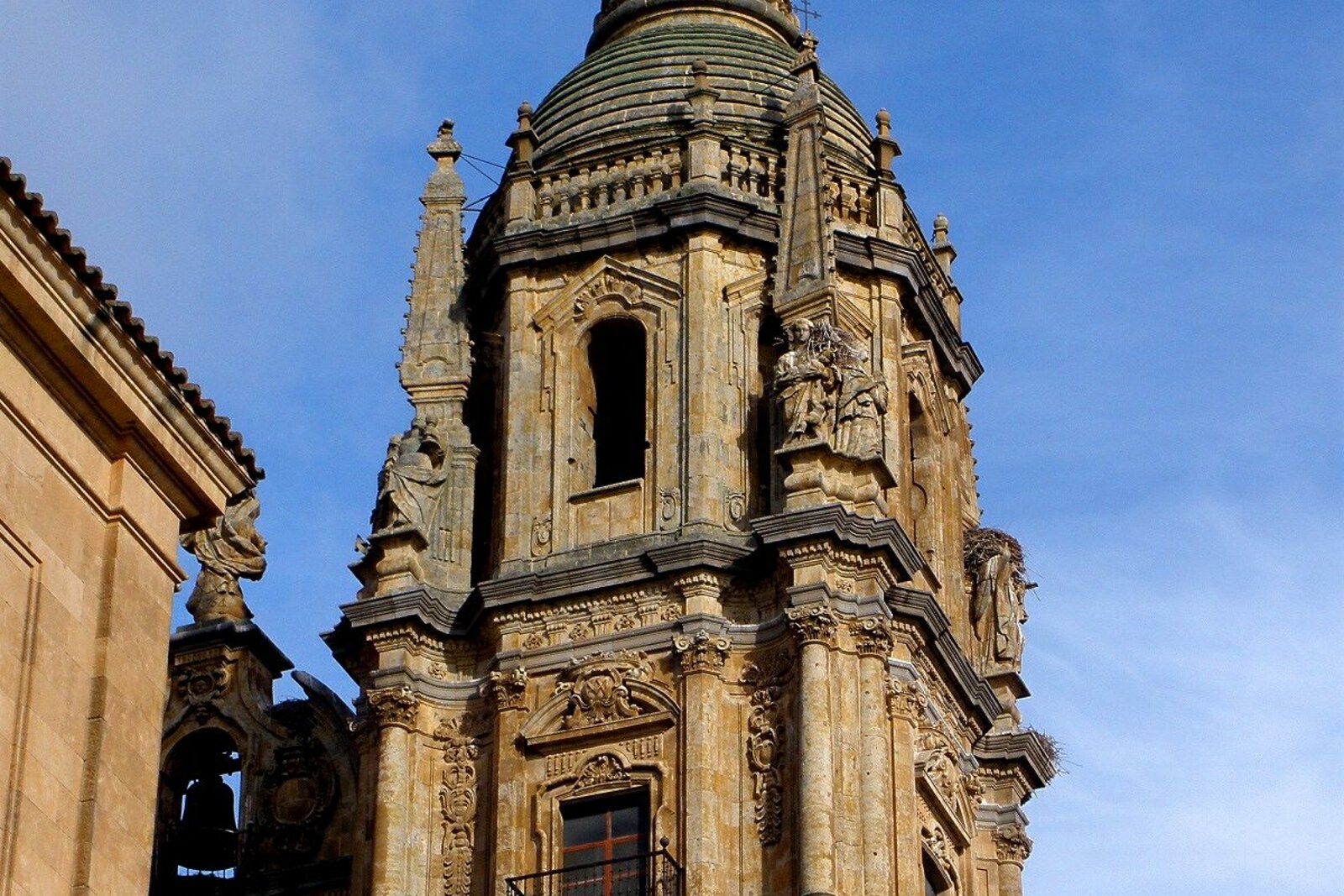
Look around first
What to notice
- Twin towers
- Central niche
- Stone figure with a book
- Stone lion
The story of the place
The complex began as La Clerecía: under one roof stood a church, teaching rooms, and living quarters for members of the Society of Jesus. Students of the Society of Jesus were trained here, while teachers also took part in classes at the old University of Salamanca; support came from funds bequeathed to the Society of Jesus by Queen Margarita of Austria. The façade is framed by two towers, a stone figure with a book stands in the niche above the main entrance, and a lion is visible at its feet. The Pontifical University of Salamanca now operates in these buildings, where not only theologians and specialists in canon law but also philosophers, psychologists, medical students, and programmers study.
On the night of April third, seventeen sixty-seven, cavalry surrounded this quarter. The city judge Pedro Pablo Pereda received a sealed packet from Madrid, with orders to open it only at night. During the day, he had time to study the entrances and the building plan, and he requested soldiers in the king's name without explaining to their commander why they were needed.
Behind the façade stood La Clerecía: a church, lecture rooms, and living quarters for members of the Society of Jesus. The complex was built with funds bequeathed to the Society of Jesus by Queen Margarita of Austria, the wife of Philip III. The Society of Jesus taught here, trained its own students, and took part in university classes; their salaries, meals, and lodging depended on La Clerecía.
In the morning, Pereda entered and read out the decree of Charles III: within a day, all members of the Society of Jesus had to leave their homes, and their property would pass to the Crown. No proven Salamanca crime was charged against them. In the text, the king cited serious reasons that he kept to himself. At court, the Society of Jesus was suspected of political unreliability, and its wealth and influence were disputed, but the expulsion extended across all of Spain and its overseas possessions. Secrecy was required to deny the community time to resist or conceal papers.
The members of the Society of Jesus handed Pereda the keys. Within a few hours, carriages were found for them; the journey was paid for by the very La Clerecía that had already been taken from them. At six in the morning on April fourth, the community was sent to Burgos, an assembly point for exiles. They arrived there on April tenth. The estate managers remained in Salamanca for almost another three months: they were questioned about income, land, accounts, the archive, and the internal organization of the Society of Jesus. Some former Salamanca teachers ended up near Bologna after further relocations. About twenty theologians were housed in a cramped four-story building, from which they went to scholarly disputations.
La Clerecía also lost its books. About twelve thousand volumes on theology, philosophy, law, medicine, mathematics, and Greek and Latin authors were transferred to the old University of Salamanca. This became one of the largest single additions to its library.
The vacated complex was divided for eleven years. Bishop Felipe Bertrán sought a seminary here: local families often lacked the money to send their sons to study, and university lectures, in his view, did not prepare a priest for work in a parish. In seventeen seventy-nine, he opened San Carlos Seminary in La Clerecía; the first pupils were between eleven and fifteen years old.
The church went to the Royal Clergy of San Marcos, an association of Salamanca parish priests that managed donations and services commissioned through wills. The clergy moved services here from their small Church of San Marcos. The entire complex received its city name, La Clerecía, from its new owner.
The inscription “Pontifical University” appeared because of another decision. In eighteen fifty-two, theology and canon law were removed from Spain’s state universities. At the request of the Spanish bishops, Pope Pius XII restored these faculties in Salamanca in nineteen forty as a new independent educational institution, and the diocese provided it with La Clerecía. “Pontifical” means that its ecclesiastical faculties are established by the Holy See and confer degrees in its name. Today, theologians, specialists in canon law, philosophers, psychologists, medical students, and programmers study in the central building.
A figure with a book remains in the niche above the central door. It was carved as Ignatius of Loyola, founder of the expelled Society of Jesus. The clergy who received the church added a stone lion at his feet—the symbol of Saint Mark the Evangelist—and declared the statue to be their saint.
Useful on site
In June 2026, the interior can be visited on a Spanish-language tour: on weekdays at 10:30, 11:15, 12:00, 12:45, 17:00, 17:45, and 18:30; on weekends and holidays, 13:30 and 18:45 are added. Ticket €4. La Clerecía’s towers are closed for work throughout June.
Checked: June 24, 2026. Check the official source before visiting.The main idea can be read from the street; check visits to the interior rooms and climbs to the towers separately, without treating them as a guaranteed part of the walk.