 Guide On Map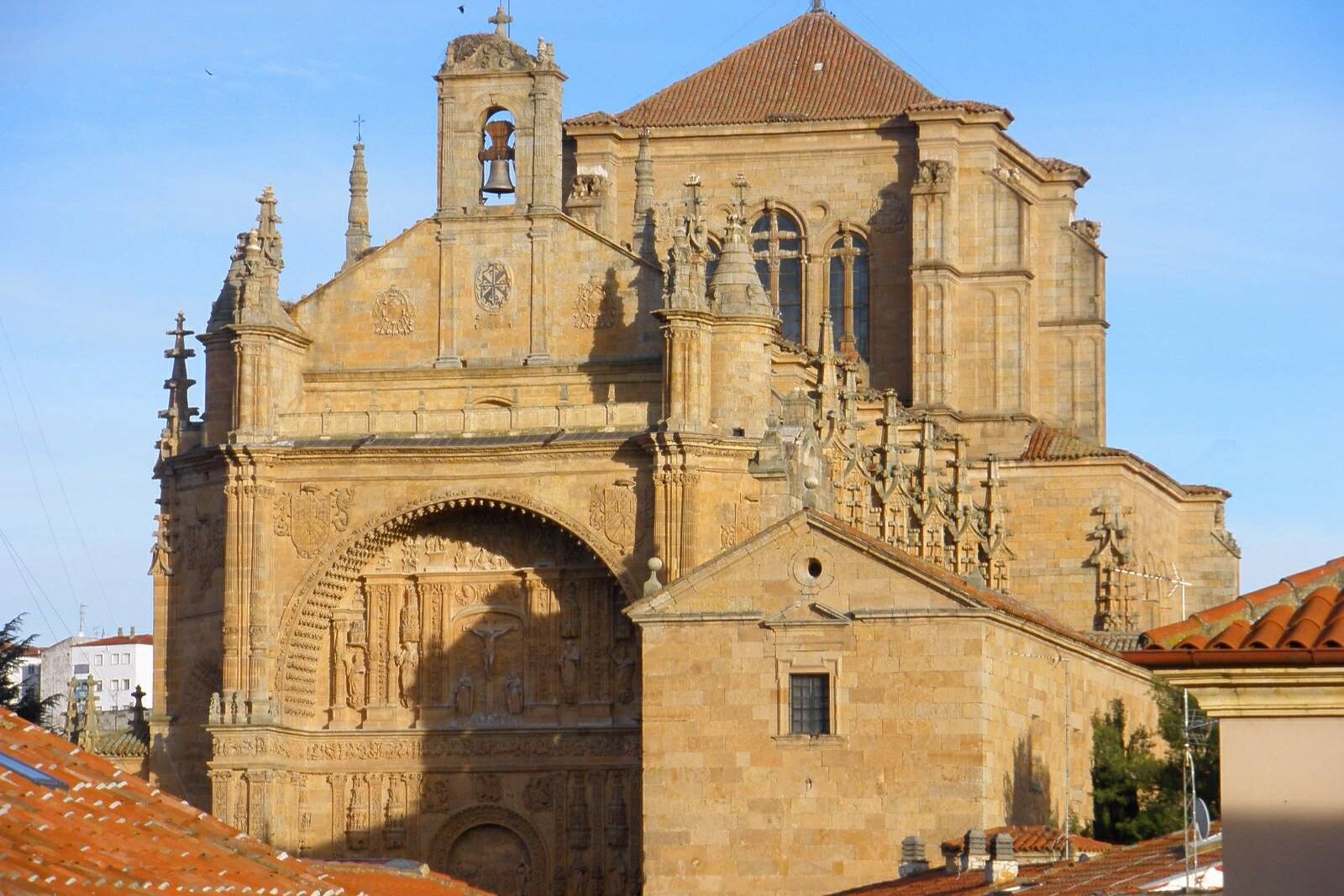
Look around first
What to notice
- Large carved portal
- Relief of the execution of Saint Stephen
- Entrance arch
- Convent façade
The story of the place
The Dominicans received a religious house here with a school of theology: the brothers trained future preachers, and some taught at the university. Construction of the large stone church with its carved portal above the old convent began only in fifteen twenty-four. Before that, the site was occupied by the parish church of Saint Stephen, given to the order after a flood; the builders placed the saint's stoning at the center of the façade. Behind the façade, the old Salón de Profundis survived.
In the winter of fourteen eighty-six, Christopher Columbus came to this Dominican convent with a calculation that no ruler had yet agreed to finance. The king of Portugal had already refused him ships. Now the navigator sought a meeting with Isabella I of Castile and Ferdinand of Aragon: he promised to reach Asian spice markets by sailing west.
San Esteban was well suited to such a conversation. The Dominicans belonged to the Order of Preachers and trained theologians here; some monks also taught at the university. Among them was Diego de Deza, a former professor of theology who had recently been appointed tutor to the heir to the throne, Prince Juan. Deza could assess Columbus's arguments and pass them on to the people who controlled the fleet and the treasury.
The dispute was not about whether the Earth was round. The educated participants did not deny that. They were trying to determine whether the ships would have enough supplies to reach Asia. Columbus shortened the Earth's circumference and stretched Asia far to the east; in his calculation, the ocean was much narrower than it really was. The royal experts considered the route too long and did not approve the project at that time. In their main objection, they were closer to the truth: if an unknown continent had not lain between Europe and Asia, Columbus's ships would not have reached their goal with the supplies they had.
A convent chronicle written more than a century later claims that the Dominicans gave Columbus a room and food and paid for his journeys while he defended his calculations. State payments to the navigator do indeed begin only in May fourteen eighty-seven. Documents from the time do not name the exact room, so by tradition the Salón de Profundis inside the convent is considered the place of the conversations. Its second name is Columbus Hall.
After the refusal, Diego de Deza continued to press the case at court. For Columbus, this meant several more years of waiting instead of a final departure from Castile. In April fourteen ninety-two, the monarchs signed an agreement with him: the future leader of the expedition received the titles of admiral, viceroy, and governor of the lands discovered, as well as a share of the revenues. In August, three ships sailed west, and in October they reached the Caribbean island of Guanahani. Columbus took the lands he found for the edge of Asia.
He did not forget who had kept his project alive at court. In fifteen oh four, after four voyages, Columbus wrote to his son that Deza had secured the Indies for the monarchs and had kept Columbus himself in Castile when he was about to leave. By then, the navigator was disputing his lapsed rights with the Crown, and the former monk of San Esteban was again needed by him as an advocate.
The present enormous church came later: construction began in fifteen twenty-four. The convent itself acquired its name much earlier. After the flood of twelve fifty-six, the bishop gave the Dominicans, who had lost their former home, the parish church of Saint Stephen that stood here and the neighboring plots. Stephen was the first Christian martyr: he was accused of blasphemy and stoned to death. The builders placed the scene of his execution at the center of the new façade. And behind that façade, they preserved the old Salón de Profundis, which convent tradition associated with the conversations between Deza and Columbus.
Useful on site
In June 2026, open daily 10:00–14:00, last entry 13:15, and 16:00–20:00, last entry 19:15. General admission 4,75 euros.
Checked: June 24, 2026. Check the official source before visiting.From outside, the convent's public face is clearly visible; the cloisters and interior halls require a separate visit and may not be fully accessible.