 Guide On Map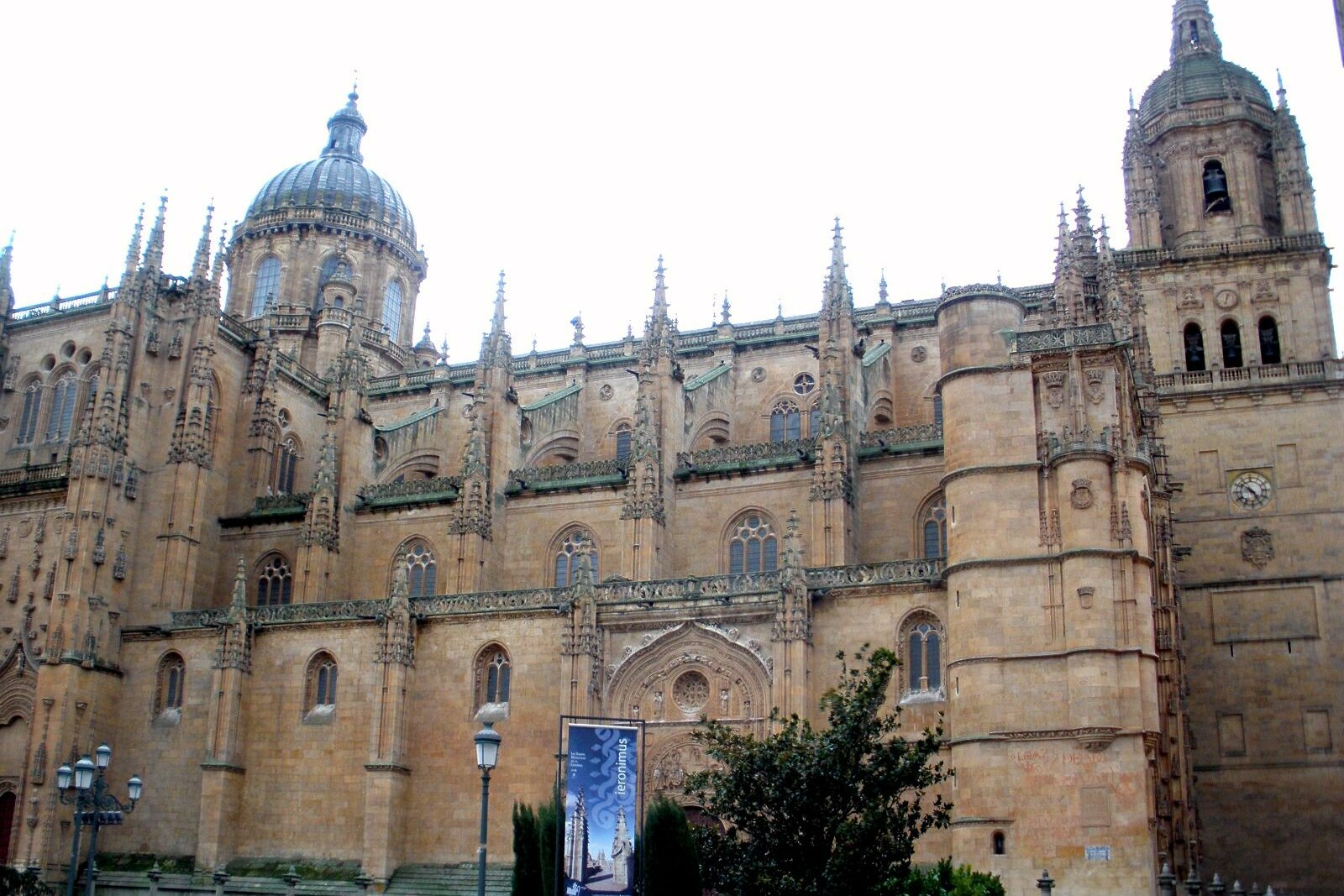
Look around first
What to notice
- The adjoining walls of the cathedrals
- Torre del Gallo
- The shared bell tower
- The west façade of the New Cathedral of Salamanca
The story of the place
The high bell tower of this pair of churches belongs to both of them: its lower part was once the tower of the old church, and the new one rose above it. The buildings have grown together through their walls, and the southern wall of the New Cathedral of Salamanca rests on the northern wall of its neighbor; for this connection, the side aisle of the old church was made narrower and reinforced from within. Torre del Gallo, a separate tower, remains above the crossing, while the large cathedral, dedicated to the Assumption of the Virgin Mary, is still called the New Cathedral of Salamanca by local people because it stands beside a twelfth-century church.
The two cathedrals stand here because of a temporary measure that lasted two hundred twenty years.
In fourteen ninety-one, the cathedral chapter—a council of canons that governed the main church of the diocese—decided that its church was too small, dark, and low. This is how the canons described what is now the Old Cathedral of Salamanca, dedicated to Saint Mary of the See. The university drew students and teachers to Salamanca, the city grew, and during major services there was not enough room for the congregation.
The canons were responsible for the cathedral's daily worship and its administration. Their maintenance and the cathedral's expenses were paid from tithes, donations, and rents from the chapter's houses and lands. They secured the support of King Ferdinand the Catholic, who sent experienced master builders to choose a site and draw up plans for a large church. They decided not to touch the old one for the time being: if it were dismantled first, the bishop, clergy, and congregation would have to go without a cathedral church for years. The New Cathedral of Salamanca was begun beside it on May twelfth, fifteen thirteen. Once it was completed, the old cathedral was to be demolished.
Generation after generation paid for the construction: alms, loans, fees for family chapels, and burial places were added to the usual income. Work stopped and resumed. The canons who made the original decision died; then their successors died. The New Cathedral of Salamanca did not open until August seventeen thirty-three.
Services continued in the old cathedral throughout this time. When the replacement was finally ready, the chapter abandoned the demolition. By then, the two churches could no longer be separated without further rebuilding. The southern wall of the New Cathedral of Salamanca rests on the northern wall of the Old Cathedral of Salamanca; to accommodate it, the old cathedral's side aisle was narrowed and reinforced from within. The high bell tower of the New Cathedral of Salamanca was built directly above the former bell tower of the Old Cathedral of Salamanca.
The large cathedral is officially dedicated to the Assumption of the Virgin Mary, but in the city it is called the New Cathedral of Salamanca, in relation to the neighboring twelfth-century church. The Old Cathedral of Salamanca retained its own tower above the crossing, Torre del Gallo, while the high bell tower belongs to both buildings. Its lower part was the tower of the Old Cathedral of Salamanca even before the first stone of the New Cathedral of Salamanca was laid beside it.
Useful on site
In June 2026: Monday–Saturday 10:00–20:00, last entry 19:15; Sunday 10:00–18:00, last entry 17:15. Combined ticket 10 euros, museum audio guide included.
Checked: June 24, 2026. Check the official source before visiting.The later figures can be seen from outside; to understand how the joined churches are arranged, it is useful to go inside or walk around outside to the point where their junction is visible.