 Guide On Map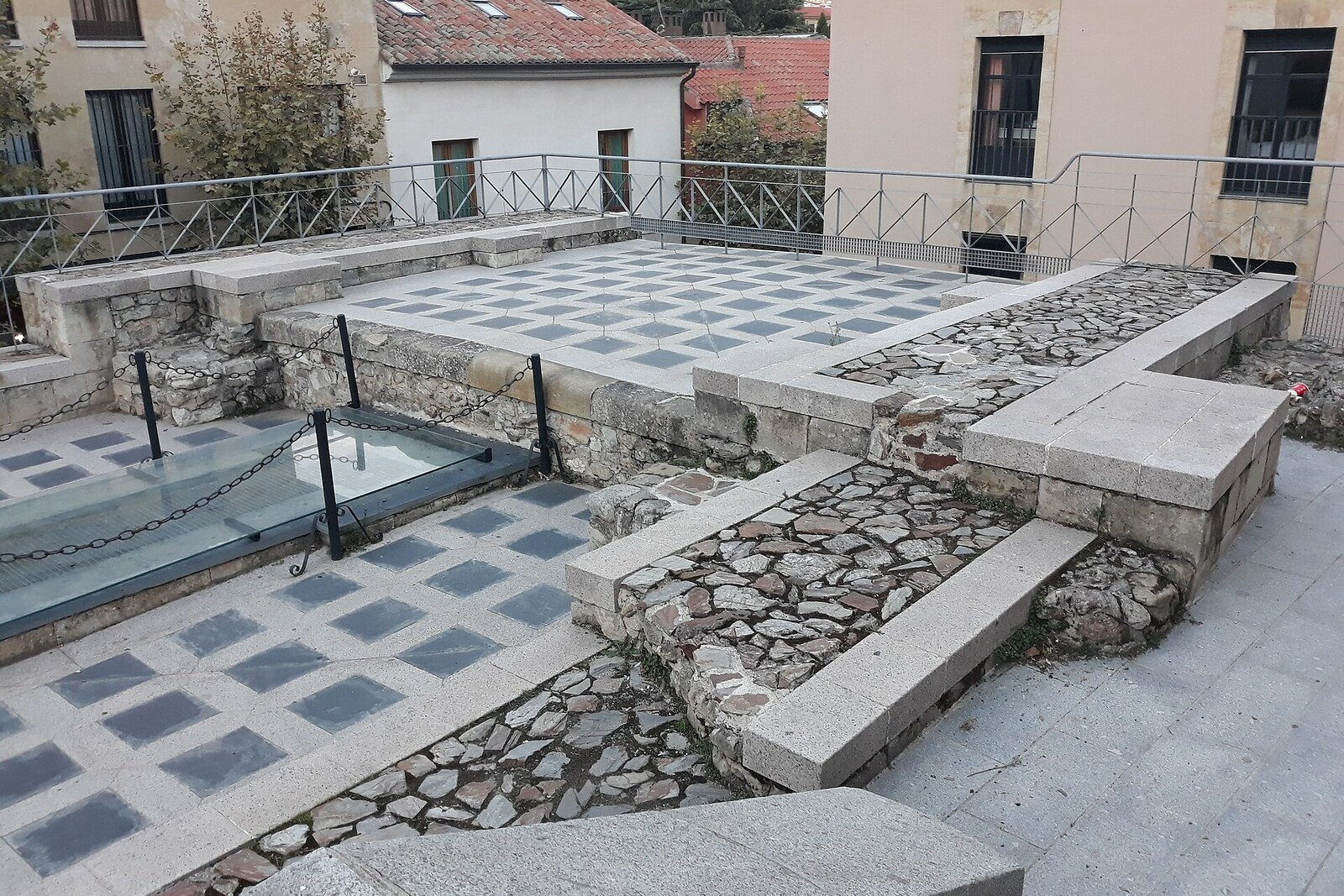
Look around first
What to notice
- Stone vault
- Vaulted staircase
- Doorway
- Neighboring tower
The story of the place
The steep slope allowed the builders of the Romanesque Church of San Cebrián to create a service room beneath its altar. They came down here by a narrow vaulted staircase to fetch furnishings and prepare for worship. When the dilapidated church was demolished, its stone went into the construction of the New Cathedral, while the vault, doorway, and part of the steps remained from the underground room. The city links the neighboring tower to this cave, although its owner had nothing to do with the legend.
According to a Salamanca legend, Enrique de Villena, a student seeking forbidden knowledge, was locked in this very underground room. His fellow students twice arranged for the lot to fall to him to pay. The first time, Enrique paid for everyone; the second, he decided to deceive the teacher.
The legend called the teacher the sacristan—a church servant in charge of the furnishings, who secretly taught magic. He took on seven students for seven years. At the end of the course, one of them had to pay for the others, and the debtor was locked up here until friends or relatives sent money.
Enrique hid in a large cracked water jar and put back the things that had been lying on its lid. When the sacristan opened the room and did not find the prisoner, the books left on the table suggested the only explanation to him: the student had become invisible. The frightened witnesses left, forgetting to lock the door. Enrique climbed out of the jar, went up the stairs into the church, spent the rest of the night behind the altar curtain, and in the morning left through the doors opened for Mass. A few days later, he told of the trick and secured such a post for the teacher that the teacher could no longer continue the lessons. The underground school closed.
In another version of the same legend, the sacristan becomes the devil, the payment becomes eternal service, and the jar is replaced by a shadow. Enrique leaves it in the room so that the teacher will think the prisoner is still there, and escapes to freedom, but for the rest of his life he casts no shadow.
This is a legend, and one with an obvious chronological error: one retelling dates the escape to the year thirteen twenty-two—sixty-two years before Enrique's birth. The historical Enrique de Villena was a noble courtier, writer, and translator. He served at royal courts, undertook difficult translations in hopes of recovering lost estates, and died impoverished. His interest in astrology and unusual books earned him a reputation as a sorcerer: after his death, King Juan II ordered Enrique's library examined, and about fifty scholarly volumes were burned. That gave storytellers a suitable student for Salamanca's underground school.
The “cave” itself was made by people. In the twelfth century, the builders of the Romanesque Church of San Cebrián, dedicated to Saint Cyprian, used the steep slope: beneath the altar there was a room reached by a narrow vaulted staircase. This was the sacristy, where church furnishings were kept and preparations were made for services.
By fifteen eighty, the church had fallen into disrepair, and its parish was joined to Church of San Pablo. Four years later, almost all its stone was sold for one hundred sixty ducats to the builders of the New Cathedral. Along with the semicircular altar section, half of the underground sacristy was demolished. From the other half, the stone vault, the door, and traces of the steps descending from the vanished church remain.
The neighboring tower belonged to the Albandea Mayorazgo Palace. Townspeople call it the Albandea Mayorazgo Palace Tower only because of this legend: there is no reliable connection between the tower and Enrique.
Useful on site
As of 24 June 2026, the Cave of Salamanca is closed for restoration work.
Checked: June 24, 2026. Check the official source before visiting.Do not count on being required to enter: the stop also works from outside, because the main subject of the story is the transformation of a real remnant into a fictional school.