 Guide On Map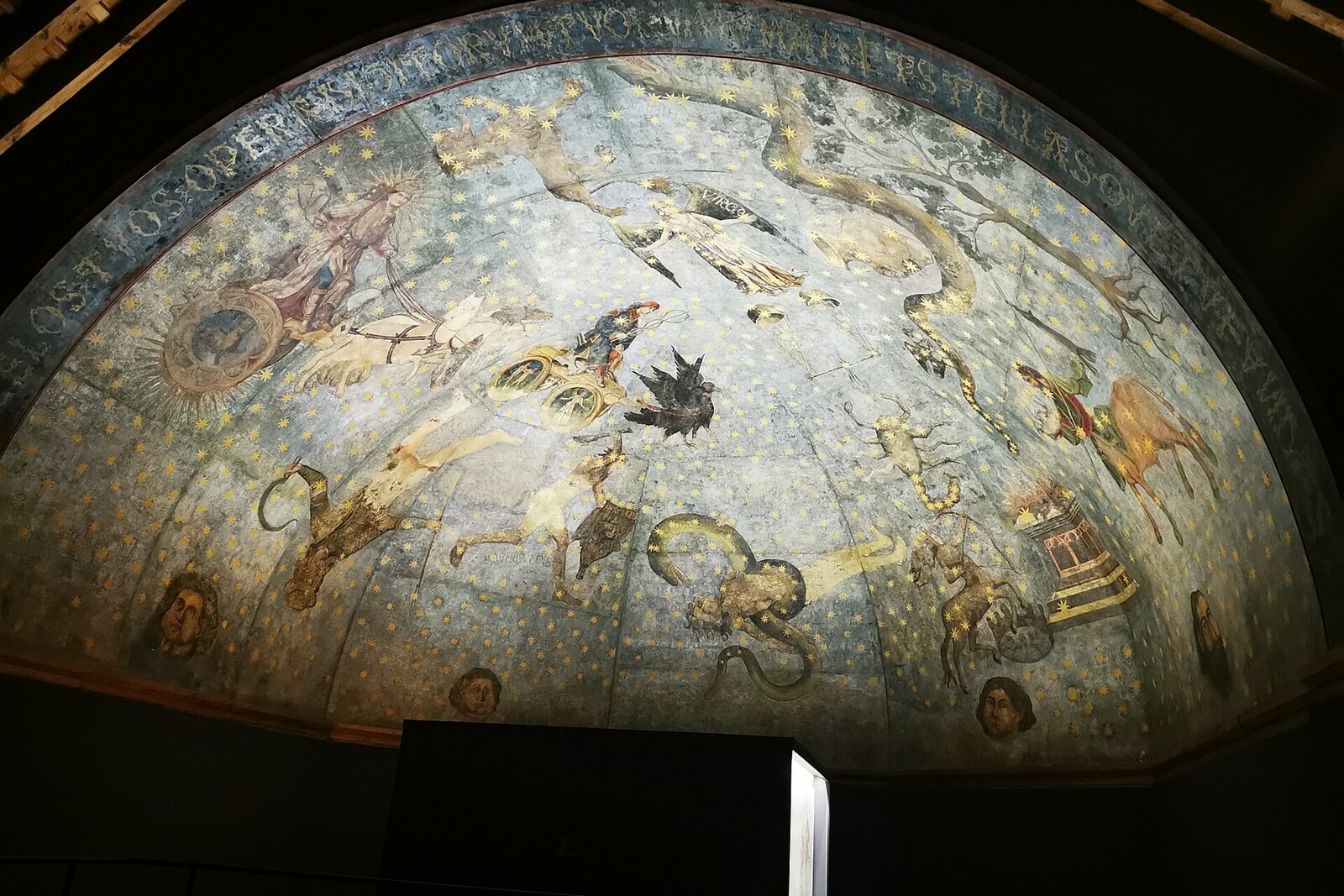
Look around first
What to notice
- Courtyard arcades
- Wooden vault
- Blue background of the mural
- Figures of constellations
The story of the place
In Salamanca, “lesser schools” meant the classrooms where students prepared for a bachelor’s degree. The degree was considered lesser in comparison with the licentiate and doctorate awarded by the neighboring Escuelas Mayores. Children were not taught here. The former classrooms are now used for exhibitions, and the most famous one holds a work created for another building.
In the dark room, paint lies on a wooden vault. There is no fifteenth-century stone beneath it. This is the result of an operation in which the surviving part of the mural was removed from the wall, taken to Barcelona, and reassembled here.
In the fourteen eighties, the University of Salamanca commissioned the Salamancan painter Fernando Gallego to paint the ceiling of the first university library. It stood opposite, in Escuelas Mayores, above the old Chapel of Saint Jerome. The vault contained the signs of the zodiac, planets, winds, and all forty-eight constellations described by Ptolemy. At the time, astrology was the name for a university discipline in which observing celestial bodies had not yet been separated from attempts to judge earthly affairs by them. The mural above the books showed one of the subjects studied by the professors here.
After the library was moved, the former hall was joined to the chapel. In seventeen sixty-one, it was decided to remodel it: two thirds of the old vault were destroyed, and the builders covered the final third with a new ceiling. It was forgotten for almost a century and a half. In nineteen oh one, Professor Antonio García Boísa discovered a hidden chamber above the chapel and damaged figures against a blue background.
By the middle of the twentieth century, the University of Salamanca was preparing to mark seven hundred years since receiving university status. The civil governor of Salamanca, Joaquín Pérez Villanueva, secured a project to save the mural. The architect and historian José Gudiol was commissioned to remove it and transfer it to Escuelas Menores; the technical work was led by his brother, the restorer Ramón Gudiol. It was a paid commission with an estimate of two hundred thirty-one thousand pesetas, which the university paid in three installments. The brothers used the strappo method, the removal of the paint layer: cloth was glued to the surface, and the thinnest paint layer was separated from the plaster. A mistake could have destroyed the final third of Gallego’s work. The removed fragments were sent to the Gudiols’ workshop in Barcelona, reinforced on a new backing, returned to Salamanca, and in nineteen fifty-three fixed to the wooden vault prepared here.
When the paint was separated, sinopias—preparatory drawings that Gallego had left on the lower plaster layer—were revealed. Several of these drawings were removed as well. José Gudiol did not return the sinopias of Leo and the Centaur to the university and kept them until his death in nineteen eighty-five. The family gallery then displayed them as a private collection and sold them. The university began a search, officers of the Civil Guard’s historical heritage protection unit found the drawings, and in two thousand nine they were handed over to Salamanca. The Supreme Court later ruled that separating the sinopias for restoration had not turned them into merchandise: they remained part of a public university building.
The name “Sky of Salamanca” was coined by the art-history professor Rafael Laínez Alcalá in nineteen fifty-one, when the mural was being prepared for its move. It gave rise to a version that Gallego had depicted the exact positions of the heavenly bodies above the city on a particular night, but there are no fifteenth-century documents about this, and modern researchers dispute that interpretation. Of the original sky, a third of the paint layer remains here on a wooden base; the other signs of the zodiac and planets are absent because they were on the two collapsed parts of the vault.
Useful on site
In June 2026, open daily 10:00–20:30. Free admission.
Checked: June 24, 2026. Check the official source before visiting.The mural is not visible from the street, so check access in advance; if there is no access, stop in the courtyard and listen to the story as an account of a lost whole.