 Guide On Map
From Piazza Venezia to the Colosseum: Power in Rome
Through Capitoline Hill, the Roman Forum, and Palatine Hill
Guide On Map on your phone
Open the walk like a regular app
It takes about 10 seconds to install. No app store needed.
The whole path
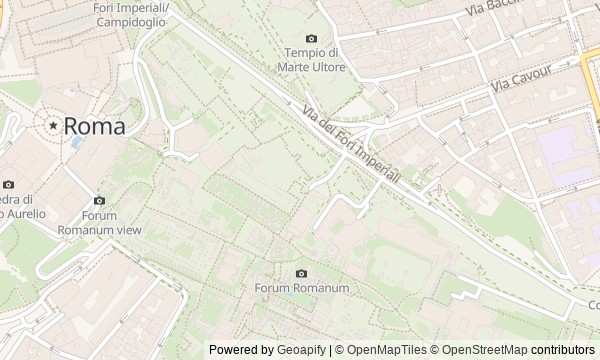
Route map
About the walk
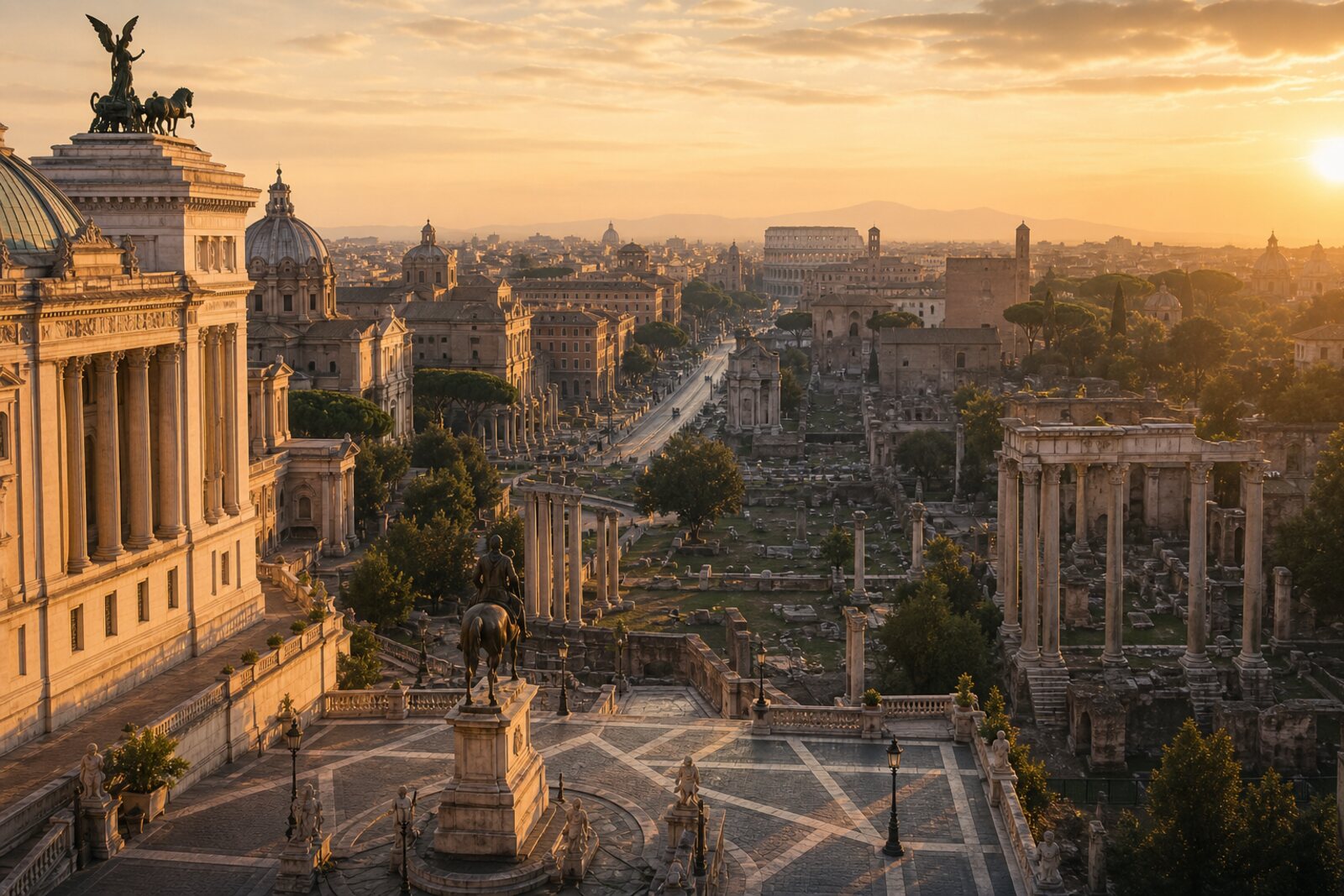
You will begin at Piazza Venezia, beneath the balcony and the white mass of the Vittoriano. Then you will climb Capitoline Hill, circle the city hall, and see the Roman Forum from above. Next, you will descend to Curia Julia, follow Via Sacra, climb Palatine Hill, and finish between the Colosseum and the Arch of Constantine.
This walk follows places where power was proclaimed to a crowd, formalized by a vote, taken by assault, and displayed in stone. But the stories will remain human. Why would a conspirator wear a bandage for several days? Why would a weapon beneath a pillow fail to save the owner of a palace? Whose death would people wait for before continuing a celebration?
The narration rests on such episodes, inscriptions, and surviving rooms. It separates later versions from what ancient authors and the monuments themselves report. By the end, you will be able to tell where in central Rome power was seized, where it was given the appearance of legitimacy, and where the defeated had their name erased.
Why this order
Piazza Venezia sets the later scene of public power; the climb up the Cordonata leads to Palazzo Senatorio, where the same choice between the square and the closed palace becomes medieval. Behind the palace, the Roman Forum and the slope of the assault come into view: the panorama shows the distance between the lower city and the stronghold. The descent to Curia Julia replaces a seizure by force with a decision formalized inside the senate chamber. From Curia Julia, Via Sacra follows the ceremonial route of victory to the Arch of Titus. Near the arch begins the climb to Palatine Hill—from a public procession to the emperor's private quarters. The descent to the Colosseum brings the action back outside: the amphitheatre and the Arch of Constantine show what victors presented to the whole city after palace conspiracies and civil wars.
Those who care about the human decisions behind famous monuments Those who want to connect Capitoline Hill, the Roman Forum, and Palatine Hill through one story Those who enjoy documents, inscriptions, and disputed versions without ceremonial rhetoric
Those looking for a brief overview of the Colosseum alone Those who prefer architectural styles to political history Those who do not want to climb Capitoline Hill and Palatine Hill
Before you go
Decide in advance whether you will enter the archaeological area of the Roman Forum and Palatine Hill, as well as the Colosseum: these parts of the route require separate admission, and a visiting time is usually selected for the amphitheatre. Check current conditions with the official operator before your walk. Piazza Venezia, Piazza del Campidoglio, the view over the Roman Forum, and the exterior of the final monuments are available as the city portion of the route. Wear shoes with sturdy soles: there will be stairs, slopes, and uneven ancient stone. Bring water and sun protection—shade is not available everywhere inside the archaeological area. Do not try to listen to the audio while walking through traffic: first find a safe spot, then look around.
When to go
Start in the morning or closer to evening, when it is easier to linger in open squares and the contours of the Roman Forum read more clearly in slanting light. If you have a reservation for the Colosseum, treat it as your main time marker and allow extra time for the walk through the Roman Forum and Palatine Hill.
Backup plan
If you cannot enter the archaeological area, the route still works from outside. Walk through Piazza Venezia and Capitoline Hill, pause at an accessible viewpoint over the Roman Forum, and spot below Curia Julia, the line of Via Sacra, and the Arch of Titus. Then continue along public streets to the outer edge of the Colosseum and the Arch of Constantine. In this version, it is best to listen to the stories of the Roman Senate, triumph, and Palatine Hill from a viewpoint, matching the narration to the overall terrain rather than trying to see every detail. In intense heat, shorten pauses in exposed places and save a detailed visit to the archaeological park for another day.
Route conditions
Surface. Paved — 2 km; unpaved — 9 m (data covers 80% of the route)
Stairs. Flights: 8, 114 m in total
Access. Wheelchair — no; stroller — limited (stairs)
Facilities. Toilets — 12; drinking water — 17
Elevation. Ascent — 37 m; descent — 34 m
OpenStreetMap extract of June 25, 2026: database data, not a check on the ground. Data © OpenStreetMap contributors, ODbL licence
Walk plan
Open in maps ↗- 1
Piazza Venezia
The route begins with the most recent and best-preserved stage for mass politics. - 2
Piazza del Campidoglio
Here, the city hall becomes the setting for testing how long popular support can keep a ruler in a palace. - 3
The edge of Capitoline Hill overlooking the Roman Forum
The panorama will help you trace the soldiers' route from the city square to the fortified summit. - 4
Curia Julia
The Senate chamber is needed on this route to show, after the assault in the street, power acquired through a lawful procedure. - 5
Via Sacra and the Arch of Titus
Here, the triumphal procession will appear as a ceremony that could not be completed without news from the Forum. - 6
Palatine Hill
The emperor's private quarters will show how access to a single room could decide the fate of a reign. - 7
Colosseum and Arch of Constantine
The finale will compare two ways of presenting new power to the city: a public arena and a monument to the victor.
Route features
Everything you need stays in the browser
Progress, saves and your trip plan are stored on this device.
Add Guide On Map to your home screen so the walk opens outside the browser.
How we handle sources, maps and corrections: our editorial standards