 Guide On Map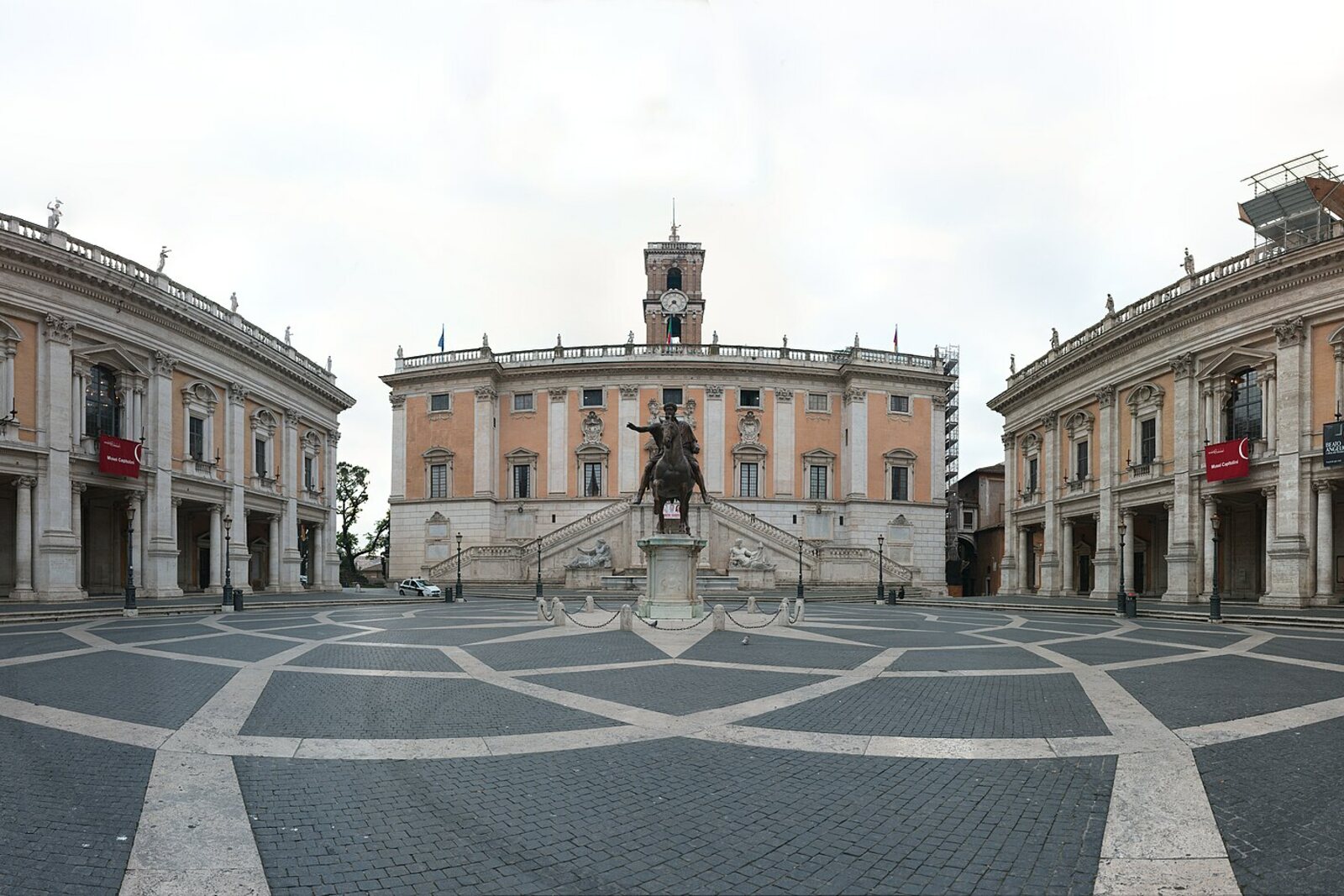
Look around first
What to notice
- The facade of Palazzo Senatorio
- The palace’s double staircase
- The equestrian statue in the center of the square
- The bronze figure of Cola di Rienzo
The story of the place
A broad double ascent leads to the upper landing, created two centuries after the medieval staircase with its stone lion disappeared. At the same time, the palace facade was refashioned to Michelangelo’s design, and the square’s present strict symmetry became a later outer layer over the old city center. On the green strip to the left of the ascent stands a small bronze figure—the trace of a man whose fate will unfold here.
“Campidoglio” is the Italian name for Capitoline Hill, the hill on which this square stands. The far facade belongs to Palazzo Senatorio. Today, the mayor and city administration work there, and Rome’s elected assembly meets there. City institutions have occupied this site since the eleven forties. At the time, a senator was the head of the municipal administration and court, not a member of parliament.
It was here, in the spring of thirteen forty-seven, that Cola di Rienzo arrived—a notary who earned his living drafting legal documents and petitions. His father ran a tavern, and his mother washed laundry; Cola belonged to none of the baronial families that divided Rome’s offices, courts, and armed detachments among themselves. He sought to have the city governed once again by a community of citizens.
On May nineteenth, his supporters drove municipal officials and guards from the square. The next day, Cola climbed up to the palace with the papal vicar and an armed guard. Before the assembled Romans, he read out new rules: the court was to punish murderers regardless of their family name, the city’s revenues were to be returned from the barons’ hands to the treasury, and the roads and trade were to be protected. The assembly approved the program and granted him extraordinary powers. Soon, Cola adopted the ancient title of tribune of the people—the defender of citizens. Representatives of the Colonna family, the Orsini family, and other noble families were forced to climb Capitoline Hill and swear an oath to the new order.
Cola’s first rule lasted seven months. He managed to fill the city treasury and pay the infantry, but increasingly relied on lavish ceremonies and his own unlimited powers. The pope, who was then living in Avignon, saw the tribune’s claims as a threat, and the expelled barons gathered troops. In December, Cola left the palace and fled Rome.
Seven years later, he returned to the same square as the pope’s senator. The papal legate tasked him with restoring order and subduing the Colonna family and the Orsini family. Cola brought with him two hundred fifty horsemen and mercenary infantry, but he was not provided with money to maintain them. To continue the war against the barons, the senator raised charges on wine and salt—goods Romans paid for every day.
On October eighth, thirteen fifty-four, rebels climbed up to Palazzo Senatorio. A chronicler contemporary with Cola linked the uprising to the senator’s taxes and cruelty. Historians add that only four city districts rose up, under the strong influence of the Savelli family and the Colonna family, so this was probably not a spontaneous uprising of all Rome.
Cola came out to the people in senatorial robes, carrying the city banner, and tried to speak. Stones and arrows flew at him. The servants left the palace, and the attackers set the doors on fire. The senator then dressed as a peasant, changed his voice, and blended into the crowd, shouting curses at the “traitor” along with everyone else. According to the chronicler, the bracelets Cola forgot to remove gave him away. Cola was taken to the stone lion at the upper landing of the palace staircase and killed. His body was displayed for two days outside the palace of his enemies, the Colonna family, and then burned at the Mausoleum of Augustus.
The medieval staircase and the lion in front of the palace are no longer there. Two centuries later, the current double ascent was created here to Michelangelo’s design, and the facade was refashioned. Palazzo Senatorio remained the city hall, while below the square, on the green strip to the left of the broad Cordonata, stands a small bronze figure of Cola di Rienzo—the notary who climbed Capitoline Hill twice to rule Rome and who, the second time, never left here alive.
Useful on site
The square is accessible as an urban space; check separately with Musei Capitolini for museum interiors and special visits.
Checked: June 27, 2026. Check the official source before visiting.Walk around the square along its edge and see how the composition changes. In the open area, watch for moving service vehicles.