 Guide On Map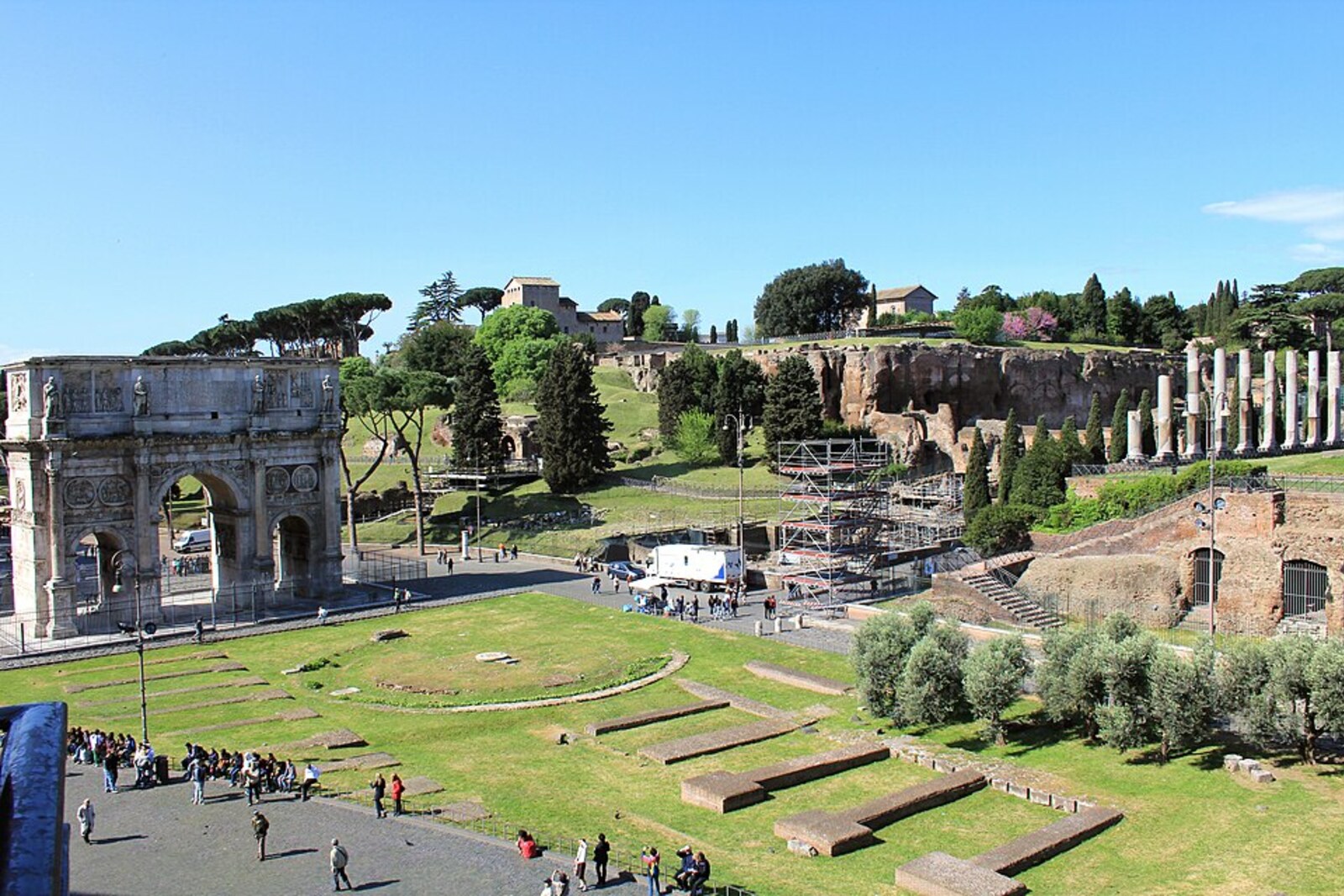
Look around first
What to notice
- Brick foundations of the palace
- Rectangles of the ceremonial halls
- Ruins of the private quarters
- Palace stadium
The story of the place
The brick foundations of Domitian's imperial residence survive on Palatine Hill. On September eighteenth, ninety-six, Parthenius, the steward of the emperor's private quarters, stopped Domitian on his way to the bath. He said that a man was waiting in the bedroom with information of the utmost importance. Domitian dismissed his attendants and went there alone.
The same Domitian who ordered an arch built for his dead brother Titus turned the central part of Palatine Hill into a single imperial residence over fifteen years of rule. Its present brick foundations occupy almost the entire summit of the hill. The western, ceremonial half is called Domus Flavia—after the dynasty of Vespasian, Titus, and Domitian. Here the emperor received embassies, heard cases, and held official banquets. The eastern half, Domus Augustana, served as living quarters for him and his court. Its name means the imperial house, not the house of the first Augustus. Parthenius controlled access to this very restricted part of the palace.
By the end of his reign, people in Domitian's inner circle feared that they would be the next to be accused. Shortly before the murder, the emperor executed his personal secretary Epaphroditus for a long-ago act: he had helped Nero, abandoned by all, take his own life. According to Suetonius, Domitian wanted to show his servants that even helping a doomed master would be punished.
Stephanus, the estate manager of a relative of the emperor, became the man who carried out the conspiracy. He himself was on trial for embezzlement; a guilty verdict would deprive him of his position, his means, and perhaps his freedom. For several days, Stephanus wore a woolen bandage on his left arm, as though after an injury. He hid a dagger beneath it.
Parthenius brought him into the bedroom on the pretext of exposing a conspiracy. Suetonius wrote down this story about a quarter of a century later, based on accounts from palace servants. According to his account, Stephanus handed the emperor a note, waited until he began to read it, and struck him. Wounded, Domitian called for the boy who attended the household shrine and ordered him to fetch a weapon from beneath the pillow. Only the hilt was left there: the blade had been removed in advance. The doors, too, were locked.
Domitian knocked Stephanus down and tried to wrest away the dagger. Then the other participants in the conspiracy burst into the bedroom and struck the emperor several more times. Stephanus died in the same fight. Domitian's body was carried out of the palace he had built on a cheap bier; his nurse secretly took away his ashes.
That same day, Nerva was proclaimed emperor. The senators ordered Domitian's images smashed and his name erased from inscriptions. Parthenius outlived his master only briefly: a year later, soldiers of the palace guard forced Nerva to hand over the organizers of the murder and killed Parthenius.
The room where Domitian died can no longer be identified among the ruins. The layout of his residence survives: reception halls on one side, private quarters on the other, and the doors between them, which Parthenius controlled that day. Later emperors continued to live here, and the hill's name—Palatium—became the common word for “palace” in Western European languages.
Useful on site
Within the ticketed area of the Roman Forum-Palatine; in summer 2026, the area opens from 09:00, last entry 18:15, closing 19:15; individual Palatine Hill sites may have restrictions.
Checked: June 27, 2026. Check the official source before visiting.Palatine Hill is within the archaeological area and requires separate access. Save your energy for the climb and choose a stable spot away from the passage to listen.