 Guide On Map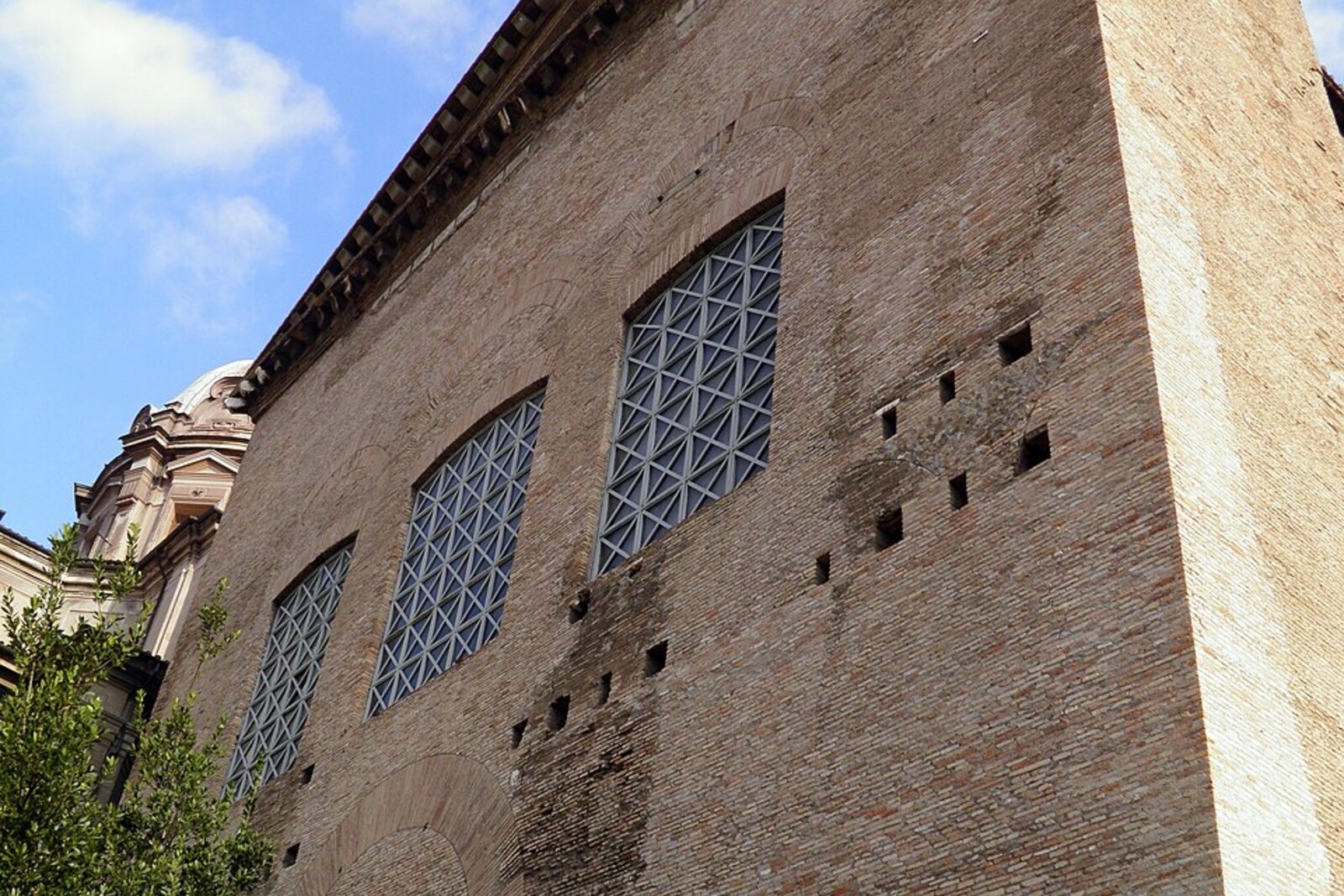
Look around first
What to notice
- Tall brick walls
- Three broad steps along the walls
- An open strip of marble floor
- Bronze doors
The story of the place
Curia Julia bears the name of Julius Caesar, the dictator who ordered a new chamber to be built for the Roman Senate and included in his own forum. Caesar was not killed here and did not even see the building completed. On the fifteenth of March, forty-four BC, senators killed him elsewhere—in the Curia of Pompey. His adopted heir, Octavian, continued the work. He opened Curia Julia in twenty-nine BC.
Two years later, Octavian entered this chamber as the victor of the civil wars and a man who needed to legitimize his position. He had seen how lifelong dictatorship had ended for Julius Caesar. Yet Octavian could no longer become an ordinary private citizen either. Legionaries served under his command, veterans awaited the land they had been promised, and the careers of his supporters depended on appointments and patronage. Octavian himself possessed an immense fortune and spent it on payments to soldiers. Behind the words about returning to the old order stood people who had something to lose.
In January twenty-seven BC, Octavian announced to the senators that he was returning the republic to their control and relinquishing his extraordinary powers. His speech has not survived. Later, he himself recounted this episode in a commemorative inscription, so what is known is the victor's version, not a transcript of the meeting.
The senators did not accept his resignation. For ten years, they entrusted Octavian with the administration of the provinces where most Roman legions were stationed. The peaceful regions remained with the Roman Senate: former consuls and praetors received them by lot, usually for one year. Octavian controlled the military provinces through commanders he appointed. Thus, he gave up the exceptional position created by the civil war and immediately received the legal right to command the main armies.
Then Lucius Munatius Plancus, the senior senator, proposed giving Octavian a new name—Augustus. Others wanted to call him Romulus, the second founder of Rome, but that name too directly recalled a king. “Augustus” meant a man worthy of reverence and hallowed by the favor of the gods; no official office with that name had existed before. Octavian accepted it. He ruled until his death in fourteen AD, and the word “Augustus” became the title of his successors.
The Roman Senate was not dissolved. The senators retained their offices, courts, and provinces, but the military foundation of the state was in Augustus's hands. Later historians called this order the principate—from the word “princeps,” the first citizen. Augustus had no royal crown; he had republican offices granted to him by those seated along the sides of this chamber.
These men met differently from members of a modern parliament. Their seats stood on broad steps along the two long walls. The presiding officer called on senators in order of seniority, and each gave his opinion from his place. During a vote, supporters of a proposal could physically move over to the person whose position they supported. The central strip of the floor was left clear precisely for such movements.
After the January decisions, the Roman Senate ordered a golden shield to be placed in the Curia, listing Augustus's qualities: courage, mercy, justice, and piety. The shield disappeared. So did the seats of those who took part in the meeting. The present brick walls were built under Emperor Diocletian after a fire in the third century, preserving the chamber's former dimensions. Three broad steps still run along the sides, with an open marble floor between them, and the building is still called Curia Julia—after the man who began building it but did not live to sit in it.
Useful on site
Inside the Roman Forum-Palatine ticketed area; in summer 2026, the area opens at 09:00, last entry is at 18:15, and it closes at 19:15; access to Curia Julia depends on the current ticket and site operating arrangements.
Checked: June 27, 2026. Check the official source before visiting.Curia Julia is in the ticketed area, and access inside may be restricted. From outside, its scale and deliberate simplicity are clearly visible.