 Guide On Map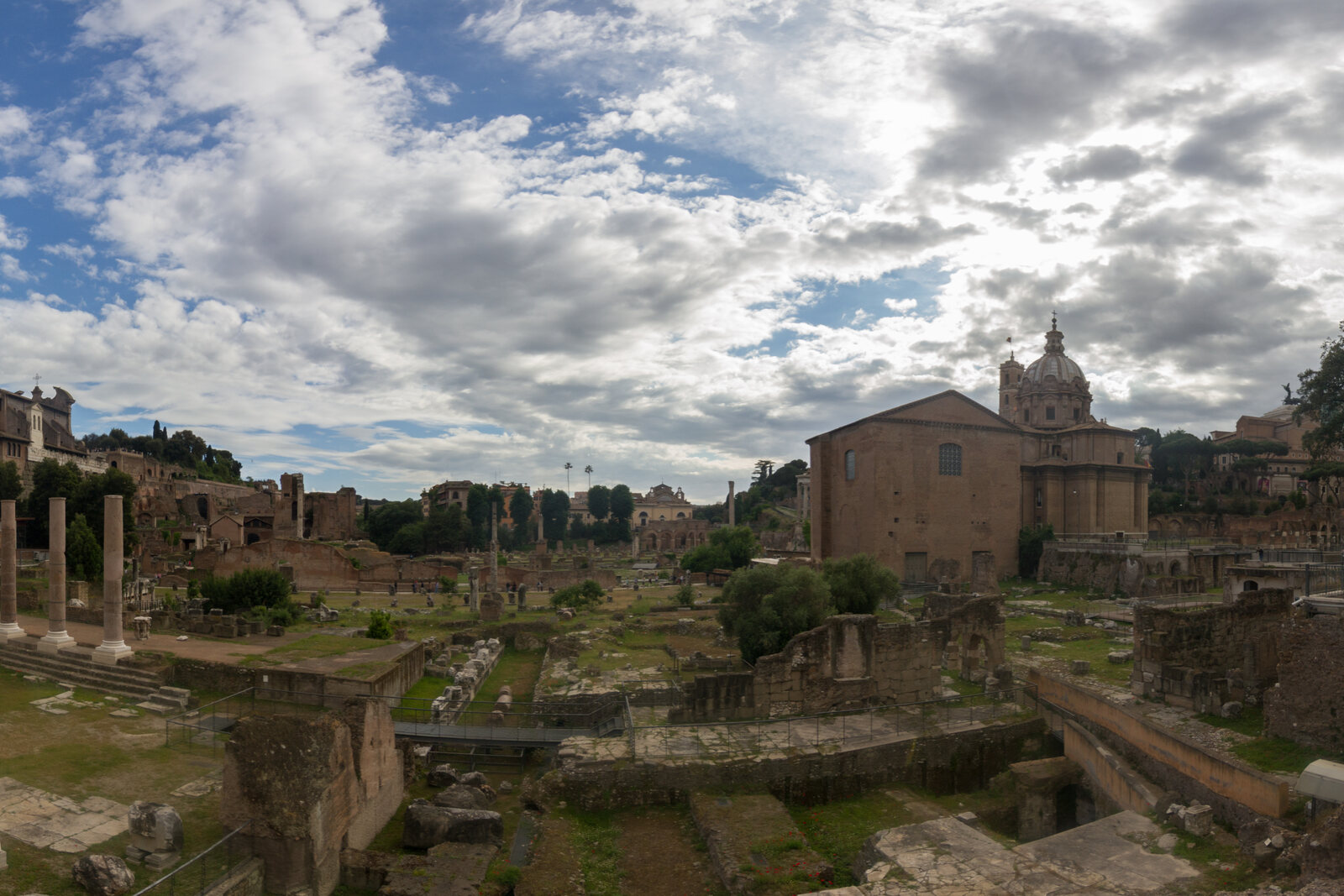
Look around first
What to notice
- The slope of Capitoline Hill
- Ruins of the Roman Forum
- Temple columns
- Brick walls of Palatine Hill
The story of the place
The edge of Capitoline Hill rises directly above the Roman Forum's field of stone: below, temple columns stand among the ruins, while the brick walls of Palatine Hill stretch opposite. For centuries, the upper terrace held Rome's chief sanctuary of Jupiter. The building itself is gone, but beneath Palazzo Caffarelli, parallel walls of its broad tuff foundation remain.
In December of sixty-nine CE, soldiers crossed the Roman Forum below, passed the temples, and marched uphill in a column toward the first gates of the fortress on Capitoline Hill. This slope separated the city square from the summit, which could be defended as a separate citadel. That day, Romans stormed it, taking Rome back from other Romans.
After Emperor Nero's suicide, armies had proclaimed three rulers in succession. By winter, Emperor Vitellius held Rome, but his troops had already been defeated by the supporters of Vespasian—a commander whom the eastern legions had declared the new emperor. Vitellius agreed to abdicate in exchange for money, safety, and a life away from the capital.
Flavius Sabinus, Vespasian's older brother and the city prefect responsible for order in Rome, was to take over the city. He sought a handover without a final battle. However, Vitellius's soldiers would not let their emperor leave. They understood that after capitulation, they would be left with nothing but the victors' promises.
After the first clash, Sabinus occupied Capitoline Hill with a small mixed detachment, several senators, and equestrians. At night, the besiegers posted their guards so carelessly that Sabinus could have left. He stayed and sent a messenger to his brother's approaching army: help was needed at once.
In the morning, Vitellius's soldiers advanced from the direction of the Roman Forum. The defenders climbed onto the roofs of old porticoes and threw stones and roof tiles down at them. The attackers had swords but no engines for hurling missiles; they did not want to wait for them and set fire to the projecting gallery. The flames brought them to the gates. Sabinus then ordered statues erected in memory of famous Romans to be torn from their pedestals and piled into a barricade.
The attackers split up. Some went across the saddle between the hill's two summits—where Piazza del Campidoglio now stands. Others climbed the staircase by Tarpeian Rock. Houses built in peacetime right up against the slope helped them: their upper floors rose almost to the level of the fortress.
Beyond this point, even the historian Tacitus could not establish the culprit precisely. In the most widespread version, the defenders set a new fire as they tried to stop the people climbing over the houses. From the roofs, the flames spread to the porticoes of the Temple of Jupiter Capitolinus. Wooden supports shaped like eagles, which held up its roof, caught fire one after another. The chief sanctuary of the supreme Roman god burned with its doors locked.
The fire broke the defenders. Some threw down their weapons, others dressed as slaves or hid among other people's baggage. Unarmed, Sabinus did not try to flee. He was seized and brought to Vitellius. The emperor wanted to address the soldiers surrounding them, but they forced him to retreat, killed Sabinus, and dragged his body to the Gemonian Stairs by the Roman Forum.
Soon, Vespasian's troops entered Rome. Vitellius was found in the deserted palace, led past the Roman Forum to the same Gemonian Stairs, and killed there. Vespasian became emperor before he had even arrived in the capital, and then ordered the temple, which had burned along with his brother, to be rebuilt.
The gates that Sabinus barricaded with statues have disappeared. The Temple of Jupiter no longer stands above the slope either: beneath Palazzo Caffarelli, only the parallel walls of its huge tuff foundation remain. From here, you can still see the lower part of the attackers' route—the Roman Forum, where their column began its ascent.
Useful on site
The viewpoint by Capitoline Hill is accessible from outside; admission to the Roman Forum-Palatine is by tickets for Parco archeologico del Colosseo, in summer 2026 from 09:00.
Checked: June 27, 2026. Check the official source before visiting.Do not block the narrow viewpoint, and stay behind the barrier. Here, the overall terrain matters more than individual ruins.