 Guide On Map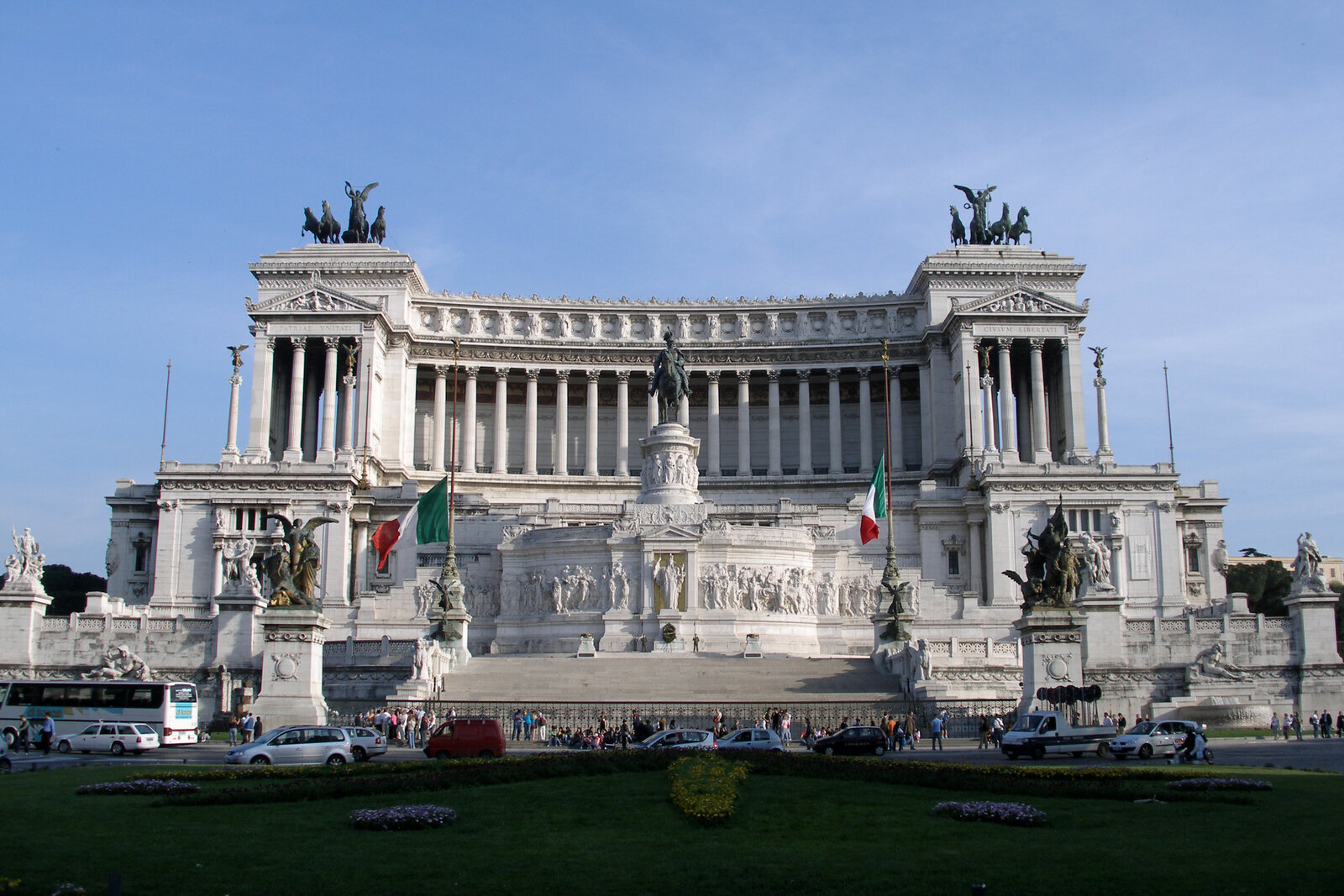
Look around first
What to notice
- The balcony of Palazzo Venezia
- The dark facade of Palazzo Venezia
- The white facade of the Vittoriano
The story of the place
Roads from Via del Corso, Capitoline Hill, and the Forums converge at Piazza Venezia. This broad intersection appeared comparatively late. After Rome became the capital of the Kingdom of Italy, builders cleared the blocks near Capitoline Hill and opened up the space in front of the Vittoriano—the white monument to Victor Emmanuel II, the first king of the united country. Under the Fascist regime, a straight street was laid from here to the Colosseum.
The square takes its name from the dark palace opposite the Vittoriano. In the sixteenth century, Pius IV, head of the Papal States, handed it over to the Venetian Republic for its embassy at the papal court. Diplomats lived here for more than two centuries; the palace came to be called Palazzo Venezia, and the square was named Venezia after it.
In nineteen twenty-nine, Benito Mussolini, the Fascist dictator and head of the Italian government, made the former embassy his headquarters. In Sala del Mappamondo, he placed his desk beside the fireplace and received ministers and foreign guests. A door from this same hall opened onto the balcony above the entrance. The enlarged square made it possible to gather an audience of many thousands in front of the balcony.
On June tenth, nineteen forty, Mussolini stepped onto this balcony and announced that Italy was entering the war against the United Kingdom and France. Until then, the country had remained outside the fighting: military commanders warned that the army and industry were not ready for a major war. But German troops had already crushed the French defenses, France seemed almost defeated, and Mussolini feared being late for the division of the spoils. He sought an empire of his own in the Mediterranean and a place beside Germany at future peace talks.
The war did not turn out to be short. The Italian offensive in France brought modest results, while campaigns in Greece and North Africa ended in defeats and required German help. In July nineteen forty-three, Allied forces landed in Sicily. Now members of the Fascist leadership were looking for a way to remove the man who, three years earlier, had spoken from the balcony as a future victor.
On July twenty-fourth, they gathered at Palazzo Venezia, in Sala del Pappagallo beside Mussolini's office. Dino Grandi, the former minister of foreign affairs and justice and one of the regime's old leaders, proposed restoring supreme command of the army to the king. He understood what he was risking: Grandi had received his positions and standing under Mussolini, and defying the dictator could end in death. A majority of the council members supported his proposal.
The next day, King Victor Emmanuel III, who intended to replace the head of government and lead the country out of catastrophe, dismissed Mussolini. After an audience with the king, the dictator was arrested. German military forces later freed him and installed him as head of a state in northern Italy dependent on Germany; in April nineteen forty-five, Italian partisans shot Mussolini. Grandi managed to leave the country: Mussolini's supporters sentenced him to death in absentia, but he survived the war.
The balcony from which war was announced still survives above the entrance to Palazzo Venezia. Behind it is the hall containing Mussolini's former office, and beside it is the room where his own council voted against him.
Useful on site
Piazza Venezia is accessible as an urban space; the Vittoriano is open daily 09:30-19:30, last admission 18:45; the changing of the guard at the Tomb of the Unknown Soldier takes place every hour.
Checked: June 27, 2026. Check the official source before visiting.Listen from the edge of the square, staying out of the flow of traffic. The main contrast between the monuments can be appreciated from outside.