 Guide On Map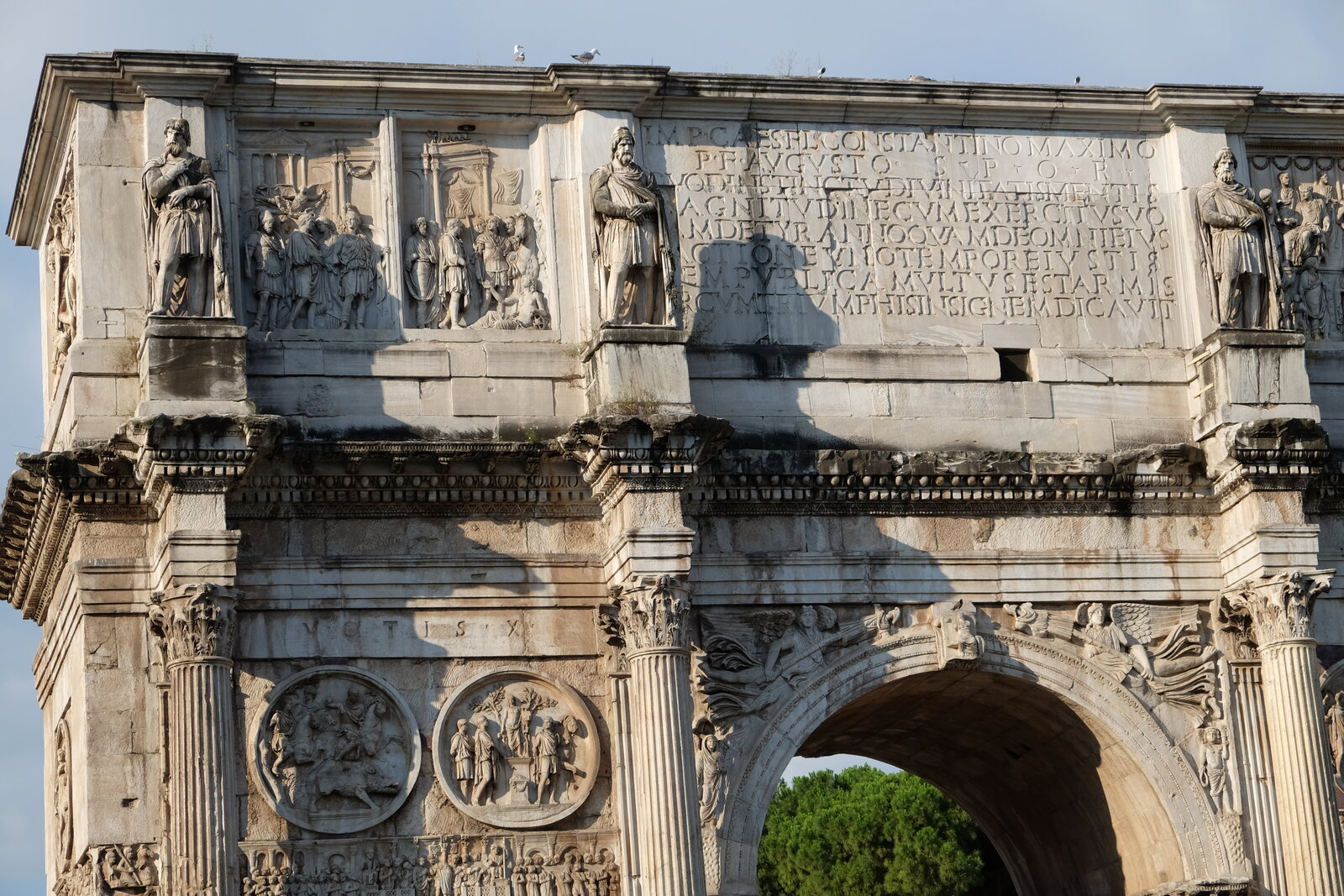
Look around first
What to notice
- The oval bowl of the Colosseum
- The arena's underground corridors
- The three archways of the Arch of Constantine
- The narrow frieze of the Arch of Constantine
The story of the place
The Colosseum is arranged as a huge urban machine for spectacles: tens of thousands of people sat here according to rank, from the emperor and senators by the arena to ordinary city dwellers at the top. Beneath the vanished floor, stone corridors have been opened where cages, scenery, and lifts were kept; people and animals were brought onto the arena through trapdoors. Nearby, on the ancient road of triumphal processions between the amphitheater and Palatine Hill, stands the Arch of Constantine with three archways. Its lower frieze unfolds the ruler's own story, while above it, old reliefs have acquired new faces.
The oval bowl of the Colosseum occupies the bottom of a former lake. After the fire of sixty-four, Emperor Nero incorporated this valley into the Domus Aurea—a palace complex with gardens, pavilions, and an artificial body of water. Nearby, he erected a bronze colossus more than thirty meters tall depicting the emperor himself.
Four years later, the Roman Senate declared Nero an enemy of the state, and he killed himself. Then the armies of different provinces raised four emperors to the throne in succession. Vespasian was the last to prevail—a commander of the eastern legions who had to make a new dynasty acceptable to Rome. He did not belong to the previous imperial house: his father earned a living through tax collection and banking, while Vespasian's own position was secured by military service and by the soldiers who proclaimed him emperor.
Vespasian chose Nero's lake as the site for Rome's main arena. Builders drained it, drove foundations into the soil at the bottom, and began constructing an amphitheater designed for tens of thousands of spectators. The court poet Martial later described this replacement as the return to the city dwellers of land that had previously been used by one master. That was the official version of the new dynasty, but the site it chose was entirely tangible: a former palace pond became a public arena.
The money came from the First Jewish–Roman War, which ended with the capture and destruction of Jerusalem. This is known from a marble slab found inside the Colosseum. Later, it was inscribed with a notice of repairs after an earthquake, and its original bronze letters were removed. Their holes remain. From their arrangement, researchers reconstructed the phrase: Vespasian ordered a new amphitheater to be built with funds from military spoils. The triumph of Vespasian and Titus had already passed along the Via Sacra; here, its trophies became stone, seating for the public, and an arena.
Vespasian died without seeing the full opening. His son Titus, his heir and a participant in the same war, completed the main work and in eighty held games that lasted one hundred days. Gladiators fought on the sand, hunters killed animals, and condemned people were brought out for public executions. Spectators sat according to rank: closest to the arena were the emperor, senators, and priests; higher up sat the other city dwellers. The gift to the public was designed so that everyone could see both the spectacle and their own place in the Roman order.
After Titus's death, his brother Domitian completed the stone underground corridors. The network of walls now open beneath the vanished floor appeared at that very time. Cages, scenery, and lifts that brought people and animals up through trapdoors were kept there. A modern cross-section shows the working half of the spectacle, which the ancient public did not see.
The Romans called the building the Flavian Amphitheatre, after the family name of Vespasian, Titus, and Domitian. Its current name became established later and came from the neighboring statue. After Nero's death, the face on the colossus was replaced with an image of a solar deity. Emperor Hadrian then moved the bronze giant closer to the amphitheater, clearing the site for the Temple of Venus and Roma; an ancient author claimed that twenty-four elephants were needed for the transport. The statue disappeared, but its nickname passed to the building. The Colosseum bears the name of an object that is no longer here.
Between the amphitheater and Palatine Hill ran the road of triumphal processions. More than two centuries later, the Roman Senate erected the Arch of Constantine on it. Its name points to the victor of a civil war.
At the beginning of the fourth century, the Roman Empire was ruled by several co-emperors. Maxentius held Rome and Italy and intended to keep the western provinces for himself. Constantine commanded an army in Gaul and Britain and sought supremacy in the west. In the autumn of three twelve, he crossed the Alps, reached Rome, and met Maxentius's army at the Milvian Bridge. Maxentius's army was defeated; during the retreat, he drowned in the Tiber. Constantine entered the city and became the sole ruler of the western part of the empire.
Three years later, the Roman Senate dedicated an arch to him in memory of this victory and to mark the beginning of the tenth year of his reign. Constantine is named in the inscription above the central archway. Maxentius is not there: the authors of the inscription referred to the dead emperor as a “tyrant” and to his supporters as a “clique.” They attributed the victory to Constantine's valor and the prompting of a deity, without specifying which one. Christian authors told of a heavenly sign and the sign of the cross before the battle; the arch itself provides no such explanation.
To decorate it, craftsmen removed reliefs from older monuments to Trajan, Hadrian, and Marcus Aurelius. On some figures, the faces of the earlier emperors were reworked into portraits of Constantine. Between them, they placed a new narrow band showing the campaign against Maxentius, the battle, the entry into Rome, a speech before the city dwellers, and a distribution of money. On the lower frieze, Constantine's own story remains; above him, he is surrounded by other people's victories with altered faces. The victor's name is carved in marble, while the name of the man he defeated is absent from the arch.
Useful on site
The Colosseum opens in summer 2026 from 08:30, last entry 18:15, closing 19:15; entry is only with a named ticket for a timed slot. The Arch of Constantine can be viewed from outside free of charge.
Checked: June 27, 2026. Check the official source before visiting.Both monuments can be viewed from outside. To enter the Colosseum, arrange a separate visit in advance; around the amphitheater, stay within the marked pedestrian areas.