 Guide On Map
Riga's Quiet Centre: Art Nouveau and Apartment Buildings
From Kronvalda Park through Alberta Street to Dzirnavu Street
Guide On Map on your phone
Open the walk like a regular app
It takes about 10 seconds to install. No app store needed.
The whole path
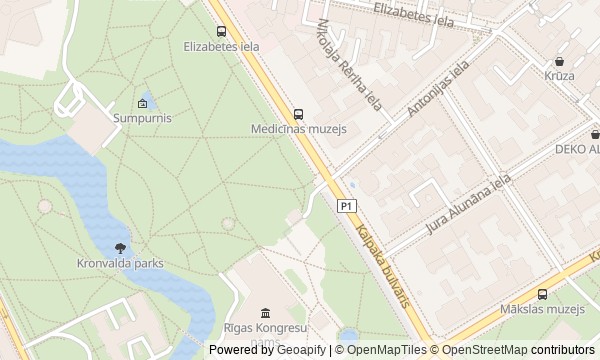
Route map
About the walk
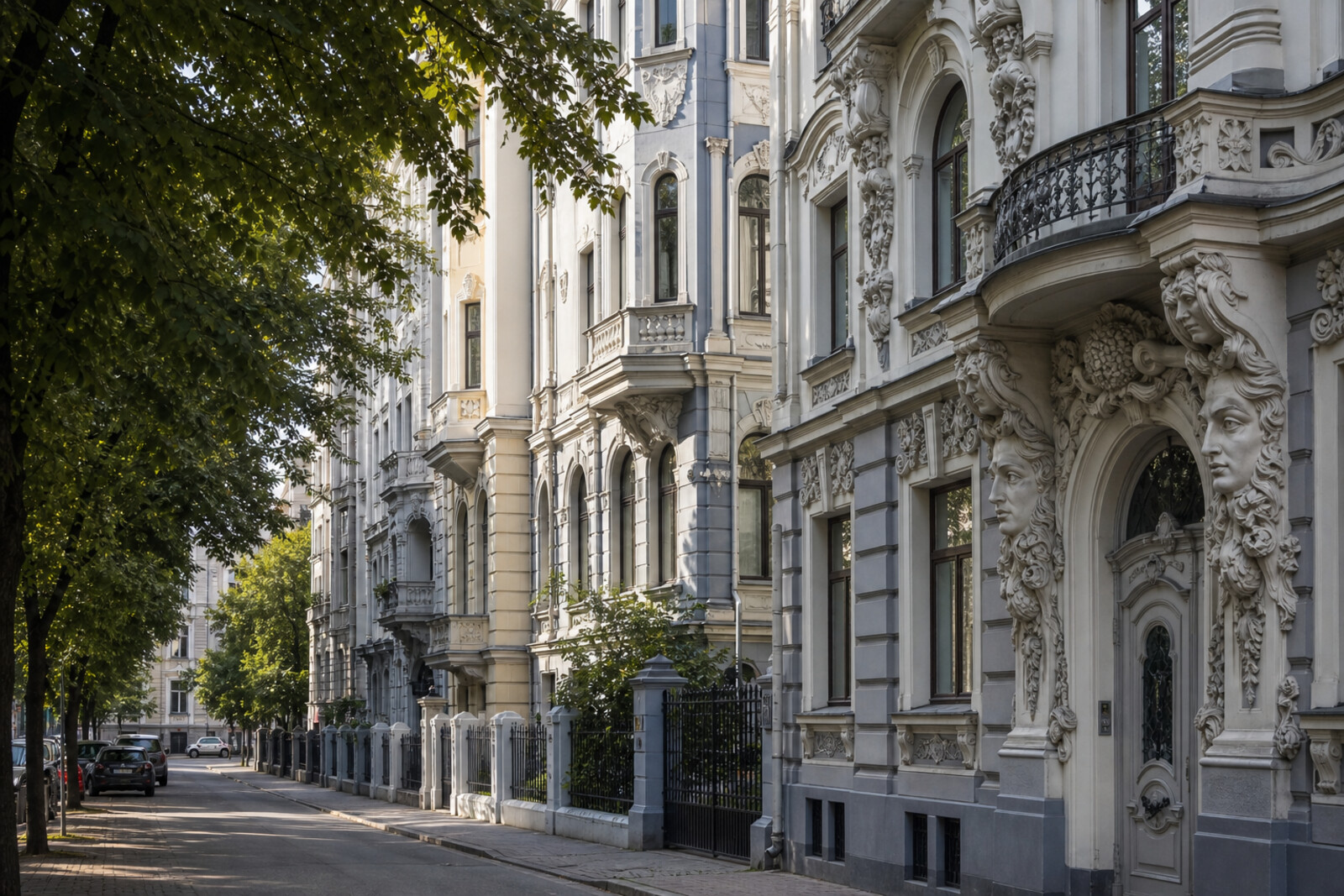
You will begin beside the Riga Canal, where an entire exhibition village once rose for a month. Then you will enter the Quiet Centre, heading toward blue tiles, enormous faces, dragons above a doorway, and windows that refuse to follow the rhythm of the floors.
On Alberta Street, the facades will stand almost shoulder to shoulder. But this walk will not turn into a list of styles and ornaments. You will work out who these buildings were made for and why beauty figured into the business calculation. Why did a foundation extend beyond the permitted line? How did a drawing from a printed album acquire an address in Riga? Why was a staircase brought out onto the facade?
The story will be calm and grounded in specifics. It will set lavish decoration against contracts, rents, and the workings of the buildings themselves. At the end, on Dzirnavu Street, you will leave stucco behind for flour, pipes, and production in the courtyard. After the walk, you will recognize the Quiet Centre by the ways people earned money, taught, and reshaped urban life behind its facades.
Why this order
The park and canal establish the route's starting point: the former grounds of the Union of Riga German Riflemen prepare the transition to Strēlnieku Street, where an educational institution once again occupies the space behind a decorative facade. From there, nearby 13 Alberta Street continues the story of the same architect and apartment-building development, while adding a dispute between a private commission and the city's boundary line. The building opposite, 12 Alberta Street, should come next: after a project for a client, you will reach the house the architect built for himself and his work. Next, 8 Antonijas Street lets you compare his own home with a commissioned apartment building whose internal staircase is visible on the facade. 10b Elizabetes Street continues the discussion of renting but shifts attention from the building's layout to the origins of its design. The final walk to 62 Dzirnavu Street leaves the showpiece avenue for a courtyard: after architecture designed to generate apartment rent, you will see how an urban plot was adapted for industrial baking.
Anyone who wants to understand Art Nouveau, not just photograph its facades Fans of urban details and archival twists Anyone curious about the business life of old buildings
Anyone expecting a walk focused mainly on interiors Anyone looking for an overview of all Old Riga Anyone who dislikes spending time examining facades
Before you go
Charge your phone and clear some space for zoomed-in photographs: the key masks, birds, and figures are high above the street. For a full view, cross to the opposite side only at an authorized crossing, and choose a spot where you will not obstruct pedestrians. Almost all the buildings remain active residential, educational, or office premises, so view them from outside and do not enter stairwells without an invitation. The Riga Art Nouveau Centre at 12 Alberta Street is a separate visit: check its current opening hours and exhibition access in advance.
When to go
Allow about one and a half hours for the walk without the museum. If you want to enter the Riga Art Nouveau Centre at 12 Alberta Street and take your time over every facade, plan on roughly two and a half hours. The sculptural decoration is easier to read in light from the side; under harsh midday light, the upper reliefs can disappear into shadow.
Backup plan
If the museum is closed or you do not have time for it, examine the facade of 12 Alberta Street from outside and continue toward Antonijas Street: the main shift in tone, from decorative overload to structural clarity, will still be visible. For a shorter version, keep 4a Strēlnieku Street, 10b Elizabetes Street, and 62 Dzirnavu Street—the school building with a facade staged like a spectacle, the famous composition with blue tiles, and the quiet residential finale. In the rain, do not stand beneath cornices or try to inspect the upper details from directly below: find a stable spot with an open view and use your camera's zoom.
Route conditions
Surface. Paved — 850 m (data covers 42% of the route)
Facilities. Toilets — 1; drinking water — 1
Elevation. Ascent — 9 m; descent — 3 m
OpenStreetMap extract of June 18, 2026: database data, not a check on the ground. Data © OpenStreetMap contributors, ODbL licence
Walk plan
Open in maps ↗- 1
Kronvalda Park and the Riga Canal
Here, a temporary exhibition site will explain the origins of the museum collection and the public park. - 2
4a Strēlnieku Street
This stop will show how the building became Latvia's contribution to a new international school. - 3
Thirteen Alberta Street
Here, an archival construction dispute invites a closer look at the building's position relative to the street. - 4
Riga Art Nouveau Centre at 12 Alberta Street
Here you will distinguish the authentic parts of the architect's apartment from the museum furnishings assembled later. - 5
Eight Antonijas Street
Here you will see how the position of the staircase determined the design of the entire facade. - 6
10b Elizabetes Street
Here you will see which part of the famous facade appeared in Riga and which came from a printed album. - 7
Sixty-Two Dzirnavu Street
The final stop will shift the discussion from apartment-building facades to the production facilities hidden in the courtyard.
Route features
Everything you need stays in the browser
Progress, saves and your trip plan are stored on this device.
Add Guide On Map to your home screen so the walk opens outside the browser.
How we handle sources, maps and corrections: our editorial standards