 Guide On Map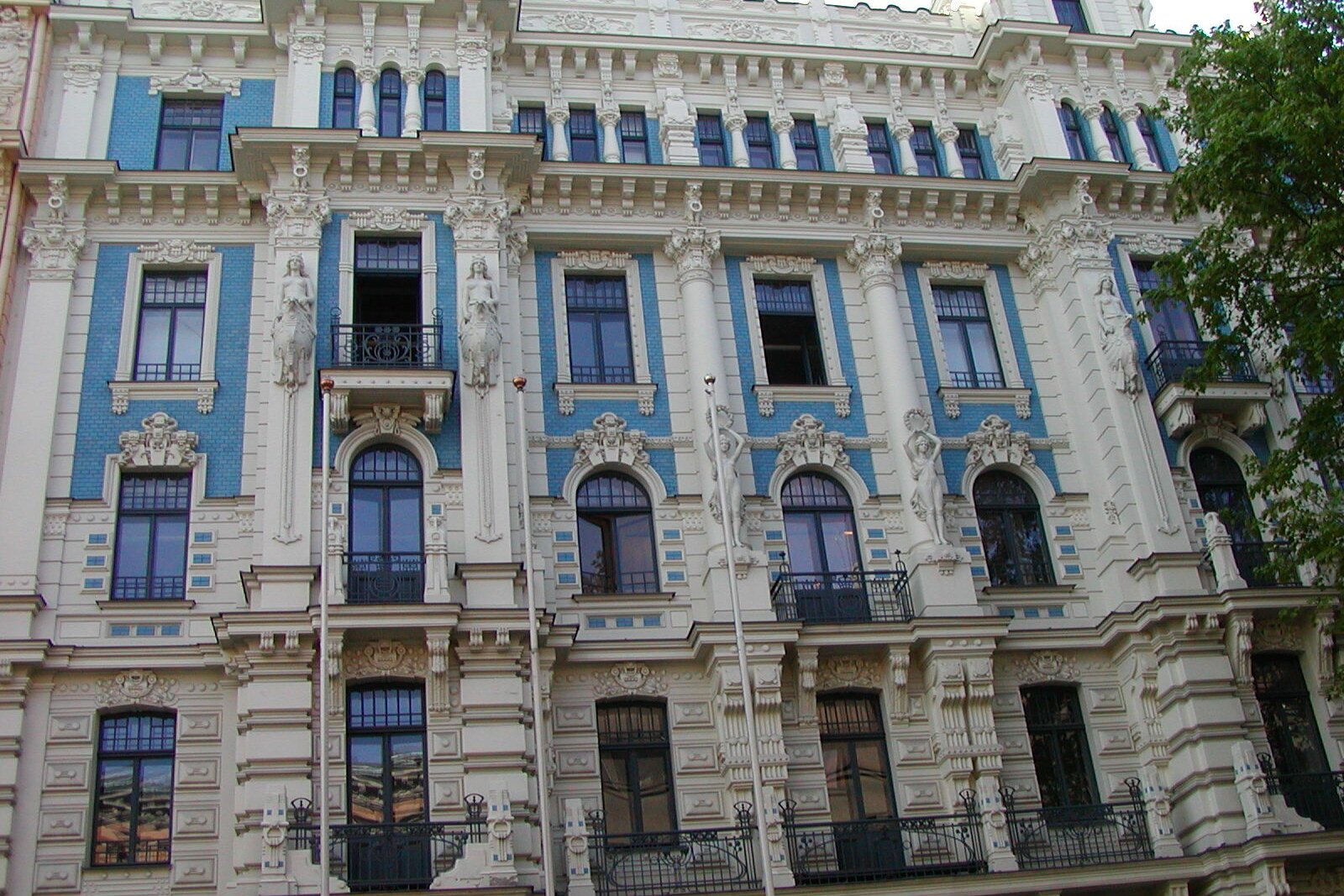
Look around first
What to notice
- Blue tiles
- Female figures
- Eagles and ram heads
- Atlantes beneath the upper cornice
The story of the place
Education was part of the plan for this building from the very beginning: it was commissioned for the Stepan Mitusov Private School, and classrooms were included alongside the living quarters. Later, a German school, an Estonian school, and a Russian school occupied the building in succession, followed by a technical school. The blue tiles, female figures, eagles, ram heads, and atlantes beneath the cornice have survived from the building's early years, although only a few old details remain inside. Students are now learning within these walls once again.
In the early nineties, a construction technical school's dormitory stood behind this blue-and-white facade. What brought the Stockholm School of Economics here was not the beauty of the building, but the opportunity to use it as payment for a new institution of higher education.
The driving force behind the school was Staffan Burenstam Linder, rector of the Stockholm School of Economics and a former Swedish minister of trade. After the collapse of the Soviet economic system, he wanted to train economists and managers in Riga for all three Baltic countries. The instruction was to be in English: graduates were expected to create businesses and restructure organizations that would have to operate by the rules of a market economy.
In nineteen ninety-two, representatives of the Stockholm School of Economics presented the idea to the Latvian Ministry of Education. Minister Andris Piebalgs ensured that Latvia contributed the building at 4a Strēlnieku Street to the joint venture. The building was valued at almost four hundred eighty-two thousand lats, which amounted to forty-nine percent of the future school's capital. The Swedish side contributed just over five hundred thousand lats and received fifty-one percent. That was how the former dormitory became Latvia's stake in an international educational project.
Reconstruction began in December nineteen ninety-three, but it was not completed in time for the first intake. The fifty-six students who had been admitted studied for several months at the Faculty of Geography of the University of Latvia. Only in the fall did they move here. In November nineteen ninety-four, the renovated building was opened by Latvian president Guntis Ulmanis and Sweden's King Carl XVI Gustaf. The very next intake admitted students from Latvia, Lithuania, and Estonia.
The school was given a building that had itself been built for education. In nineteen oh five, the wealthy Russian official and tsarist adviser Stepan Nikolayevich Mitusov bought this plot for a private school and commissioned civil engineer Mikhail Eisenstein to design it. A year later, the city sanitary physician recorded that the living quarters were ready, while the schoolrooms and basement were not yet finished. Mitusov's own institution did not remain here for long: the first permanent pupils were boys from a German school. Later, the building housed German schools, an Estonian school, and a Russian school, followed by a technical school and its dormitory.
After the reconstruction, only a few details of the old interior decoration survived. Eisenstein's facade, however, remained in place: the blue tiles, female figures, eagles, ram heads, and atlantes beneath the upper cornice all belong to the building of nineteen oh five. Classrooms are once again behind them—only Mitusov's name on the sign has been replaced by the name Stockholm School of Economics in Riga.
Useful on site
Active school building; exterior viewing from the street, verified 29.06.2026.
Checked: June 29, 2026. Check the official source before visiting.The school is in operation, so limit your visit to viewing it from the street and do not follow students or staff inside.