 Guide On Map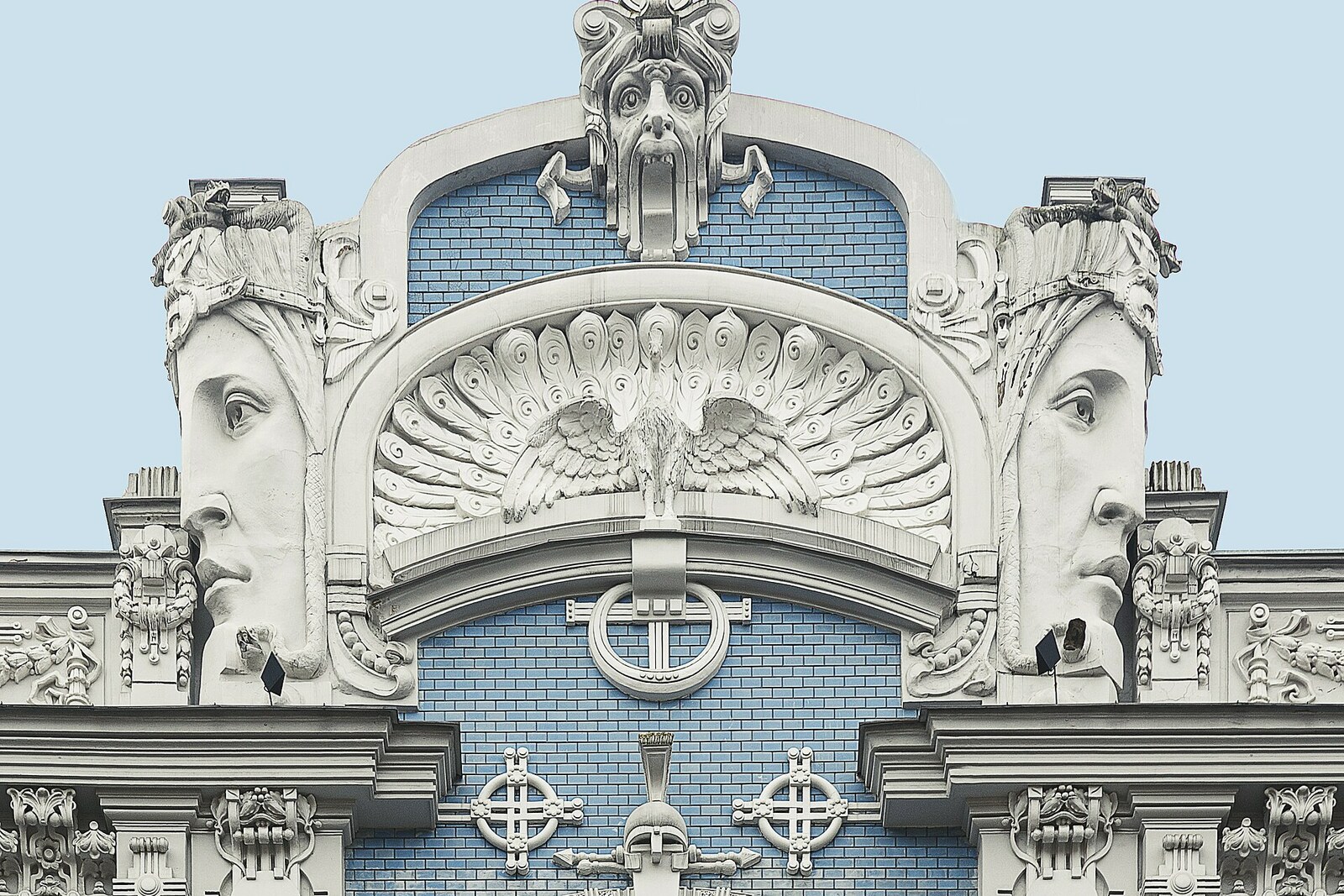
Look around first
What to notice
- Blue ceramic tiles
- Enormous female faces
- Peacocks
- Masks
The story of the place
Behind the blue ceramic tiles, peacocks, and masks lies an apartment building: from the very beginning, the lower premises were intended for commerce, while the upper floors were rented to residents. This part of the suburb was replanned after the fire of eighteen twelve, and the street was named after Empress Elizabeth Alexeievna. In two thousand, the facade and the main staircase were restored, while the building remained residential.
The two enormous female faces above the central part of the facade initially existed only on paper. In nineteen oh one, the Leipzig architect Georg Wünschmann and the artist Hans Kozel prepared a model apartment building for an album of new facades. The drawing was not tied to any particular site. A year later, it was printed in St Petersburg as a ready-made idea that another designer could use.
That was how the drawing reached Mikhail Eisenstein. He served as head of the provincial transport administration while taking on architectural commissions alongside his work as a civil servant. In nineteen oh three, Actual State Councillor Andrey Lebedinsky commissioned him to build a house here with apartments and shops. Lebedinsky's rank was equivalent to that of a major general; in addition to his salary, he invested money in real estate and owned several apartment buildings. This one was intended to generate rent from residents and merchants.
For the street facade, Mikhail Eisenstein copied and expanded the published Leipzig drawing. The composition on paper acquired brick walls, blue ceramic tiles, peacocks, masks, and sculpted heads two stories high. Lebedinsky gained another rental property, Wünschmann and Kozel's design gained a real address, and Mikhail Eisenstein became associated with one of Riga's most recognizable buildings.
At the time, the street was called Elizavetinskaya Street; today it is Elizabetes Street. It was named after Empress Elizabeth Alexeievna, wife of Alexander the First, when the streets of the suburb were laid out again after the fire of eighteen twelve.
In two thousand, the facade and the decorated staircase were restored. Apartments still lie behind the blue tiles and gigantic faces: Lebedinsky's apartment building has retained its original purpose, although its exterior appearance came here from the pages of a St Petersburg album.
Useful on site
Exterior viewing; private residential building with commercial premises, checked 29.06.2026.
Checked: June 29, 2026. Check the official source before visiting.For the color and symmetry, you need a full view, while the faces require camera zoom; choose a safe vantage point and do not step into the roadway.